from a 5,500-year-old shoe to genocide to fountains: 72 hours in yerevan

As the plane got ready to land in Yerevan, Armenia’s capital, I looked through the window and was met with a snow-capped Mt. Ararat reaching out to the skies. Armenia’s most beloved national symbol and site of the proverbial Noah’s Ark, Mt. Ararat became part of Turkey in 1921. Yet for Armenians, seeing the mountain looming over their capital city is a sign of good tidings. Just like it has been for the past two millennia.

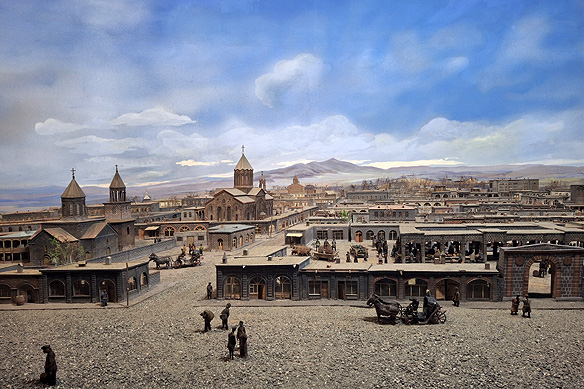
In a strange twist of fate, the very geopolitics that gave Mt. Ararat away, also created Modern Yerevan. One of the oldest inhabited cities in the world, Yerevan’s current avatar is a product of the Soviet Union. 2,800 years ago, it used to go by the name Erebuni.

When Alexander Tamanian was assigned the task of drawing up Yerevan’s city-plan, he was first at a complete loss. He had no idea how he was going to convert the laid-back provincial town, previously under the Russian empire, into a cultural, political, and industrial centre befitting its new role as a Soviet Socialist Republic capital.

But creativity soon followed. Tamanian ingeniously combined neoclassical design, Armenian motifs, and local tuff stone in a graceful radial layout. Unfortunately, he also razed many of the earlier churches, mosques, and bazaars in the process so there is very little remaining from the pre-1920s in the city.

Off-the-beaten-path? True. Lacking in things to see and do? No ways.

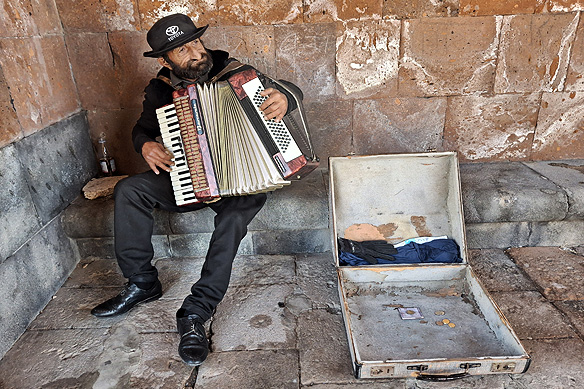
Yerevan today is filled with museums, art galleries, roadside cafes, and buskers churning out fabulous music. Come nighttime, the city transforms into a riot of curated lighting, with fountains dancing to classics.

Here is a 3-day itinerary for Yerevan, a city swarming with intrepid travellers eager to explore its heady mix of Soviet and Armenian charms.

Have you been to Yerevan? What did you like most about it? Do share in the comments. I would love to read them. 🙂 Continue reading

travel shorts: khachkars, markers of armenian christianity

There are over 50,000 khachkars in Armenia. You will see them everywhere. At ancient monasteries and modern cathedrals, along the highways encircling the Armenian Highlands, in medieval cemeteries, inside every museum whether state-of-the-art or plain old-school, and next to frigid mountain lakes.

Indigenous to Armenia, the UNESCO-listed khachkar, literally meaning ‘cross-stone,’ is, yes, a stone with a cross. 🙂 But look closely, and you will soon notice each piece is unique in its details. No two are alike. Continue reading

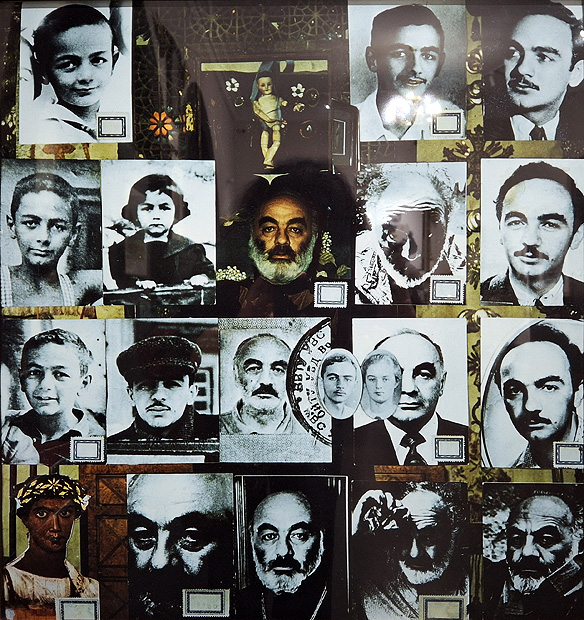
film in a frame: the eclectic world of sergey parajanov’s collages

I Am 60 Years Old, 1984.

I Am 60 Years Old, 1984.

When one’s life pans out like a movie, can one’s art be far behind?

Described as a magician in the world of cinema, Sergey Parajanov’s movies stand out for their tableaux sheathed in visual poetry. There are no clearly defined narratives or dialogues in the four globally acclaimed films he made in his lifetime. Instead, in its place are near-static scenes lush with colour and symbolism which explore the stories within us rather than outside of us.

Born to Armenian parents in Tbilisi in 1924, Parajanov’s first love was a Tatar Muslim woman Nigyar Kerimova. Soon after their marriage in 1951 she was murdered by her brother for marrying a Christian and converting to Christian Orthodoxy. When 32, Parajanov fell in love with 17-year-old Ukrainian Svetlana Sherbatiuk. The marriage ended in divorce.

Unlucky in love, but lucky in life? It was not to be so with Parajanov. Fame merely brought him more misery. His refusal to conform to Soviet Union ideals and the Socialist Realism style led him to being imprisoned twice. The second time around, when released, it was on condition that he be forbidden from living in Moscow, Leningrad [St. Petersburg], Kiev or Yerevan, nor be allowed to make films. The ban lasted for 15 years.

Bereft of the freedom to create films, it was in the dark squalor and aching hunger of the gulag camps that he turned to making collages. He described his collages as ‘compressed films.’ The most poignant are his seemingly simple boxed dolls which hold lifetimes in their narratives, made from pieces of sack he would pick up whilst doing manual labour. Continue reading

global travel shot: the pagan temple that became a christian country’s favourite

Image

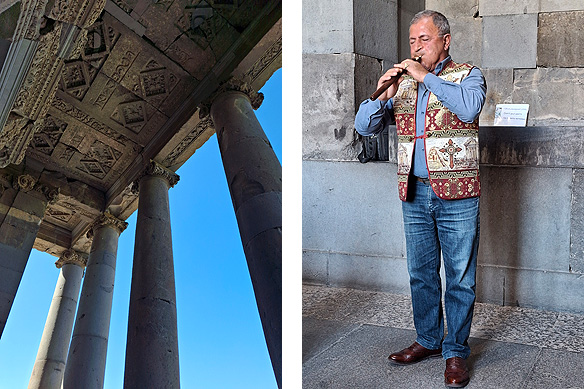
When I walked into Garni Temple’s Cella one October morning there was a 2,000-year-old UNESCO-listed duduk performance taking place inside the stone confines to the unbridled joy of a rapt audience. Once the show was over, I somehow managed to get the temple all to myself for a few long moments.

Garni Temple is the only one of its kind in all of Armenia and [now defunct] Soviet Union. The fact that it still stands—a rare pagan Greco-Roman remnant in the world’s first Christian country despite wars, religious upmanship, atheism, and even an earthquake—is a miracle.

Two thousand years old, scholars differ on its exact purpose and age. Is it a temple to the Zoroastrian sun god Mihr built in 77 AD by the Romanized Armenian King Tiridates I or a Roman tomb of the 2nd Century? Either way, its soaring 24 basalt Ionic columns reaching out to a ceiling draped in reliefs of grapes and vine leaves, perched above nine 12-inch-high steps is an evocative magnificent otherworldly sight.

Seated on the stone floor by the empty altar, it was just me and the echoes of those who had passed through the sanctuary two millennia ago. And that remote yesterday from the distant annals of time, briefly became my today.

Welcome to my Armenia series, dear Reader. ❤

72 hours in qatar in pictures

The fifth smallest country in the middle-east also has the highest GDP per capita in the world at USD 114,648.03. It is a data point made possible because of a 38-fold growth in the economy over the past three decades. 88.4 percent of this country’s population are foreign workers, and 92 percent of the population lives in its capital city. It is the headquarters of Al Jazeera English, an acclaimed independent editorial media channel, and the world’s best airline. Outdoor air-conditioning is common, desalination is the primary source of potable water since there are no rivers in its arid plains, and there is no personal income tax.

Welcome to Qatar.

Until 1939, however, things were very different in this peninsula jutting off Saudi Arabia’s coast into the Persian Gulf. A British Protectorate from 1916 to 1971, the pearling industry which sustained the emirate had died a rapid death in the 1920s with the introduction of the cultured pearl by Japan; the economy was sinking. Qatar was fast becoming one of the poorest countries in the world. Then a miracle happened. Not one, but two. The second even more incredible in scope, and its timing.

Oil was discovered in the Dukhan Field in 1939. Ten years later, the first crude oil exports left Qatar’s harbours. The Qataris were happy enough with this. But there was more wealth in store for them. In 1971, immediately after gaining Independence from the British, one of the world’s largest gas-fields was discovered off its shores—the North Field. Qatar exported its first shipment of liquefied natural gas [LNG] in 1996.

Ruled by the House of Al Thani since 1776, Qatar today contains 14 percent of the world’s known natural gas reserves, third only to Russia and Iran’s, and is the second largest LNG exporter globally with China, India, and Japan the country’s top trade partners.

There has been no looking back for Qatar after 1996. It just continues to surge ahead.

Immense wealth and traditional Bedouin values guide this nation where in two hours one can traverse its 160 kilometres length from north to south, and go from east to west in half that time.

Here’s how to spend 72 hours in Qatar. In pictures. For at times, pictures just say it better. 🙂 Continue reading

a travel guide to the vietnam war

This post is not a political article. It is a travel feature. But to fully understand certain places in our world, it becomes essential to know their political contexts. Why they are the way they are. The answers are invariably in their political history. Such is the case for South Africa, Israel … and Vietnam.

A major event in world history, what the world refers to as the Vietnam War, the Vietnamese call the American War, and history books call the Second Indochina War. But this war actually has four perspectives: That of North Vietnam, South Vietnam, America, and the world at large. Also, this war was not just between Vietnam and America, but between North and South Vietnam as well.

Confusing? Read on.

The photo that stopped the war: Pulitzer prize-winning photograph 'The Terror of War,' also known as 'Napalm Girl,' Associated Press, 8 June 1972. [War Remnants Museum, Ho Chi Minh City]

The photo that stopped the war: Pulitzer prize-winning photograph ‘The Terror of War,’ also known as ‘Napalm Girl,’ Associated Press, 8 June 1972. [War Remnants Museum, Ho Chi Minh City]

Continue reading

72 hours in ho chi minh city

Aah, the buzz of Ho Chi Minh City, better known simply as HCMC, as thousands of scooters whiz past towering colourful tube-houses. Whether you are here in search of elegant Saigon or Uncle Ho’s namesake, looking for Vietnamese modern art or Soviet brutalism, fancy a street-side noodle soup or the perfect quiche in a quiet patisserie, you won’t be disappointed in this fastest growing city on Vietnam’s southern end sliced by the Saigon river.

No other south-east Asian city has quite captured the imagination of travellers the way HCMC has done. And continues to do.

Part of a unified Vietnam under the Nguyen Lords and Nguyen Dynasty, the city on the fringes of the Mekong Delta became a French colonial stronghold from 1862 to 1954. Next in line was its role as the capital of US-backed South Vietnam. After being ripped apart by decades of war, the city finally fell to communist North Vietnam on 30 April, 1975, paving the way for a re-unified nation.

On 2 July 1976, Saigon was renamed Ho Chi Minh City, as a mark of respect to the man who had dreamt of a free and reunited Vietnam, and the dream that came true.

The city has seen it all, at close quarters. Yet there is no bitterness or anger or melancholy whatsoever. No vengeance or self-pity. Instead, it seems to waltz better, with a more experienced step and twirl.

One could easily spend a week in this frenzied fast-paced populous city which never seems to sleep, and still not be bored of it. Where does one start? How about 72 hours to see the best it has to offer? And then maybe a few more days to relish it further. ❤️

[Title photo: Detail, Central South and North Spring Garden by Nguyen Gia Tri, Lacquer on Wood, 540 cm x 200 cm, 1969 – 1989, HCMC Museum of Fine Arts.]

Table of Contents:

Continue reading

vietnam’s capital hanoi, stories told and untold

A thousand years of Chinese rule, followed by a thousand years of independence. Except for a misfit seventy years under the French, somewhere in-between.

Hanoi’s story is like no other.

After being a Chinese territory from 179 BC onward, it finally threw off the yoke in 1010 when the first indigenous Vietnamese dynasty [Ly Dynasty] made Hanoi its capital. Since then, multiple local dynasties stuck to the tradition, apart from the Nguyen dynasty who moved their capital to Hue. The later French occupation followed suit, and chose Saigon in the south as their base, but made Hanoi capital of French Indochina from 1902 to 1945.

By the time Hanoi took back its mantle of being a political and administrative seat in 1954, Vietnam had ousted the French and part of the country was communist. Today, Hanoi is the capital of one of only five officially communist countries in the world, balancing Marxism-Leninism socialism with a market-oriented economy.

The result of this eclectic past and present has created a culturally rich city where contradictory layers coexist. Ancient Confucian temples, Buddhist pagodas, and a sprawling royal citadel which doubled up as both a medieval fortress and a 20th Century war bunker. Colonial houses replete with wooden shutters and a towering French stone cathedral, surrounded by local eateries jostling for space on footpaths and railway tracks. A communist-styled marble memorial for an embalmed ‘Uncle Ho,’ and sombre Lenin statue in a city square. It would not be too far off the mark to say there is something for every ideology in Hanoi!

Small wonder then that there are stories galore in this Vietnamese city tucked away in the country’s north. Some repeated often. Some which only the locals know. And some, midway between the two, which intrepid curious travellers stumble upon.

Shall we begin? 🙂


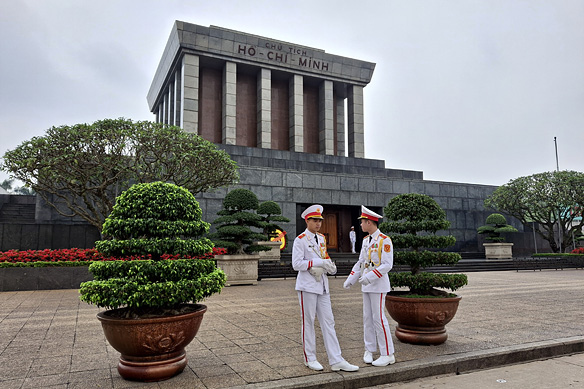
Hanoi’s most iconic landmark is the Ho Chi Minh Mausoleum where visitors silently file past the embalmed corpse of Vietnam’s beloved Uncle Ho. If it was not for him, the French may not have left or the country not united. He had wanted a simple cremation after his death. Instead, he got a gigantic marble mausoleum, like those accorded other communist stalwarts: Lenin and Mao. Continue reading

travel guide: hue, capital of vietnam’s last royal dynasty

Welcome to my travel guide on royal Hue.

Often reduced to an overnight visit enroute to colourful Hoi An or sidelined completely for Vietnam’s buzzing metropolises and beach cities, Hue is where Vietnamese history and culture bask in full authentic glory.

For 143 years, from 1802 to 1945, the city on the banks of the Perfume river in the middle of the country served as the capital of the Nguyen dynasty, Vietnam’s last royal ruling family. Prior to this, Hue had been the capital of their predecessors—the Nguyen Lords, a feudal noble clan, since 1558.

The Nguyen empire marked a period of dramatic flux in the country’s history. Starting off as an isolationist Confucianism-driven kingdom of unified Viet Nam, it morphed into a military might to reckon with, on to an eclectic marriage of European and Vietnamese cultural elements, before being ousted in 1945.

Thirteen Nguyen emperors ruled from Hue’s Imperial Citadel during these years—a fortress-cum-administration centre-cum-royal residence. It is where military decisions to conquer neighbouring lands, followed by agreements to relinquish the same lands to French colonial rulers were drawn and sealed.

In and around the city, seven of Hue’s 13 emperors designed and built their grand tombs to be remembered by. These reflected not just their personalities, philosophies, and aspirations as rulers, but also the prevailing geopolitical scenarios.

Whilst the UNESCO-listed Imperial Citadel and royal tombs took care of the Nguyen emperors’ lives and afterlives, patronage of spiritual places continued unabated. An age-old royal practice, it ensured the gods were kept happy and added a touch of divinity to dynastic rule.

Yes, Hue has all this and even more!

Dear Reader, I hope you find this travel guide useful as I take you along Hue’s imperial history, connecting its rich and varied monuments to the city’s incredible story. ❤

Table of Contents:

Continue reading

travel diaries: in search of champa, vietnam’s ancient hindu kingdom

It is still dark. The sun, groggy-eyed as it squints through the heavens punctuated by a sole star.

I am on my way from Hoi An to My Son Sanctuary—the temple ruins of an ancient Hindu kingdom which called this part of Vietnam home for 1,600 years. You may ask, but why so early? Because some places are best seen at sunrise. When it is just them, you, and the centuries of silence in-between. This silence then starts talking, regaling stories. Some voraciously. Some hinted at with a smile. Don’t you agree? 😊

An hour later, walking through the site’s lush green meadows, I pass scores of my country-folks. Perplexed, I am about to stop one of them and ask the reason, when a large placard explains their presence. They are archaeologists from the Archaeological Survey of India carrying out restoration work in association with the Vietnamese government. It makes sense. Who else could understand the remnants of a millennia-old Hindu kingdom better, even if it wore a different mantle on a foreign ground.


My Son Sanctuary, a UNESCO-listed World Heritage Site, is one of the most important ancient religious sites in south-east Asia. Continue reading