72 hours in baku

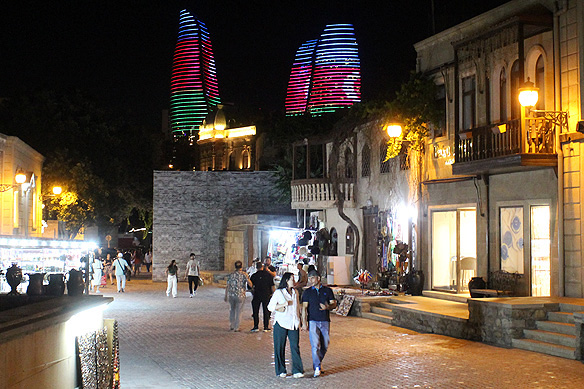
Baku is often described as one of the most beautiful cities in the world. It is a description that is not off the mark. The city’s rich heritage spanning three millennia can be invariably seen in a single line of vision. Now where else would you have such a splendid view!

But Baku is not only about pretty buildings. A world city in every respect, it abounds with museums and galleries wherein local meets international. Literature, art, and music thrive here, both at the esoteric and popular levels. Can the culinary be far behind in all this? With one-fourth of Azerbaijan’s population, Baku buzzes with life. Literally. Not in a chaotic haphazard way. But as a celebration.

Travellers have only recently started noticing this city on the shores of the Caspian Sea which comes with the moniker ‘Windy City.’ On its part, the Azerbaijan government is making every effort to ensure it is a memorable visit. The visa department sends out surveys to its tourists to find out what worked, what did not, and how Azerbaijan could be a better travel destination.

Here is a three day/ 72-hour itinerary with context, tips, and links to help you make the most of your stay. To go straight to the itinerary for a specific day, use the table of contents below. Wishing you happy travels, this time to Baku. 🙂

Table of Contents:
Continue reading

the road less travelled: azerbaijan’s unusual villages

In just five to six hours, one can traverse across Azerbaijan’s length or breadth, crossing nine of the world’s 11 climatic zones along the way. And whilst at it, you would most likely not pass another soul.

Of Azerbaijan’s population amounting to just over 10 million, almost half of these live and work in the capital city Baku and the surrounding Absheron peninsula. The rest of the country is deserted. A tiny village tucked away in a forest-canopied valley or perched on a mist-wrapped mountain is as busy as it gets, apart from a handful of administrative and historical towns.

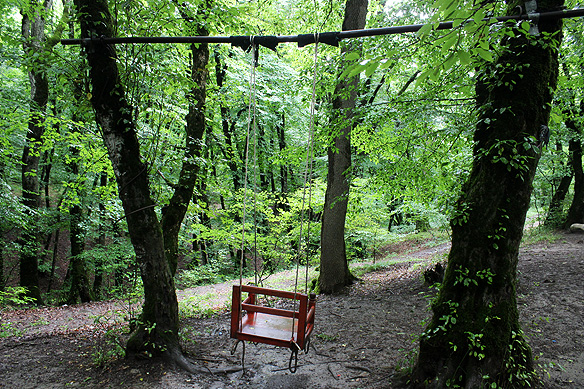
Nature is at its most magnificent on these stretches, free of exploitation for commercial gains and plastic waste. It is a setting which has also created some of the world’s most unique villages.

Take for instance Lahij, a thousand-year-old Persian village on the southern slopes of the Greater Caucasus Mountains. Unable to find suitable building material, the villagers created an entire settlement of homes and roads with river boulders. Over the centuries they also developed copper handicrafts of exquisite workmanship. It is a craft that is still practiced by its residents and has been listed in UNESCO’s Intangible Cultural Heritage of Humanity.

Then there are the villages in Lerik district in the foothills of the Talysh Mountains in south-east Azerbaijan where centenarians are the norm. Home to some of the oldest people that have ever lived on earth, the Talysh people, also of Persian descent, can be seen working on their fields and grinning cheerfully way into their hundredth birthday. At 90, they would be quick to exclaim that they still felt incredibly young!

If Lerik is about villagers renowned for their longevity, Khinalig high up in the Greater Caucasus range is the oldest inhabited village in the world—historians place it at 5,000 years. Its semi-nomadic villagers travelling between pastures have their own language, possess a distinct genetic make-up, and till recently had no contact with the rest of the world. Together with the mountains encircling it, the village and its inhabitants are a UNESCO-listed World Heritage Site.

Fascinating, isn’t it? Here are some more insights into these villages and their incredible secrets on the road less travelled, this time in the mountains of Azerbaijan.

Oh, and when on that road, don’t forget to have a qutab and chai from one of the many eateries nestled deep in dark lush forests. 😊 Continue reading

travel shorts: a tale of two heritage cities—shamakhi and sheki in azerbaijan

This slideshow requires JavaScript.

This is the tale of two cities in the land of fire, oil, and gas: Shamakhi where Azerbaijan’s rich medieval heritage took birth. And Sheki, which witnessed this same heritage’s closing chapter before the country was enveloped, first into the Russian empire and soon after, into the Soviet Union.

One specific dynasty’s rule had dominated Azerbaijan’s windswept plains and highlands in the Middle Ages. They were the Shirvan Shahs who ruled the Shirvan region, and whose capital Shamakhi was a trading post on the famed Silk Road.

Such was the glory and power of the Shirvan Shahs that their capital Shamakhi flourished for seven hundred years, from the 9th to 15th Centuries. When it did end its role as their capital, it was only because of nature’s unpredictable jostles. Shamakhi was prone to earthquakes. In the 15th Century, after one of the worst earthquakes the city had seen till then, its rulers felt it was wiser to move their capital lock-stock-and-barrel to Baku.

Most of Shamakhi was razed to the ground in this earthquake. Except for Juma Mosque, Caucasus’ second oldest mosque dating to 743. Juma or Friday Mosque has consistently, and lovingly, always been restored over the centuries. Its most recent face-lift was in 2013. Continue reading

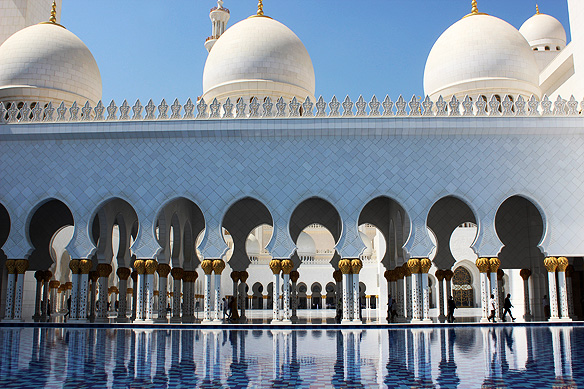
the 5 untold treasures of abu dhabi and sharjah

Think of the United Arab Emirates [UAE] and the one city that invariably pops up in our minds is Dubai—the city of steel, glass, and gold. But Dubai is not the only emirate. Notice the plural in the country’s name? There are six others, each with its own ruler, and of these, two are steadily vying with Dubai for a space in global tourism. For a reason: The incredible treasures they both hold which not many know about. They are Abu Dhabi and Sharjah.

Abu Dhabi is the richest emirate in the grouping and its city by the same name, Abu Dhabi, is the country’s capital. 96 percent of the UAE’s 100 billion barrels of proven oil reserves are within its borders, ranking it at number six worldwide. Abu Dhabi’s ruler is also the President of the UAE. Sharjah, on the other hand, is in a time-warp. It is older, more traditional, and regarded as the UAE’s cultural capital.

It was in 1958 when the UAE first discovered it had oil, and that too loads of it. Four years later, in 1962, Abu Dhabi, then a small fishing village on the edge of a desert, exported its first cargo of crude oil, and the country changed forever.

Supplying 4 percent of the world’s oil requirements with a production of 3.2 million barrels per day, the UAE has spiralled its way through progress at an astonishing speed. However, there is another side to the country that was formed on 2nd December, 1971. Its pre-oil era, swathed in a heritage that is beyond its oil. There is also a whole country that is beyond Dubai.

With ancient desert roots and a vision of unity through globalisation, here are some of UAE’s most spectacular treasures in its two lesser visited cities Abu Dhabi and Sharjah. For often the most beautiful sites are on the road less trodden. ❤ Continue reading

global travel shot: homeboys in dubai

Image

Me: “Kahaan se hai aap?” [Where are you from?] I call out to the group of men working at the Dubai Creek. Their blue salwar kameezes had caught my eye and I was photographing them from across the road.
“Dera.”
Me: “Dera Ishmail Khan?”
“Nahin, Dera Ghazi Khan.” [No, Dera Ghazi Khan.]
Me: “Main bhi.” [Me too.]

For a while I am stunned. Dera Ghazi Khan in Punjab province, Pakistan, is where my ancestors are from. It is a medieval city, founded in 1530 by Ghazi Khan, a Balochi chieftain, and has its own dialect. From the 16th to 18th Centuries, it was part of Mughal empire’s Multan province. When British India was partitioned in 1947 as part of independence, my family came to the other side of the newly created border as refugees. I have never been able to cross the border back, even briefly, because of political differences between the two nations since then.

I had also never met anyone from my hometown outside my immediate family and Delhi’s refugee community—ever. There are not that many of us, namely, Dera Ghazi Khan Hindus. And here was a group from “back home,” laughing and chatting with me across a glistening tarmac road in Dubai. I wondered if they were distant relatives. Those eyes reminded me of my father’s.

For many years now, I have been travelling to Dubai and via Dubai. From a time it had not yet become a city of glass and steel, and life centred around the Deira instead. I have often been asked what do I like so much about the city. My answer is in the group of young men I met today. Dubai for me will always be the place where two arms of a warring family hug each other in camaraderie, away from the glare of politics back home. Here, their pasts and differences have been put to rest. 🙂

the complete travel guide to the treasures of sri lanka’s cultural triangle

Welcome to my travel guide on Sri Lanka’s Cultural Triangle told a bit differently—through short photo-essay chapters on the country’s ancient and medieval history.

Of the six UNESCO-listed cultural world heritage sites in Sri Lanka, five lie within the Cultural Triangle in the heart of the country. It is a region rooted in 2,500 years of history and heritage, both sacred and secular, from timeless Theravada Buddhist sites to splendid Sinhalese royal capitals. All surrounded in lush tropical jungles.

Before I write any further, I would like to briefly explain two terms used in this guide which are part of the warp and woof of the country. Theravada Buddhism and ‘Sinhalese.’ Theravada Buddhism is the oldest school of Buddhism and a direct offshoot of Buddha’s teachings. There are five countries in the world which have Theravada Buddhism as their official religion, and Sri Lanka is one of them. Sinhalese refers to the Indo-Aryan ethnic race native to Sri Lanka.

Whilst this guide covers the five UNESCO-listed sites, it also includes some gems scattered in-between. I hope you find it useful and it helps put the country’s Cultural Triangle as a seamless whole with all the dots connected. ❤

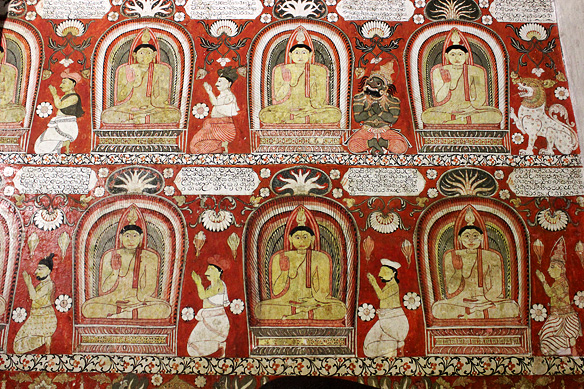
[Title photo: 18th Century Mural at Lankatilaka Vihara, Kandy.]

Table of Contents:

Continue reading

exploring sri lanka’s coastal towns: from galle to trincomalee

Indian Ocean from the Galle Fort ramparts just after sunset.

Indian Ocean from the Galle Fort ramparts just after sunset.

For a country whose length and width are merely 435 kilometres and 240 kilometres respectively, Sri Lanka, the tear-drop-shaped Buddhist island in the Indian Ocean has a remarkable variety of coastal towns.

Starting at windswept Galle with its Dutch colonial vibes in the south-west, next in line is the cosmopolitan financial capital Colombo. Then on to Negombo, the sunny Catholic fishing town in the west, to Jaffna in the north which till recently was completely out of bounds to all and sundry. And finally, Trincomalee in the north-east steeped in ancient Tamil culture against the backdrop of surf-worthy waves.

Come along and explore with me Sri Lanka’s five coastal gems, their unique heritages, and what not to miss. ❤

Table of Contents:

Continue reading

4 sri lankan game reserves for 4 authentic safaris

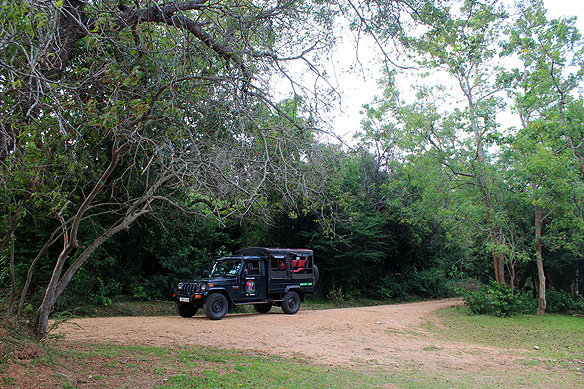
What’s a visit to Sri Lanka without a safari in its iconic game reserves? Blessed with a rich heritage and oodles of natural beauty, the tropical island’s game reserves offer a peek into its third charm: a teeming wildlife. But which one should you go to? Here is a rundown of Sri Lanka’s four most famous ones, and what to expect from each, in no specific order. For not all game reserves are ever the same. 🙂

1. Udawalawe National Park

If elephants are what you are seeking, and that too in plenty, then head straight to the Udawalawe National Park. With a head count of around 500 and herds of 50-or-so roaming the grasslands, sighting of the wild Asian elephant is guaranteed in all its glory, all year round. In fact, be prepared to have multiple close encounters with the gigantic mammals who will oftentimes come right up to your safari vehicle. Smaller than their African counterparts, the Sri Lankan subspecies of the Asian Elephant you see is characterised by patches of depigmentation on its ears, face, trunk, and belly. Continue reading

the road less travelled: delft island

Forty kilometres off the northern coast of Sri Lanka, is its farthest island—Delft.

It is an unusual name to come across for a tropical island in the Indian Ocean. After all, there is not much in common between the bleached island and the picture postcard region in Netherlands where white glazed pottery with blue decorations have been historically made. The 18th Century Dutch colonial rulers obviously felt differently; for them it was a perfect fit for their new home. Perhaps a gentle reminder of their roots in faraway lands.

Remote and sparsely populated, Delft is the largest island in the Palk Strait which separates Sri Lanka from the Indian subcontinent. Eight kilometres wide and 5.5 kilometres long, it is not just its name which is out of the ordinary. Delft Island used to be a coral reef in the distant past as revealed by the petrified coral chunks strewn on its emerald green beaches. Sans any streams, potable water is limited to catchment areas for surface water and a few pockets of ground water.

Despite these challenges, 1,300 Tamil Christian and Hindu families call the island their home today; their houses clustered around compounds in the north. Empty, windswept scrublands meanwhile stretch out in the south, right up to the rugged charred coastline. Continue reading

travel diaries: hiking through the horton plains

There is a deafening silence as I enter the Horton Plains in the wee hours of the morning. Above me, the silver sun is still trying to find its way back into the sky. It is not an easy task.

A thick blanket of mist and cloud engulf me, the golden blades of montane grass, and the sand-spattered 3.5-billion-year-old Precambrian-era boulders. Every now and then a slight drizzle kisses my upturned face. I peer through the mist, strain my ears for another human sound. A footstep, laugh, threads of a conversation. All I can hear is my own breath. I look at my phone. There is no signal. Continue reading