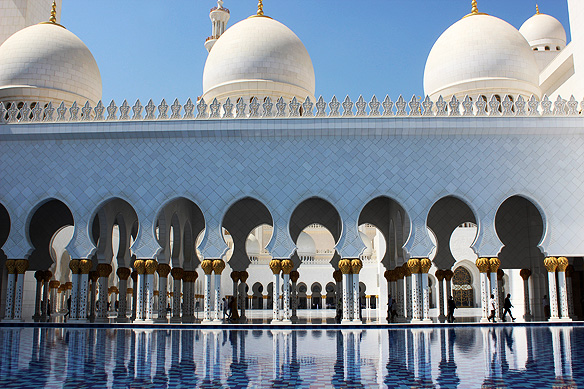
Think of the United Arab Emirates [UAE] and the one city that invariably pops up in our minds is Dubai—the city of steel, glass, and gold. But Dubai is not the only emirate. Notice the plural in the country’s name? There are six others, each with its own ruler, and of these, two are steadily vying with Dubai for a space in global tourism. For a reason: The incredible treasures they both hold which not many know about. They are Abu Dhabi and Sharjah.
Abu Dhabi is the richest emirate in the grouping and its city by the same name, Abu Dhabi, is the country’s capital. 96 percent of the UAE’s 100 billion barrels of proven oil reserves are within its borders, ranking it at number six worldwide. Abu Dhabi’s ruler is also the President of the UAE. Sharjah, on the other hand, is in a time-warp. It is older, more traditional, and regarded as the UAE’s cultural capital.
It was in 1958 when the UAE first discovered it had oil, and that too loads of it. Four years later, in 1962, Abu Dhabi, then a small fishing village on the edge of a desert, exported its first cargo of crude oil, and the country changed forever.
Supplying 4 percent of the world’s oil requirements with a production of 3.2 million barrels per day, the UAE has spiralled its way through progress at an astonishing speed. However, there is another side to the country that was formed on 2nd December, 1971. Its pre-oil era, swathed in a heritage that is beyond its oil. There is also a whole country that is beyond Dubai.
With ancient desert roots and a vision of unity through globalisation, here are some of UAE’s most spectacular treasures in its two lesser visited cities Abu Dhabi and Sharjah. For often the most beautiful sites are on the road less trodden. ❤ Continue reading

 rama toshi arya's blog