the complete travel guide to the treasures of sri lanka’s cultural triangle

Welcome to my travel guide on Sri Lanka’s Cultural Triangle told a bit differently—through short photo-essay chapters on the country’s ancient and medieval history.

Of the six UNESCO-listed cultural world heritage sites in Sri Lanka, five lie within the Cultural Triangle in the heart of the country. It is a region rooted in 2,500 years of history and heritage, both sacred and secular, from timeless Theravada Buddhist sites to splendid Sinhalese royal capitals. All surrounded in lush tropical jungles.

Before I write any further, I would like to briefly explain two terms used in this guide which are part of the warp and woof of the country. Theravada Buddhism and ‘Sinhalese.’ Theravada Buddhism is the oldest school of Buddhism and a direct offshoot of Buddha’s teachings. There are five countries in the world which have Theravada Buddhism as their official religion, and Sri Lanka is one of them. Sinhalese refers to the Indo-Aryan ethnic race native to Sri Lanka.

Whilst this guide covers the five UNESCO-listed sites, it also includes some gems scattered in-between. I hope you find it useful and it helps put the country’s Cultural Triangle as a seamless whole with all the dots connected. ❤

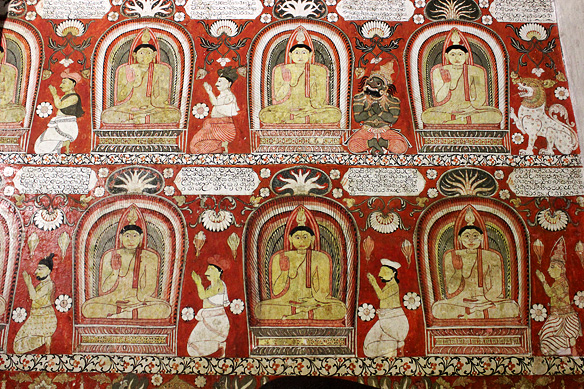
[Title photo: 18th Century Mural at Lankatilaka Vihara, Kandy.]

Table of Contents:

Continue reading

exploring sri lanka’s coastal towns: from galle to trincomalee

Indian Ocean from the Galle Fort ramparts just after sunset.

Indian Ocean from the Galle Fort ramparts just after sunset.

For a country whose length and width are merely 435 kilometres and 240 kilometres respectively, Sri Lanka, the tear-drop-shaped Buddhist island in the Indian Ocean has a remarkable variety of coastal towns.

Starting at windswept Galle with its Dutch colonial vibes in the south-west, next in line is the cosmopolitan financial capital Colombo. Then on to Negombo, the sunny Catholic fishing town in the west, to Jaffna in the north which till recently was completely out of bounds to all and sundry. And finally, Trincomalee in the north-east steeped in ancient Tamil culture against the backdrop of surf-worthy waves.

Come along and explore with me Sri Lanka’s five coastal gems, their unique heritages, and what not to miss. ❤

Table of Contents:

Continue reading

jaffna: the unexplored north of sri lanka

Twenty-six years of civil war is a long time. A whole generation grows up exposed to the horrors of war, stripped of their right to education, health-care, and utilities. It is hard for one living in a ‘secure’ country to even fathom such dreadfulness day in and day out, year in and year out.

Sri Lanka’s LTTE-Sinhalese civil war started on 23 July, 1983 and ended on 19 May, 2009, during which an estimated 40,000 civilians died according to a UN Experts Report. Those who could leave, left the country. Root causes of the civil war were a series of anti-Tamil riots following independence in 1948 and the 1956 Government Act which recognized Sinhalese as the only official language.

Fuelled further by the government’s citizenship and education policies, it led to the creation of the LTTE or Tamil Tigers, as they were known, and their demand for a separate Tamil state ‘Tamil Eelam.’

Suicide bombers were a trademark of the Tamil insurgency. Even India, Sri Lanka’s neighbour, could not be immune to it. India’s ex-Prime Minister Rajiv Gandhi was assassinated in 1991 by a 22-year-old female LTTE suicide bomber.

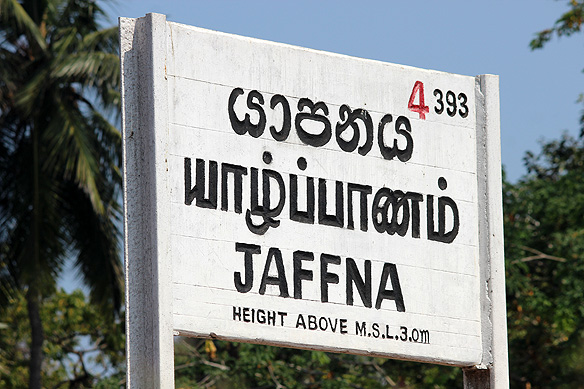
Jaffna [Yalpanam in Tamil] on the northern tip of Sri Lanka, was the epicentre of this civil war which spread across the island’s northern and eastern coastlines. Mutilated factories, bombed homes, and walls pock-marked with gunshots are still scattered throughout the city and its surrounds. An echo of its turbulent past.

Three things, by some miracle, have survived from the nearly three decades of fighting: One, the region’s places of worship—magnificent colourful Hindu temples, poignant grand churches, and sacred Buddhist sites—two, its bygone colonial ruins, and three, a bunch of remote sleepy isles on the Palk Strait in the Indian Ocean. Continue reading