[Note: Click on the play button or arrows to start the slide show.]
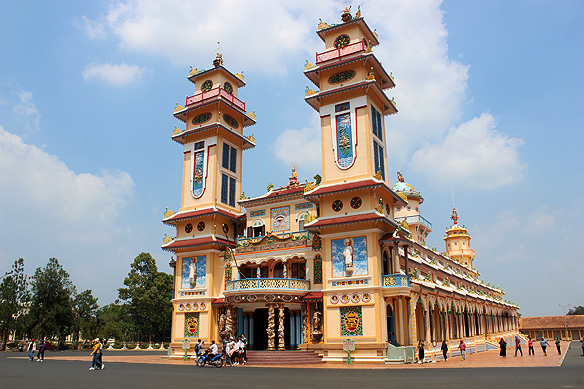
It is mid-day, somewhere in southern Vietnam, 80-odd kilometres from Ho Chi Minh City in Tay Ninh province. I am seated cross-legged inside a cavernous colourful ‘cathedral,’ on the fringes of a 99-year-old hypnotic performance of chants and rituals carried out by hundreds of solemn, serene-faced white-robed disciples.
Teal dragons, in contrast, wrap around soaring pink columns. Their candy red and white tongues stuck out mid-air. Above me, a ceiling recreates the heavens, punctuated with coiled snakes and flowers. Triangles with rays emanating from eyes adorn the windows and facades.
Rich in symbolism, every form and colour in the Cao Dai Holy See represents a belief or value mandated by divinity. Nothing is redundant here.
After all, there is enough inspiration. Vietnam’s very own monotheistic syncretic religion fuses together Buddhism, Confucianism, Taoism, Roman Catholicism, and ancestor worship, with a generous douse of seance [talking to spirits of the dead] into an eclectic mix guided by principles of harmony and simply doing good.
Overlooking this fantasyland are effigies of the first group of Cao Dai spirit mediums who ‘God’ identified himself to on Christmas eve in 1925. On the other end is the Bat Quai Dai altar. The most sacred part of the cathedral, it comprises a large sphere with a left ‘Divine’ eye painted on it, surrounded with religious paraphernalia. The eye represents the all-seeing supreme god Duc Cao Dai who is the universe which lives in all creation.
Not to be construed as an offshoot of any of the religions in its mix, Caodaism, born out of nationalism, was recognized as an independent religion on 7 October 1926 by Vietnam’s French colonial rulers. Officially known as The Great Faith for the Third Universal Redemption, the Holy See in Tay Ninh is its largest place of worship.
 rama toshi arya's blog