Welcome to my travel guide on Sri Lanka’s Cultural Triangle told a bit differently—through short photo-essay chapters on the country’s ancient and medieval history.
Of the six UNESCO-listed cultural world heritage sites in Sri Lanka, five lie within the Cultural Triangle in the heart of the country. It is a region rooted in 2,500 years of history and heritage, both sacred and secular, from timeless Theravada Buddhist sites to splendid Sinhalese royal capitals. All surrounded in lush tropical jungles.
Before I write any further, I would like to briefly explain two terms used in this guide which are part of the warp and woof of the country. Theravada Buddhism and ‘Sinhalese.’ Theravada Buddhism is the oldest school of Buddhism and a direct offshoot of Buddha’s teachings. There are five countries in the world which have Theravada Buddhism as their official religion, and Sri Lanka is one of them. Sinhalese refers to the Indo-Aryan ethnic race native to Sri Lanka.
Whilst this guide covers the five UNESCO-listed sites, it also includes some gems scattered in-between. I hope you find it useful and it helps put the country’s Cultural Triangle as a seamless whole with all the dots connected. ❤
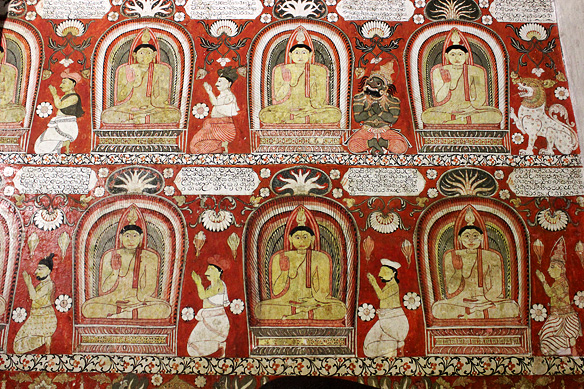
[Title photo: 18th Century Mural at Lankatilaka Vihara, Kandy.]
Table of Contents:
- Chapter 1: Anuradhapura, Sri Lanka’s first capital
- Chapter 2: Sigiriya, the 5th Century rock fortress
- Chapter 3: Polonnaruwa, Sri Lanka’s second capital
- Chapter 4: Kandy, Sri Lanka’s last royal capital
- Chapter 5: Dambulla, a Kandyan sacred art masterpiece
- Additional Sites
- Mihintale, birthplace of Sri Lankan Buddhism
- Avukana, ancient Sri Lanka’s finest standing statue of Buddha
- Yapahuva, the 13th Century citadel of a lost city
- Ritigala, a 2,300-year-old Buddhist monastery
- Nalanda Gedige, Sri Lanka’s central point
 rama toshi arya's blog