travel diaries: from bamyan to herat via the minaret of jam

Be still, dear wild dancing heart! I chide it that it’s being ridiculous. I am no novice traveller. I have travelled all my life, been to countless countries, places many have not even heard of.

“But this is the first time to the Minaret of Jam,” it whispers gleefully.

Yes, true. And I let it dance away, and smile at it fondly. If it were not for this crazy heart of mine, I would be leading a pretty dull life.

Dear reader, I am about to start a 7-day road trip across Afghanistan’s remote heartland to see its most glorious treasures, including the 12th Century Minaret of Jam. The latter, the very reason why I had travelled all the way to Afghanistan in the first place.

It will take me one-and-a-half days through nothingness to reach the minaret, and then another one-and-a-half days off-road driving to reach civilization, namely Herat.

Here’s to once-in-a-lifetime journeys! ❤ Continue reading

persian herat and its hidden wonders

Right at the very end of the battered and bruised road, cutting across the country from east to west, is the Persian historical city of Herat. Not many travellers come this far. It is way too out, perched near Afghanistan’s western border with Iran. Yet, it has always been of great importance, as is revealed by its architectural and cultural treasures to those who take the trouble to reach it.

Herat’s been around for a long time; 6th Century BC records describe it as a Persian city which went by the name Aria. Yes, the same pronunciation as my surname. 🙂

Its strategic location on the Great Silk Road and the banks of the Hari River made it particularly appealing to conquerors and rulers. Alexander the Great defeated Herat’s Persian Achaemenids in 330 BC and put up a majestic citadel to celebrate his victory. He was followed by the Abbasid Caliphs in the 8th Century, Ghurids in 1175, the Mongol Genghis Khan who destroyed everything in 1221, the Kartids who then rebuilt it, and the Timurid Tamerlane who destroyed it once again in 1380.

When Tamerlane’s favourite son Shahrukh Mirza decided to move his capital from Samarkand to Herat, he was determined to make Herat the grandest city in the region. A vision shared by his wife Gawhar Shad and later descendent Husayn Bayqara.

The result was a city of much beauty and grace whose praise was extolled far and wide. Of its many buildings, 830 ‘cultural sites’ are still believed to survive today, warranting it a place in UNESCO’s tentative list in 2004.

It is a difficult combination. War and conservation. However, despite all the odds, both UNESCO and the Aga Khan Trust for Culture have consistently worked on Herat, ensuring its treasures, hidden from the world at large, manage to survive.

Come along with me on a virtual tour of Timurid Herat, the city on the Hari River, to see why it was called the ‘Pearl of the Khorasan’ for the longest time! Continue reading

travel shorts: hazrat-e mazar, afghanistan’s most sacred site

Image

This slideshow requires JavaScript.

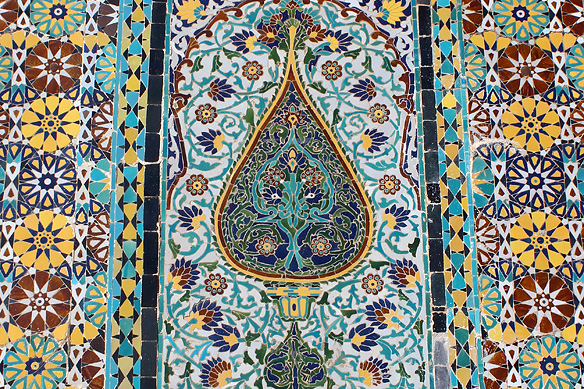
One of Islam’s most sacred sites lies in northern Afghanistan, a mere 55 kilometres from the Uzbekistan border. It is a blue-tiled mosque which glistens like a jewel, changing colour through the day, and home to countless pristine white pigeons.

Whilst the Shi’a sect of Islam believe that Ali, Prophet Muhammad’s cousin and son-in-law, is buried in Najaf, Iraq, the Sunni sect regard Hazrat-e Mazar in Mazar-e Sharif as Ali’s actual tomb.

Both, the city Mazar-e Sharif and its spiritual centrepiece Hazrat-e Mazar, date back to the 12th Century.

There is an interesting Afghan legend as to how the tomb came to be here. Continue reading

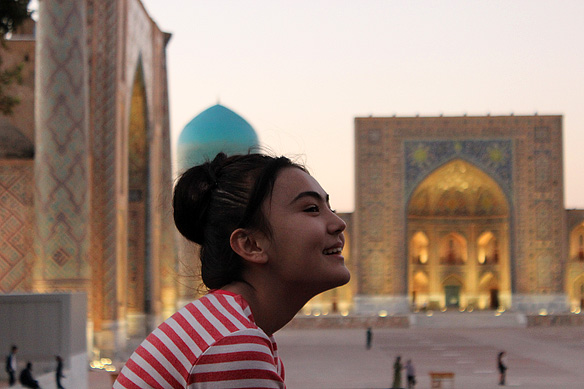
the spectacular treasures of samarkand

Registan, Samarkand

We travel not for trafficking alone;
By hotter winds our fiery hearts are fanned:
For lust of knowing what should not be known,
We take the Golden Road to Samarkand.

~ James Elroy Flecker

One cannot claim to be a traveller, and not have made the journey to Samarkand. Or at least have thought of it, fantasised about it. It would be blasphemy.

Samarkand is everything the traveller searches for, within and outside of oneself. It reveals secrets about life held gently amidst its spectacular edifices in blue and gold. The romantic exotic tile-clad mosques, madrasahs, tombs, bazaars and squares transpose one back 500 years in time to a grand fairy-tale city, deep in arid windswept Central Asia. On a philosophical note, Samarkand is the semi-mythological place of “justice, fairness, and righteousness” in Islamic Classical literature.

Much like Flecker’s reference to it, a lust for knowing more about ourselves and these ideals, makes the passage to Samarkand one of those non-negotiable, mandatory journeys one just has to take. 🙂 Continue reading

shakhrisabz, warlord tamerlane aka temur the lame’s hometown

shakhrisabz1
shakhrisabz2

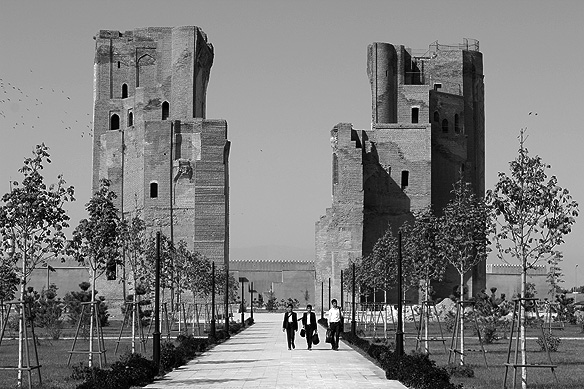
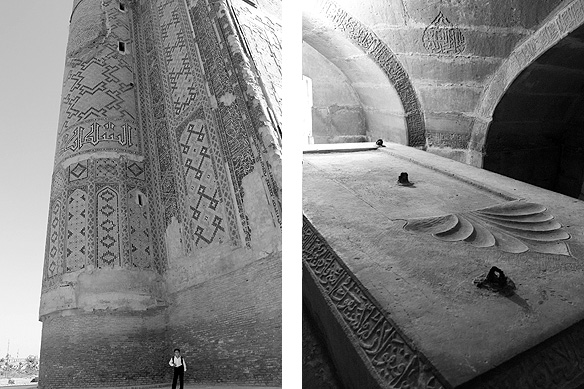
The grandeur of the Ak-Saray Palace and the simplicity of his own intended tomb—both in Shakhrisabz—perhaps best describe Amir Temur the person, better known as Tamerlane [Temur, the lame]. Complex, multi-faceted, termed history’s most callous butcher, conqueror of southern, western and central Asia, he was the founder of the Timurid dynasty, and the great-great-great-grandfather of Babur, founder of the Mughal Empire in India. He lived from 1336 – 1405 AD.

Ahmad ibn Arabshah, Temur’s Arab biographer, had to say this of him when the latter was 70 years old:

“Steadfast in mind and robust in body, brave and fearless, firm as rock. He did not care for jesting or lying; wit and trifling pleased him not; truth, even were it painful, delighted him … He loved bold and valiant soldiers, by whose aid he opened the locks of terror, tore men to pieces like lions, and overturned mountains. He was faultless in strategy, constant in fortune, firm of purpose and truthful in business.”

Continue reading