global travel shot: the pagan temple that became a christian country’s favourite

Image

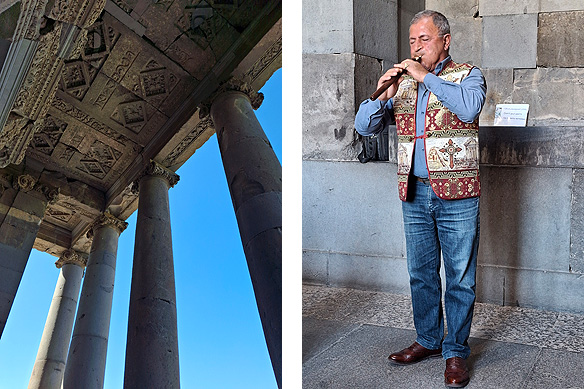
When I walked into Garni Temple’s Cella one October morning there was a 2,000-year-old UNESCO-listed duduk performance taking place inside the stone confines to the unbridled joy of a rapt audience. Once the show was over, I somehow managed to get the temple all to myself for a few long moments.

Garni Temple is the only one of its kind in all of Armenia and [now defunct] Soviet Union. The fact that it still stands—a rare pagan Greco-Roman remnant in the world’s first Christian country despite wars, religious upmanship, atheism, and even an earthquake—is a miracle.

Two thousand years old, scholars differ on its exact purpose and age. Is it a temple to the Zoroastrian sun god Mihr built in 77 AD by the Romanized Armenian King Tiridates I or a Roman tomb of the 2nd Century? Either way, its soaring 24 basalt Ionic columns reaching out to a ceiling draped in reliefs of grapes and vine leaves, perched above nine 12-inch-high steps is an evocative magnificent otherworldly sight.

Seated on the stone floor by the empty altar, it was just me and the echoes of those who had passed through the sanctuary two millennia ago. And that remote yesterday from the distant annals of time, briefly became my today.

Welcome to my Armenia series, dear Reader. ❤
the road less travelled: azerbaijan’s unusual villages

In just five to six hours, one can traverse across Azerbaijan’s length or breadth, crossing nine of the world’s 11 climatic zones along the way. And whilst at it, you would most likely not pass another soul.

Of Azerbaijan’s population amounting to just over 10 million, almost half of these live and work in the capital city Baku and the surrounding Absheron peninsula. The rest of the country is deserted. A tiny village tucked away in a forest-canopied valley or perched on a mist-wrapped mountain is as busy as it gets, apart from a handful of administrative and historical towns.

Nature is at its most magnificent on these stretches, free of exploitation for commercial gains and plastic waste. It is a setting which has also created some of the world’s most unique villages.

Take for instance Lahij, a thousand-year-old Persian village on the southern slopes of the Greater Caucasus Mountains. Unable to find suitable building material, the villagers created an entire settlement of homes and roads with river boulders. Over the centuries they also developed copper handicrafts of exquisite workmanship. It is a craft that is still practiced by its residents and has been listed in UNESCO’s Intangible Cultural Heritage of Humanity.

Then there are the villages in Lerik district in the foothills of the Talysh Mountains in south-east Azerbaijan where centenarians are the norm. Home to some of the oldest people that have ever lived on earth, the Talysh people, also of Persian descent, can be seen working on their fields and grinning cheerfully way into their hundredth birthday. At 90, they would be quick to exclaim that they still felt incredibly young!

If Lerik is about villagers renowned for their longevity, Khinalig high up in the Greater Caucasus range is the oldest inhabited village in the world—historians place it at 5,000 years. Its semi-nomadic villagers travelling between pastures have their own language, possess a distinct genetic make-up, and till recently had no contact with the rest of the world. Together with the mountains encircling it, the village and its inhabitants are a UNESCO-listed World Heritage Site.

Fascinating, isn’t it? Here are some more insights into these villages and their incredible secrets on the road less travelled, this time in the mountains of Azerbaijan.

Oh, and when on that road, don’t forget to have a qutab and chai from one of the many eateries nestled deep in dark lush forests. 😊 Continue reading