travel diaries: in search of king tamar’s svaneti

Fresco of King Tamar [left] with her father King Giorgi III. This fresco in Vardzia is the only surviving portrait of Tamar painted during her lifetime in the 12th Century.

Fresco of King Tamar [left] with her father King Giorgi III. This fresco in Vardzia is the only surviving portrait of Tamar painted during her lifetime in the 12th Century.

Mepeta Mepe, King of Kings Tamar was only 18 when she was crowned co-ruler of the Kingdom of Georgia in 1178. Six years later, when her father King Giorgi III died, she became its sole ruler. Here, I’d like to add some context regarding the word ‘Mepe’ before I write further. Georgian is a gender-neutral language, and Mepe means king or sovereign ruler, immaterial of whether the person is male or female.

Coming back to Tamar, her title was not the only unusual part of her story. Georgia, under her rule, reached its political and cultural zenith. Its borders spread from the Black Sea in the west to the Caspian Sea in the east, and the Greater Caucasus mountains in the north all the way to eastern Türkiye and northern Iran in the south. She founded multiple cultural academies, and the arts and literature flourished with masterpieces such as the epic poem Knight in the Panther’s Skin by Shota Rustaveli written as an ode to her extraordinariness.

Eight centuries ago, deeply religious herself in a deeply orthodox country, she also chose to divorce the husband the court nobles had chosen for her. She then found herself a second husband [David Soslan, an Ossetian prince] in 1189 who was more to her liking.

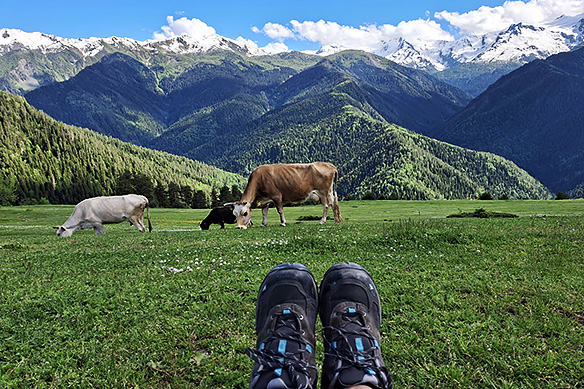
According to Georgian legends, Tamar had a special fondness for Svaneti, a region in the upper reaches of the Greater Caucasus mountains, where, come summer, she would make the journey to a castle named after her. Here, snow-capped peaks reached out to iridescent blue skies, hemming in emerald meadows in which cows mooed and stone towers pricked its sleepy valleys.

Continue reading