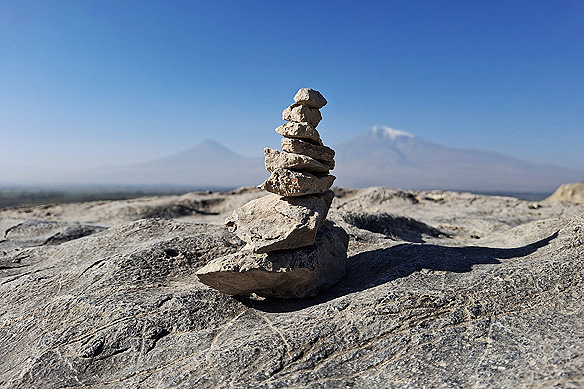
photo essay: monasteries and manuscripts, echoes from the world’s first christian country

Before Rome. Before even Constantinople. The first one to officially adopt Christianity was Armenia. Saint Gregory the Illuminator had miraculously healed King Tiridates III who had lost his mind. In gratitude, the King declared Armenia a ‘Christian’ country. It was the year 301.

A century later, in 405, the brand-new State religion introduced a brand-new script to spread ‘God’s word.’ Mesrop Mashtots, a cleric-cum-linguist, was assigned the task of creating an alphabet that would encompass the phonetic expanse of the Armenian language, a standalone member of the Indo-European language family. Over time, the scope of this script increased to document Armenian philosophy, science, and the arts.

Monasteries, as centres of faith and learning, soon cropped up across the Kingdom in breathtaking settings. Perched over canyons, atop sheer cliffs, and in verdant valleys. In the medieval era, there were tens of thousands of these. As Armenia’s realm shrunk, these reduced to a mere few thousand with four of them now UNESCO-listed.

Known as the Armenian Apostolic Church, Armenian Christianity is based on the teachings of the two early Apostles, Thaddeus and Bartholomew. What is more remarkable is that the Armenians resolutely stuck to the original version of their faith for the next 1,700 years, amidst the whirlpool of conversions, genocide, and wars that swept through the region.

Welcome to my photo essay on the most spectacular monasteries of the lot that have survived to date—each with something that sets it apart. Sometimes it is its story, sometimes its location, and sometimes its incredible art. I have punctuated these photos with those of my favourite Armenian manuscripts in Yerevan’s Matenadaran.

Wishing you happy travels, always. ❤️ Continue reading

travel diaries: moscow to vladivostok, sleepless on the trans-siberian railway

Siberia. View from my train window.

Siberia. View from my train window.

PROLOGUE

The Trans-Siberian Railway. From Moscow to Vladivostok. 9,289 kilometres across the vast expanse of Russia, and eight time zones. The longest railway line in the world. Now, how can one resist a journey of such epic proportions!

I had first heard about the railway service laid out between 1891 and 1916 by two Tsars—Alexander III and his son Nicholas II—when I just started working. Something inside me then and there decided I had to undertake this voyage. No, not because I am a train buff. Hardly. But because then, and today, a few decades later when the dream is being realized, it is the epitome of travel.

Dear Diary, here’s my 14 days of travel on the Trans-Siberian Railway with stops at the historical cities en-route. A journey that turns out to be one of my most authentic travel experiences to date. ❤ Continue reading

karelia: when russia met finland

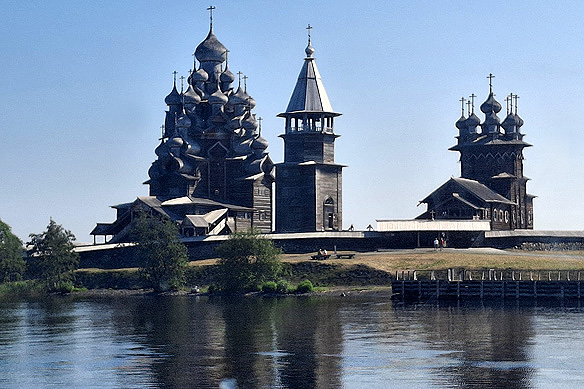
Surrounded by 1,650 islands, the 22 Aspen shingle domes tumbling down the Church of the Transfiguration on Lake Onega’s Kizhi Island seems straight out of a fairytale. Just when you expect a goblin to peep out from behind a carved gable, the church bells on the nearby bell tower break into a peal of lilting musical notes. Inside the church itself built of pine logs in 1714, a four-tiered wooden iconostasis with 102 icons recounts tales of prophets and feasts in colourful gilded, recently restored glory.

Together with the equally unique nine-domed Church of the Intercession built in 1764 and 19th Century Bell Tower, it forms the Kizhi Pogost, a UNESCO-listed ensemble of medieval Russia’s grandest wooden churches. They are evocative of the country’s archetypal onion-domed cathedrals, but are made completely out of wood, sans any nails except to hold the domes’ shingles in place, in keeping with local building traditions. There are other buildings on the island including the tiny 14th Century Resurrection of Lazarus Church, and numerous houses, barns, and windmills.

Kizhi Island is the centrepiece of the Republic of Karelia, a region which has found itself amidst a tug-of-war between neighbouring Finland and Russia through much of its history. This has resulted in a heady mix of Russian Orthodoxy laced with rituals and superstitions rooted in Finnish folklore which stubbornly live on.

Though Peter the Great [r. 1682 – 1725] and Catherine II [r. 1762 – 1796] turned Karelia’s iron-rich fields into a ‘factory’ at Petrozavodsk to produce ammunition for their wars against the Swedes and Turkey respectively, and the Soviets made it the site for their infamous White Sea Canal gulag camp, Karelia still retains its goblin Finnish charm. Look closely, it is hiding under the eaves of those quaint wooden homes and mythical churches scattered across the verdant isles and meadows.


Church of the Intercession and Church of the Transfiguration. Continue reading

travel guide: the five untold unesco-listed treasures of western russia

Not far from Moscow lies a ring of UNESCO-listed historical towns where the Russian nation, religion, arts, and architecture first took shape a thousand years ago under the rule of the Rurik dynasty. Frozen in time, these towns are a far cry from the enormity of Moscow. But their legacy has survived a millennium, through the cold-blooded Mongol onslaught and despite Soviet industrial atheism, forming the blueprint of what is intrinsically ‘Russia.’

Here are the finest of those towns. Achingly beautiful, and steeped in history and traditions, no visit to Russia is truly complete without them. And it is not just me who thinks so. The locals will vouch for it too. ❤️ Continue reading

vietnam’s capital hanoi, stories told and untold

A thousand years of Chinese rule, followed by a thousand years of independence. Except for a misfit seventy years under the French, somewhere in-between.

Hanoi’s story is like no other.

After being a Chinese territory from 179 BC onward, it finally threw off the yoke in 1010 when the first indigenous Vietnamese dynasty [Ly Dynasty] made Hanoi its capital. Since then, multiple local dynasties stuck to the tradition, apart from the Nguyen dynasty who moved their capital to Hue. The later French occupation followed suit, and chose Saigon in the south as their base, but made Hanoi capital of French Indochina from 1902 to 1945.

By the time Hanoi took back its mantle of being a political and administrative seat in 1954, Vietnam had ousted the French and part of the country was communist. Today, Hanoi is the capital of one of only five officially communist countries in the world, balancing Marxism-Leninism socialism with a market-oriented economy.

The result of this eclectic past and present has created a culturally rich city where contradictory layers coexist. Ancient Confucian temples, Buddhist pagodas, and a sprawling royal citadel which doubled up as both a medieval fortress and a 20th Century war bunker. Colonial houses replete with wooden shutters and a towering French stone cathedral, surrounded by local eateries jostling for space on footpaths and railway tracks. A communist-styled marble memorial for an embalmed ‘Uncle Ho,’ and sombre Lenin statue in a city square. It would not be too far off the mark to say there is something for every ideology in Hanoi!

Small wonder then that there are stories galore in this Vietnamese city tucked away in the country’s north. Some repeated often. Some which only the locals know. And some, midway between the two, which intrepid curious travellers stumble upon.

Shall we begin? 🙂
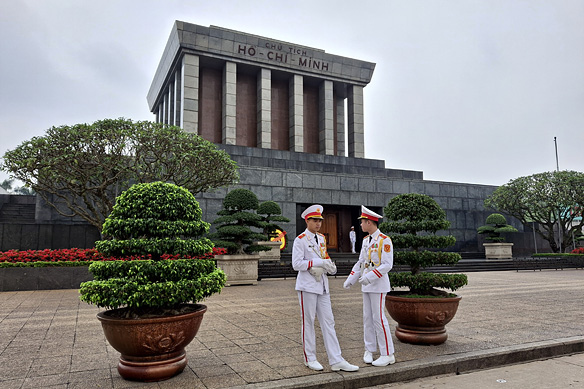

Hanoi’s most iconic landmark is the Ho Chi Minh Mausoleum where visitors silently file past the embalmed corpse of Vietnam’s beloved Uncle Ho. If it was not for him, the French may not have left or the country not united. He had wanted a simple cremation after his death. Instead, he got a gigantic marble mausoleum, like those accorded other communist stalwarts: Lenin and Mao. Continue reading

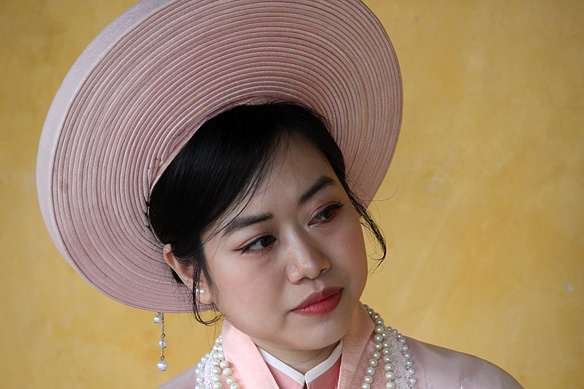
travel guide: hue, capital of vietnam’s last royal dynasty

Welcome to my travel guide on royal Hue.

Often reduced to an overnight visit enroute to colourful Hoi An or sidelined completely for Vietnam’s buzzing metropolises and beach cities, Hue is where Vietnamese history and culture bask in full authentic glory.

For 143 years, from 1802 to 1945, the city on the banks of the Perfume river in the middle of the country served as the capital of the Nguyen dynasty, Vietnam’s last royal ruling family. Prior to this, Hue had been the capital of their predecessors—the Nguyen Lords, a feudal noble clan, since 1558.

The Nguyen empire marked a period of dramatic flux in the country’s history. Starting off as an isolationist Confucianism-driven kingdom of unified Viet Nam, it morphed into a military might to reckon with, on to an eclectic marriage of European and Vietnamese cultural elements, before being ousted in 1945.

Thirteen Nguyen emperors ruled from Hue’s Imperial Citadel during these years—a fortress-cum-administration centre-cum-royal residence. It is where military decisions to conquer neighbouring lands, followed by agreements to relinquish the same lands to French colonial rulers were drawn and sealed.

In and around the city, seven of Hue’s 13 emperors designed and built their grand tombs to be remembered by. These reflected not just their personalities, philosophies, and aspirations as rulers, but also the prevailing geopolitical scenarios.

Whilst the UNESCO-listed Imperial Citadel and royal tombs took care of the Nguyen emperors’ lives and afterlives, patronage of spiritual places continued unabated. An age-old royal practice, it ensured the gods were kept happy and added a touch of divinity to dynastic rule.

Yes, Hue has all this and even more!

Dear Reader, I hope you find this travel guide useful as I take you along Hue’s imperial history, connecting its rich and varied monuments to the city’s incredible story. ❤

Table of Contents:

Continue reading

travel diaries: in search of champa, vietnam’s ancient hindu kingdom

It is still dark. The sun, groggy-eyed as it squints through the heavens punctuated by a sole star.

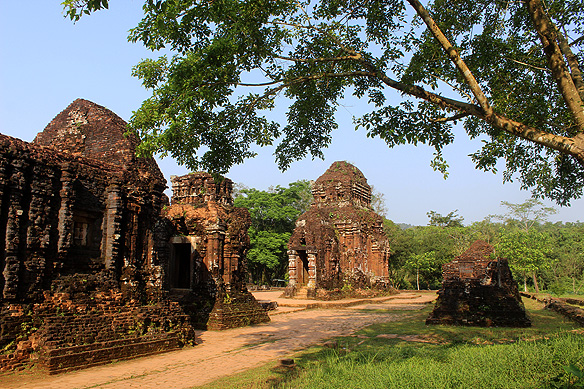
I am on my way from Hoi An to My Son Sanctuary—the temple ruins of an ancient Hindu kingdom which called this part of Vietnam home for 1,600 years. You may ask, but why so early? Because some places are best seen at sunrise. When it is just them, you, and the centuries of silence in-between. This silence then starts talking, regaling stories. Some voraciously. Some hinted at with a smile. Don’t you agree? 😊

An hour later, walking through the site’s lush green meadows, I pass scores of my country-folks. Perplexed, I am about to stop one of them and ask the reason, when a large placard explains their presence. They are archaeologists from the Archaeological Survey of India carrying out restoration work in association with the Vietnamese government. It makes sense. Who else could understand the remnants of a millennia-old Hindu kingdom better, even if it wore a different mantle on a foreign ground.


My Son Sanctuary, a UNESCO-listed World Heritage Site, is one of the most important ancient religious sites in south-east Asia. Continue reading

travel shorts: dragons of the unesco-listed ha long bay and trang an landscape

Once upon a time, thousands of years ago, Vietnam’s hamlets on its east coast were in grave danger. A fleet of foreign invaders were approaching. Defeat seemed imminent. They called upon Jade Emperor, the supreme deity in Taoism, in desperation.

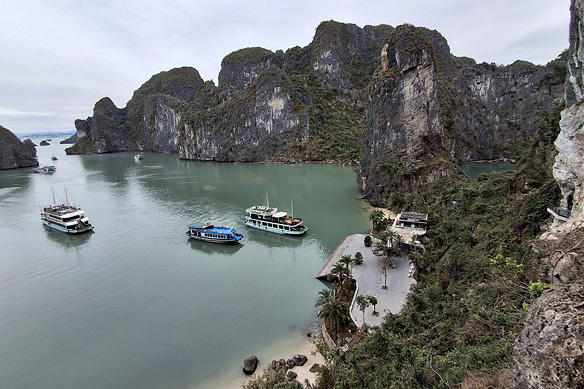
In answer to their prayers, he sent the Mother Dragon to help them. She and her children plunged into the waters spewing fire, jade, and emeralds to ward off the enemies. These jewels instantly solidified into 1,133 sea mountains spread over 65,650 hectares creating an impregnable barrier on the sea. With the invaders now battered and trapped in the rocky outcrops, the Vietnamese were able to drive them away.

This mythical place came to be known as Ha Long Bay. Meaning ‘Bay of the Descending Dragon.’ It was listed as a UNESCO World Heritage Site in 1994. No, not because of the dragons, but for its unique geological formations and marine landscape.

What happened to the dragons? They decided to stay on in the mortal world and continue to guard the Vietnamese.


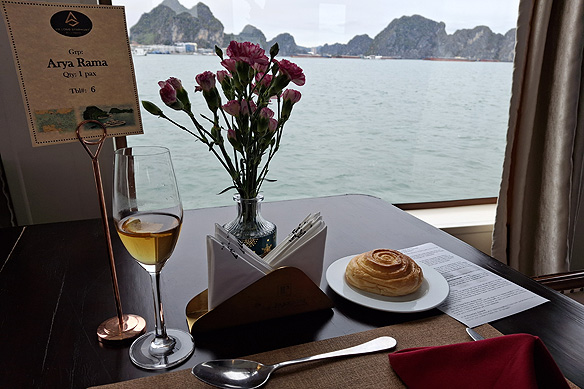
Welcome to Ha Long Bay. My table with a view. 🙂 Continue reading

photo essay: hoi an, vietnam’s unesco-listed city of lanterns

Imagine a whole town swathed in deep red and yellow silk lanterns. Across tree-lined streets and narrow alleys, on shopfronts and cutesy cafes. A centuries-old town with yellow tube houses that stretched between lanes, and a wide placid river that gently lapped against its banks.

If during the day Hoi An is a fairytale, at night it is as if those very fairies had waved a wand and created magic. Don’t be surprised if you catch yourself wondering if it was all for real. After all it is the 21st Century. How did this exquisite time capsule manage to survive. Especially one that was authentic, and not contrived.

Frozen somewhere in the 17th and 18th Centuries, UNESCO-listed Hoi An’s very name recounts its story. Hoi An means the ‘peaceful meeting place.’ Four hundred years ago, this idyllic riverside town became an international trading port in southeast Asia. Merchant vessels and traders from Japan, China, Europe, and India converged on its waterfronts and streets exchanging goods and ideas. Hoi An was their ‘peaceful meeting place.’

However, when neighbouring Da Nang started to grow as a port in the 19th Century, Hoi An’s fortunes fell and the town was forgotten. No one saw any merit in pumping money into building over its yellow trading tube homes and colourful assembly halls in the name of development. It was this very neglect which turned out to be Hoi An’s blessing in disguise and the reason for its revival, thanks to help from a completely unexpected quarter—Kazimierz Kwiatkowski, a Polish architect and conservationist.

If Hoi An is on every traveller’s bucket-list today, it is because Kwiatkowski spent years towards getting it listed as a UNESCO World Heritage Site. Hoi An never forgot the favour. A memorial in his honour stands in Kazik Park in the Old Town today.

Continue reading

top 15 memorable things to do in bahrain, pearl of the persian gulf

Fishing boats in historical Al-Muharraq overlooking modern Manama.

Fishing boats in historical Al-Muharraq overlooking modern Manama.

Bahrain, meaning ‘Two Seas’ in Arabic, is one of those delicious treats one encounters as a traveller. I do not mean that from a food perspective. Do not get me wrong. The food is fantastic here. What I mean is that it is a visual and historical treat. Layered, nuanced, and whole.

Middle East’s smallest country, the Kingdom of Bahrain is located a mere 25 kilometres off the north-east coast of Saudi Arabia. Ruled by the Al-Khalifa family, it is an archipelago of 33 islands with Bahrain Island the largest [51 kilometres long and 18 kilometres wide] and Manama as its capital. Though mainly barren desert, its freshwater underground springs and marine waters have given the country a remarkable gift: the finest Pinctada radiata oyster beds in the world, of which one in every 20 contains an iridescent natural pearl.

Since their discovery over four thousand years ago by the Dilmun civilization, these oyster beds have sustained empires who made Bahrain their home, and provided them with immense wealth. Pearl-diving, however, was no mean feat across these millennia. It was dangerous and physically demanding.

The divers, known as ghawwas, would plunge some 30 metres into the depths of the sea, armed with rudimentary nose clips and finger protectors, to collect the oysters. After gathering as many as they could with their breaths held tight, they would rush back to the surface, gasping for air. The oysters would be slit open, the pearls graded, and the wheeling and dealing begun with buyers from Europe and India. Once the prices were fixed, these little gems of nature left Bahrain’s shores to grace a crown, a robe, or a neck.

Everyone in the island was directly or indirectly involved in the business of pearls which peaked from 1810 to 1923 in Al-Muharraq, the second largest island in Bahrain. The result was a single product economy which made it to the UNESCO World Heritage list in 2012.

Any surprises then that Bahrain is often referred to by its moniker ‘Pearl of the Gulf?’

But what starts, ends. And though the oyster beds are still there, the pearling trade collapsed with the advent of the Japanese cultured pearl in the 1920s—a simpler, cheaper, and easier alternative—and the discovery of oil in Bahrain in 1932.

An Islamic nation based on Sharia Law, Bahrain’s maritime trade and exposure to multiple cultures for over four millennia has made it forward-thinking and tolerant. It is hard to distinguish between the Bahraini and 55 percent expatriate community at times. There is an easy comradery that cuts across race, class, and creed, peppered with some of the warmest, friendliest smiles around.

Here are 15 memorable things to do in Bahrain. Because, this little island kingdom is, well, different. ❤

Children dressed up for Bahrain's national day, 16th December, which celebrates the late Emir Isa bin Salman Al-Kalifa's ascension to power in 1961.

Children dressed up for Bahrain’s national day, 16th December, which celebrates the late Emir Isa bin Salman Al-Kalifa’s ascension to power in 1961.

Continue reading