mud, petroglyphs, oil, and fire: quintessentially azerbaijan

Sandwiched in the Caucasus, between the Caspian and Black Seas, Azerbaijan is a bit of a latecomer to global tourism. But catching up fast.

Unusual on multiple counts, four features and their unique mix set the country even further apart from the ordinary: Mud, petroglyphs, oil, and fire. Where else can one find such a cocktail! To add to its appeal, they come candy-wrapped in picturesque settings at a short distance from the capital Baku in the surrounding Absheron Peninsula.

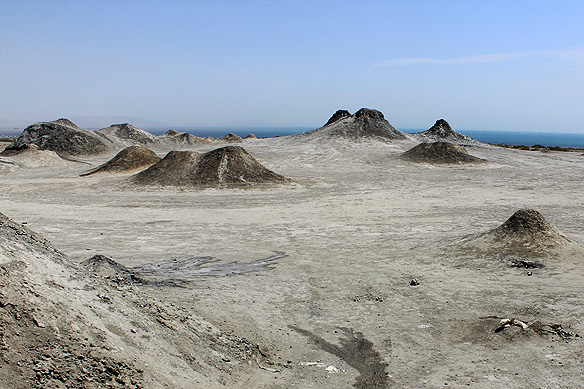
Of the 700 mud volcanoes found around our planet, 40 percent lie in Azerbaijan. They bubble away on barren stretches courtesy of methane gas trapped under the earth’s crust. When the pressurized gas encounters groundwater, and together they find an opening in a fault line, they ooze out in the form of mud, cool to the touch.

Ranging from 1 to 700 metres high, and a few centimetres to a few kilometres wide, they function similarly to regular volcanoes. When they erupt, they can spew flames and mud from the bowels of the earth. Kinezadagh [397 metres high] and Turaghay [400 metres high] are the largest mud volcanoes in the country.

Azerbaijan is also among the oldest inhabited regions in the world, going back to the Stone Age. The Gobustan Rock Art Cultural Landscape Reserve, a UNESCO-listed World Heritage Site, contains an exceptionally large collection of petroglyphs. Etched into rock with sharp stone tools, and with the advent of the Bronze and Iron Ages, with metal, the earliest of the lot is 40,000 years old.

Subjects range from dancing figures, shamans, boats with oarsmen, and battle and hunting scenes; the latter replete with bison, gazelles, horses, and goats. Some of these were ‘drawn’ even before the region’s ancient men and women shifted to farming and husbandry as a source of food. Continue reading
72 hours in baku

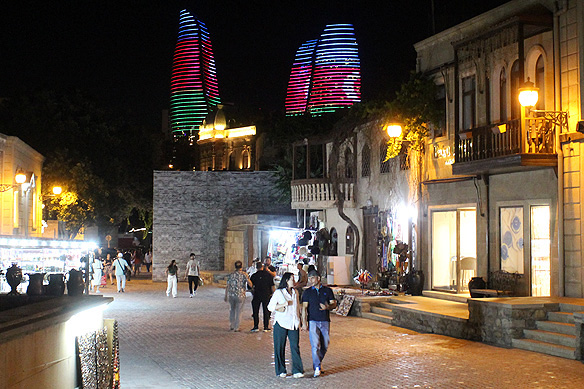
Baku is often described as one of the most beautiful cities in the world. It is a description that is not off the mark. The city’s rich heritage spanning three millennia can be invariably seen in a single line of vision. Now where else would you have such a splendid view!

But Baku is not only about pretty buildings. A world city in every respect, it abounds with museums and galleries wherein local meets international. Literature, art, and music thrive here, both at the esoteric and popular levels. Can the culinary be far behind in all this? With one-fourth of Azerbaijan’s population, Baku buzzes with life. Literally. Not in a chaotic haphazard way. But as a celebration.

Travellers have only recently started noticing this city on the shores of the Caspian Sea which comes with the moniker ‘Windy City.’ On its part, the Azerbaijan government is making every effort to ensure it is a memorable visit. The visa department sends out surveys to its tourists to find out what worked, what did not, and how Azerbaijan could be a better travel destination.

Here is a three day/ 72-hour itinerary with context, tips, and links to help you make the most of your stay. To go straight to the itinerary for a specific day, use the table of contents below. Wishing you happy travels, this time to Baku. 🙂

Table of Contents:

Continue reading

the complete travel guide to balkh: ancient bactria and silk road’s fabled city

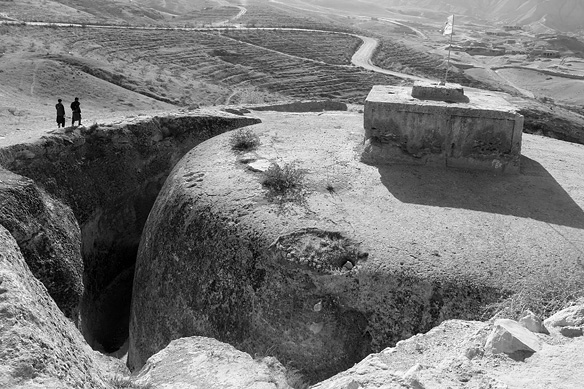
Of all the cities that has survived the annals of time, Balkh, the capital of ancient Bactria [6th Century BC to 6th Century AD] in northern Afghanistan, is perhaps the most evocative.

Volumes have been written on its wars when it was the capital of Bactria, and thereafter, a part of post-Bactrian empires. Art and literature have had a constant muse in its colourful personalities, Alexander the Great and Roxanna, and their marriage which paved the course of history. One of the oldest religions in the world, Zoroastrianism, was founded by one of Balkh’s very own citizens, Zoroaster.

But its greatest claim to fame, and subsequently its greatest legacy, came from its simultaneous role as Silk Road’s fabled city. For 1,600 years, from 130 BC – 1453 AD, Balkh was not just a confluence of commodities, but also of religions, ideas, and knowledge. Continue reading

zoroastrian khorezm: the ancient viloyat of uzbekistan

mizdakhan1

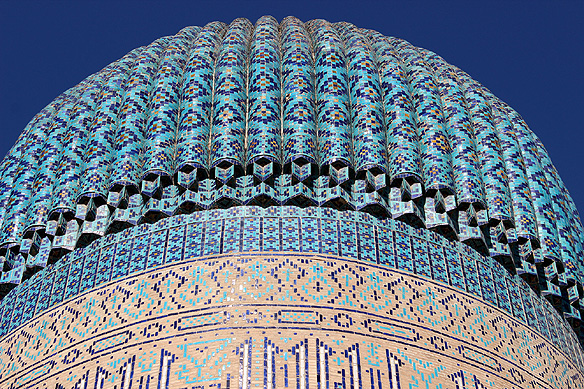
A journey to Samarkand is about medieval mythical cities and ancient forts going as far back as 500 years before Christ. First Zoroastrian, followed by Islamic, the sites still stand in all their glory today—many restored, others in ruins. But in spite of this, the journey is not just about geographies, edifices or time. It is to the grandeur within us. But that, I hope, will become clearer as my blog post series on Uzbekistan unfolds. 🙂

I started in Nukus. You may well ask, why Nukus? It is not the usual starting point. Well, my answer is: It is the western most city, has the finest collection of historical and cultural artefacts at its State Art Museum Savitsky Collection thereby offering a splendid introduction to the country, and is the most low-key in Uzbekistan’s historical circuit. Everything only gets more fantastical from here onwards.

Nukus also lies on the outskirts of Khorezm [or Khwarezm or Chorasmia (Persian)]—an oasis, the site of an ancient civilization by the same name, and now a province. Continue reading

the golden journey to samarkand

uzbekistan_samarkand1

[I traveled to Uzbekistan for 11 days in September 2015. My below post first appeared as a travelogue in Hindustan Times, one of the largest newspapers in India, in both its print and online editions. The online edition can be read here. The post remains a personal favourite, and I wanted to share it with you. 🙂 ]

– – –

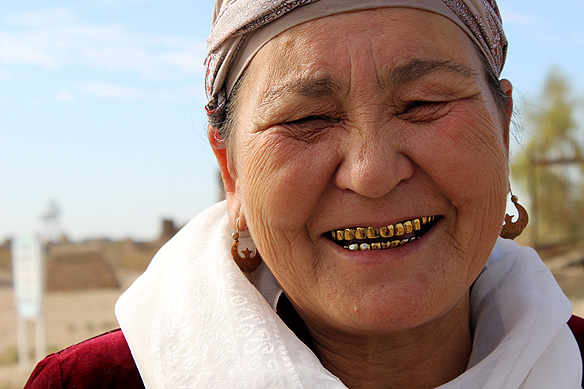
‘Ishani!’ I can feel scores of eyes bore into me. There is the blatant stare, the questioning glance, the shy surreptitious gaze. They are all invariably accompanied with the word ‘Ishani’ whispered in hushed tones. The wide-cheek-boned faces soon, thereafter, break into warm welcoming grins and I hear the magical word again, ‘Ishani’. Aah, I get it. It’s a greeting! Ishani to you too, my dear.

I have just arrived in Nukus, a remote, Russian-ised town in north-west Uzbekistan where I am to start my 11-day journey across a country I have dreamt about, bucket listed and hankered to visit since I read the poem The Golden Journey to Samarkand by James Elroy Flecker:

“We are the Pilgrims, master: we shall go
Always a little further …
White on a throne or guarded in a cave
There lives a prophet who can understand
Why men are born.”

Continue reading

iran 7: the desert city of yazd

yazdtowers1

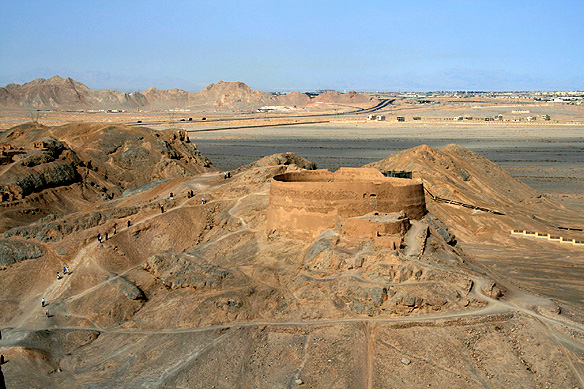
I am nearing Yazd. The landscape is stunning. Towering, barren, sedimentary mountains streaked with iron oxides flank both sides of the road. It has been a long day, driving through hundreds of miles of arid wilderness. As I wind my way through the burgeoning city, millions of street lights twinkle in the darkness in warm welcome.

– – –

Yazd is one of those not-to-be missed, no-matter-what, highlights of Iran. Wedged between two desolate deserts, it has long been a prosperous staging post on the caravan route between Esfahan and Central Asia. The city was an important center for Iran’s pre-Islamic religion, Zoroastrianism, and still has the largest Zoroastrian population in the country at 12,000. Continue reading

iran 4: the story of persepolis

“Passer-by, I am Cyrus the Great, I have given the Persians an empire and I have ruled over Asia. So do not envy me for this tomb.”
~ Inscription on the tomb of Cyrus the Great, Pasargade, 6th Century BC

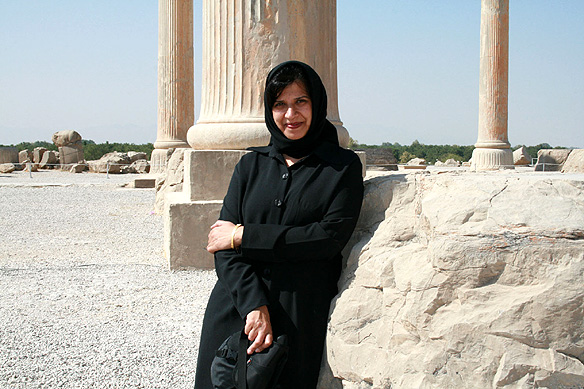
I love rambling through archaeological sites, running my fingers over millennia old ruins, walking down worn out paths where before me countless souls had also passed along. Where history was made and destinies defined. Sites like these are humbling, making us realize how small we are in the bigger picture. And yet such sites also fill us with a deep sense of pride in humanity’s political achievements and artistic endeavors which are a legacy belonging to all mankind.

persepolis_rama Continue reading

iran 3: takht-e soleyman, epicentre of zoroastrianism

kurdishvillage1

The unspoilt expanse of Western Iran is desolate. Its people simple. Barren red mountains stretch as far as the eye can see, in sharp contrast with the clear blue skies above. Decade-old cars of forgotten makes and models plough highways punctuated with police checkpoints at rapid regularity. I’m on my way to Takht-e Soleyman, the spiritual center of Zoroastrianism, and on to Takab for the night, a minuscule town less than a hundred miles from the Iraqi border. Continue reading