adobe fortresses and futuristic skyscrapers: 72 hours in riyadh

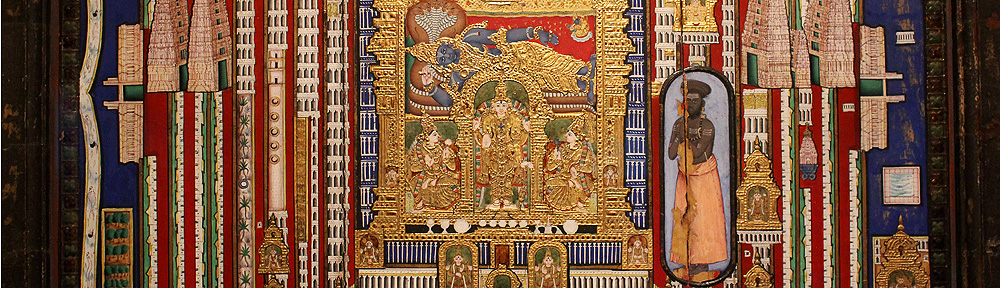
Riyadh, the Kingdom of Saudi Arabia’s capital in the middle of the Najd desert is a city of contrasts. Mud-brick fortresses from the ruling family’s yesteryears, and steel and glass skyscrapers reaching for the sky jostle next to each other in seamless ease. It is a city where the country’s past, present, and future have agreed to coexist.

If perchance you find yourself in Riyadh, here is how to make the most of 72 hours in it. Taking in the obvious, and some lesser-known gems. Continue reading

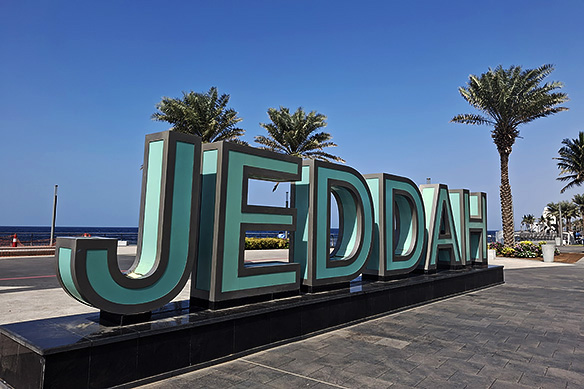
5 reasons why jeddah needs to be on your saudi arabia bucket-list

Jeddah Ghair!

If you wondering what it means, it is the city’s motto, and means “Jeddah is different.”

And it is. Cosmopolitan, liberal, capitalistic.

Most countries, over time, are seen to end up with two megapolises—the traditional, political heart and the commercial wheeling and dealing hub bursting with an eclectic art and food scene. Hanoi and Ho Chi Minh. Delhi and Mumbai. Washington and New York. Beijing and Shanghai.

In Saudi Arabia, it is Riyadh and Jeddah. But Jeddah is not just different from the country’s capital in the arid Najd desert. It is different from the whole peninsula. A difference it celebrates with a self-congratulatory pat. Continue reading

thee ain and ushaiqer: saudi arabia’s heritage villages

Looking in, Looking out. Ushaiqer heritage village in Saudi Arabia's Najd desert has been around for 1,500 years.

Looking in, Looking out. Ushaiqer heritage village in Saudi Arabia’s Najd desert has been around for 1,500 years.

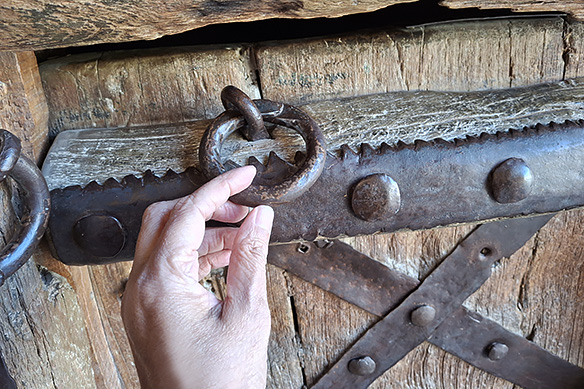
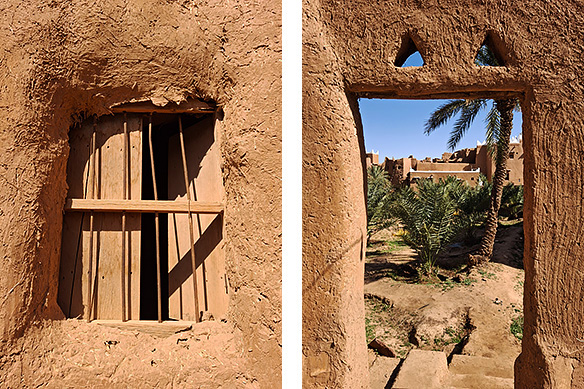
Before Saudi Arabia’s settlements transformed into steel and glass extravaganzas, they used to be made of mud-brick and rock-shards, built out of the earth they stood on. Not surprising then that very little remains of them. Over time they crumbled back into the alluvial oases or rocky outcrops on which they once stood.

Their styles were regional, with architectural features adapted to climate and available material, stamped with motifs distinctive to the local tribes. Two of the Kingdom’s most picturesque surviving villages [amongst very many] are Thee Ain and Ushaiqer. One is in the Al-Baha mountains, and another in the Najd desert. And they could not be more different from each other! Continue reading

desert x alula: art in the saudi desert

What’s this blog without some art? 🙂

Contemporary art has been a regular fixture in the Kingdom of Saudi Arabia’s cultural scene since the country drew up a vision which placed itself as a hub for global events.

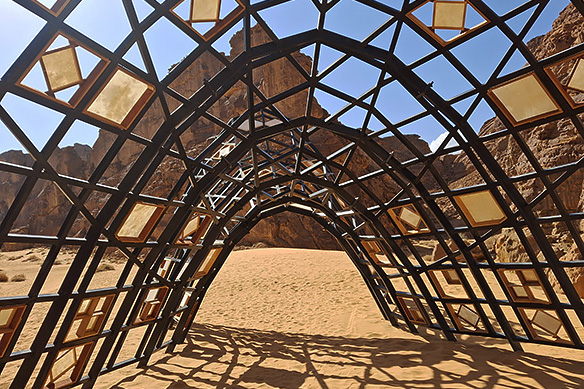
For a few weeks every Arabian winter, AlUla’s incredible landscape in the north-west of the Arabian Desert plays host to large-scale site-specific temporary installations by some of the most ground-breaking artists from across the world. This year was no different. Luckily for me, it coincided with my visit.

Currently in its 4th edition, Desert X AlUla [16 January to 28 February, 2026] was conceptualized in USA’s Coachella Valley in 2017. In 2020, the event expanded into Saudi Arabia, and has showcased over 100 artists to an audience of 2 million since its inception. The theme for 2026 was ‘Space Without Measure’ inspired by Lebanese-American poet Kahlil Gibran’s writings.

The open-air exhibition offers a completely unique way to interact and relate with the desert. After exploring its ancient and futuristic treasures, I thought I understood the shifting sands and burnt craggy canyons under the vivid blue skies. I was wrong. There was another dimension to the desert’s vastness and stillness—as the backdrop and inspiration for personal creative expression.

Here are ten artworks that were on display with a synopsis of the artist and what they wished to say. At times, rooted in the personal, and at others a commentary on global issues, and at others just an experiment to see what if? But always cajoling the spectator to reflect, deeply.

Wishing you safe and happy travels, filled with art! Continue reading

travel shorts: the world’s largest camel market in buraidah

It is 7:00 am. The sun has just broken through the Arabian horizon, wrapping the golden desert in a lilac mantle pinned by a lone morning star and a shimmering moon.

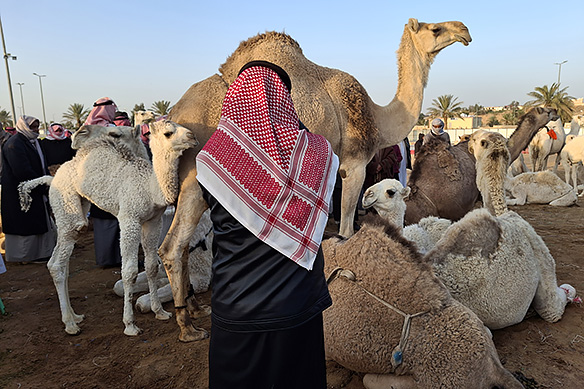
I am on the outskirts of Buraidah in north-central Saudi Arabia. Every morning, thousands of camels are traded in its camel market [the world’s largest] reaching a frenzy within an hour of the dawn prayers. A marketplace that has remained unchanged in the Kingdom for centuries—unchanged by the advent of oil, gas, or USD.

There are calves wailing for their mommies, preening hedonistic camels in the prime of their youth, and foaming giant males trying to attract a mate. In all shades of brown, black, and creamy white. Amidst them are frenetic auctioneers calling out bids whilst buyers ponder and inspect the animals’ gums and teeth. Interested, but careful not to look too interested. Continue reading

photo essay: ha’il to alula, saudi arabia’s best-kept secrets

What’s there in Saudi Arabia for the traveller? Aah, you’d be surprised.

Hidden deep inside the desert which covers 95 percent of its terrain are historical and natural wonders which are all the more extraordinary because one could not access them till recently. It is only on 27 September, 2019, that the Kingdom launched its tourist visa.

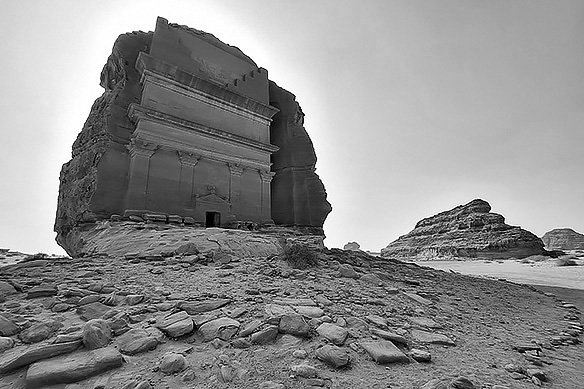
These treasures span the nation’s very essence—spread across a wide arc, both geographical and in time. From plentiful prehistoric petroglyphs in Jubbah, to impressive remnants of Saudi Arabia’s earliest civilizations from the 1st millennium BC in Dadan. From Hegra’s mystical windswept 2,000-year-old Nabataean tombs, to the medieval town of AlUla steeped in stories. Jump to more recent times, and one gets to explore Adobe forts from the Saudi States in Ha’il to the country’s vision for the future through the ‘Mirror’ aka Maraya Concert Hall nestled in the vast Arabian Desert.

Interesting? Mind-boggling is more the word. Let me take you on a photo essay from Ha’il to AlUla’s Maraya and the secrets the desert guards oh so zealously along the way. ❤️ Continue reading

global travel shot: lawrence of arabia’s home in yanbu

Image

Heard of Lawrence of Arabia? Who hasn’t. Immortalised by books and cinema, Lawrence of Arabia aka Thomas Edward Lawrence [1888 – 1935] was a Welsh British intelligence officer. He played a key role in the British-funded Arab Revolt against the Ottoman Empire during WWI. The plan was to break Ottoman hold over the Middle-East.

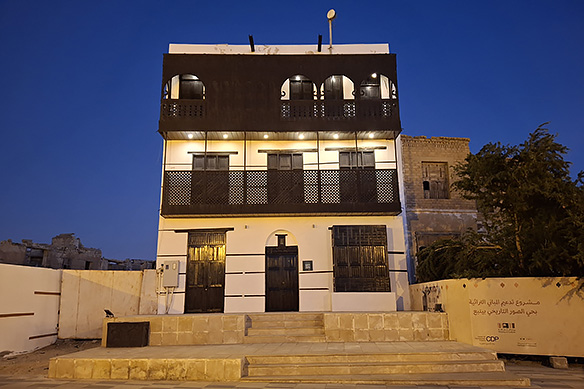
With his shemagh [headdress], thawb [robe], and fluent Arabic, Lawrence blended in well with the Arabs, living a life and in homes no different from theirs. Such as the two-storeyed coral-stone Hejazi house in Yanbu by the Red Sea in which he lived from 1916 to 1917 during his assignment.

The British eventually went back on their word in which they’d promised Saudi Arabia a large chunk of the Middle-East once it was freed from Ottoman rule. Through secret treaties with the French, the two Western nations took direct control of the countries instead. Lawrence of Arabia’s stint in Saudi Arabia became a blockbuster movie in 1962. And his abandoned home? Now carefully restored, it is Yanbu’s most famous tourist attraction. 🙂

– – –

[Note: I travelled through Saudi Arabia for 17 days in January-February this year. To read more posts in my Saudi Arabia series, click here.]

travel diaries: rama arya in medina

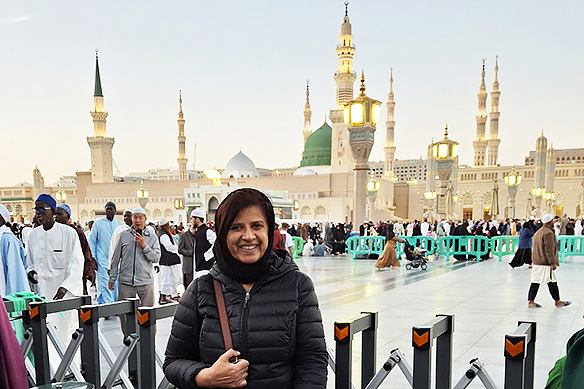
It is evening and I am watching the news, flush with images of missiles tearing through Western Asia in a war that is well into its 23rd day. Feels strange it was only a few weeks ago I was exploring the Kingdom of Saudi Arabia.

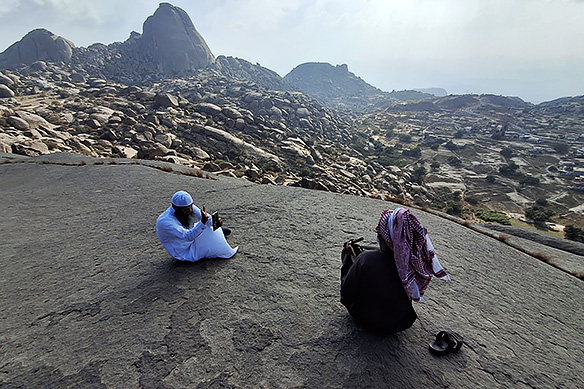
Never had I felt safer than in the futuristic cities of Riyadh and Jeddah. Or discovering the mysteries of UNESCO-listed Hegra and Jubbah. Or clambering over the butter smooth gigantic rocks of Shada Mountain and locking eyes with hundreds of camels at Buraidah, the world’s largest camel market, with a pit stop at the ancient port city of Yanbu on the Red Sea thrown in to add some blue into the desert mix.

All these were incredible parts of the Kingdom, but what’s Saudi Arabia without Mecca and Medina. And so, it was for me. Continue reading

photo essay: monasteries and manuscripts, echoes from the world’s first christian country

Before Rome. Before even Constantinople. The first one to officially adopt Christianity was Armenia. Saint Gregory the Illuminator had miraculously healed King Tiridates III who had lost his mind. In gratitude, the King declared Armenia a ‘Christian’ country. It was the year 301.

A century later, in 405, the brand-new State religion introduced a brand-new script to spread ‘God’s word.’ Mesrop Mashtots, a cleric-cum-linguist, was assigned the task of creating an alphabet that would encompass the phonetic expanse of the Armenian language, a standalone member of the Indo-European language family. Over time, the scope of this script increased to document Armenian philosophy, science, and the arts.

Monasteries, as centres of faith and learning, soon cropped up across the Kingdom in breathtaking settings. Perched over canyons, atop sheer cliffs, and in verdant valleys. In the medieval era, there were tens of thousands of these. As Armenia’s realm shrunk, these reduced to a mere few thousand with four of them now UNESCO-listed.

Known as the Armenian Apostolic Church, Armenian Christianity is based on the teachings of the two early Apostles, Thaddeus and Bartholomew. What is more remarkable is that the Armenians resolutely stuck to the original version of their faith for the next 1,700 years, amidst the whirlpool of conversions, genocide, and wars that swept through the region.

Welcome to my photo essay on the most spectacular monasteries of the lot that have survived to date—each with something that sets it apart. Sometimes it is its story, sometimes its location, and sometimes its incredible art. I have punctuated these photos with those of my favourite Armenian manuscripts in Yerevan’s Matenadaran.

Wishing you happy travels, always. ❤️ Continue reading

the 5 untold treasures of gyumri, city of 22,000 orphans

“Armenia, aah she is a prisoner of geography!” My guide Arpi exclaims as she narrates the country’s tumultuous history in a voice that any actor would envy. A professor in linguists, guiding is her second job.

We are on the way to Gyumri, Armenia’s second largest city in the country’s north-west, close to Turkey’s border. Built of local black and orange tuff [a volcanic porous rock], the city is known by various other names: cultural capital, city of arts and crafts, to name a few. But the most evocative is “city of orphans.” 22,000 orphans took refuge in Gyumri during the Armenian Genocide of 1915 – 1923, piecing together a new life in 170 orphanages across the city.

Founded as Kumayri in the 8th Century by the Urartians—the same kingdom which also established Erebuni, Yerevan’s ancestor—it has been renamed numerous times since 1837. Alexandropol on the orders of Russian Tsar Nicholas I after his wife, Leninakan in honour of Lenin, back to Kumayri on independence, and Gyumri in 1992.

A bustling industrial hub during the Soviet era [1922 – 1990], it came crashing down, literally, on 7 December, 1988 in a 6.8 magnitude earthquake. Everything turned to dust, except for Nicholas I’s Alexandropol in the Kumayri historic district. The area is a rare remnant of low-rise Armenian urban architecture in its original setting.

Tell your travel plans to an Armenian, and the first question that pops out is “Are you going to Gyumri?” Not many non-Armenians go up this far north, and if you are doing so, you will be instantly rewarded with an appreciative nod—transforming you from a flighty tourist to a traveller with gravitas.

Though its outskirts are all brand new, because of the earthquake’s devastation, the city holds its memories close to its bosom. The pain and hesitant optimism of its thousands of orphans; the filmmakers, authors, and actors who call Gyumri home; and the craftsmen who churned out masterpieces, and continue to do so, from seemingly insipid raw material.

All these and more whisper out of the black and orange tuff intrinsic to Gyumri. Here are five of Gyumri’s most magical treasures. Do not be surprised if you bookmark a few more of your own should you visit it. ❤ Continue reading