photo essay: monasteries and manuscripts, echoes from the world’s first christian country

Before Rome. Before even Constantinople. The first one to officially adopt Christianity was Armenia. Saint Gregory the Illuminator had miraculously healed King Tiridates III who had lost his mind. In gratitude, the King declared Armenia a ‘Christian’ country. It was the year 301.

A century later, in 405, the brand-new State religion introduced a brand-new script to spread ‘God’s word.’ Mesrop Mashtots, a cleric-cum-linguist, was assigned the task of creating an alphabet that would encompass the phonetic expanse of the Armenian language, a standalone member of the Indo-European language family. Over time, the scope of this script increased to document Armenian philosophy, science, and the arts.

Monasteries, as centres of faith and learning, soon cropped up across the Kingdom in breathtaking settings. Perched over canyons, atop sheer cliffs, and in verdant valleys. In the medieval era, there were tens of thousands of these. As Armenia’s realm shrunk, these reduced to a mere few thousand with four of them now UNESCO-listed.

Known as the Armenian Apostolic Church, Armenian Christianity is based on the teachings of the two early Apostles, Thaddeus and Bartholomew. What is more remarkable is that the Armenians resolutely stuck to the original version of their faith for the next 1,700 years, amidst the whirlpool of conversions, genocide, and wars that swept through the region.

Welcome to my photo essay on the most spectacular monasteries of the lot that have survived to date—each with something that sets it apart. Sometimes it is its story, sometimes its location, and sometimes its incredible art. I have punctuated these photos with those of my favourite Armenian manuscripts in Yerevan’s Matenadaran.

Wishing you happy travels, always. ❤️ Continue reading

the 5 untold treasures of gyumri, city of 22,000 orphans

“Armenia, aah she is a prisoner of geography!” My guide Arpi exclaims as she narrates the country’s tumultuous history in a voice that any actor would envy. A professor in linguists, guiding is her second job.

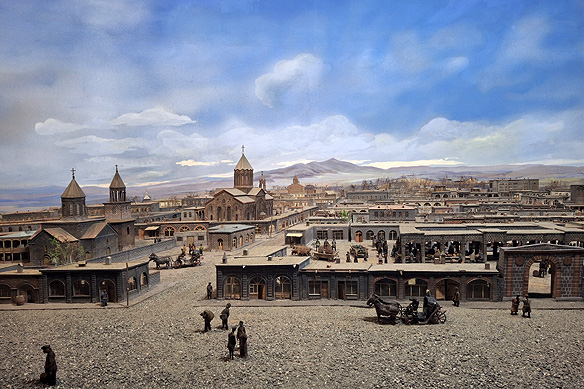
We are on the way to Gyumri, Armenia’s second largest city in the country’s north-west, close to Turkey’s border. Built of local black and orange tuff [a volcanic porous rock], the city is known by various other names: cultural capital, city of arts and crafts, to name a few. But the most evocative is “city of orphans.” 22,000 orphans took refuge in Gyumri during the Armenian Genocide of 1915 – 1923, piecing together a new life in 170 orphanages across the city.

Founded as Kumayri in the 8th Century by the Urartians—the same kingdom which also established Erebuni, Yerevan’s ancestor—it has been renamed numerous times since 1837. Alexandropol on the orders of Russian Tsar Nicholas I after his wife, Leninakan in honour of Lenin, back to Kumayri on independence, and Gyumri in 1992.

A bustling industrial hub during the Soviet era [1922 – 1990], it came crashing down, literally, on 7 December, 1988 in a 6.8 magnitude earthquake. Everything turned to dust, except for Nicholas I’s Alexandropol in the Kumayri historic district. The area is a rare remnant of low-rise Armenian urban architecture in its original setting.

Tell your travel plans to an Armenian, and the first question that pops out is “Are you going to Gyumri?” Not many non-Armenians go up this far north, and if you are doing so, you will be instantly rewarded with an appreciative nod—transforming you from a flighty tourist to a traveller with gravitas.

Though its outskirts are all brand new, because of the earthquake’s devastation, the city holds its memories close to its bosom. The pain and hesitant optimism of its thousands of orphans; the filmmakers, authors, and actors who call Gyumri home; and the craftsmen who churned out masterpieces, and continue to do so, from seemingly insipid raw material.

All these and more whisper out of the black and orange tuff intrinsic to Gyumri. Here are five of Gyumri’s most magical treasures. Do not be surprised if you bookmark a few more of your own should you visit it. ❤ Continue reading

from a 5,500-year-old shoe to genocide to fountains: 72 hours in yerevan

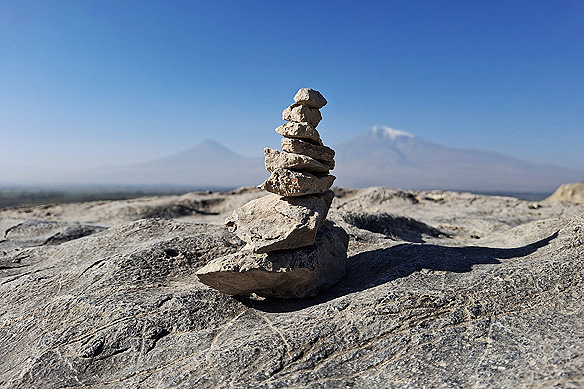
As the plane got ready to land in Yerevan, Armenia’s capital, I looked through the window and was met with a snow-capped Mt. Ararat reaching out to the skies. Armenia’s most beloved national symbol and site of the proverbial Noah’s Ark, Mt. Ararat became part of Turkey in 1921. Yet for Armenians, seeing the mountain looming over their capital city is a sign of good tidings. Just like it has been for the past two millennia.

In a strange twist of fate, the very geopolitics that gave Mt. Ararat away, also created Modern Yerevan. One of the oldest inhabited cities in the world, Yerevan’s current avatar is a product of the Soviet Union. 2,800 years ago, it used to go by the name Erebuni.

When Alexander Tamanian was assigned the task of drawing up Yerevan’s city-plan, he was first at a complete loss. He had no idea how he was going to convert the laid-back provincial town, previously under the Russian empire, into a cultural, political, and industrial centre befitting its new role as a Soviet Socialist Republic capital.

But creativity soon followed. Tamanian ingeniously combined neoclassical design, Armenian motifs, and local tuff stone in a graceful radial layout. Unfortunately, he also razed many of the earlier churches, mosques, and bazaars in the process so there is very little remaining from the pre-1920s in the city.

Off-the-beaten-path? True. Lacking in things to see and do? No ways.

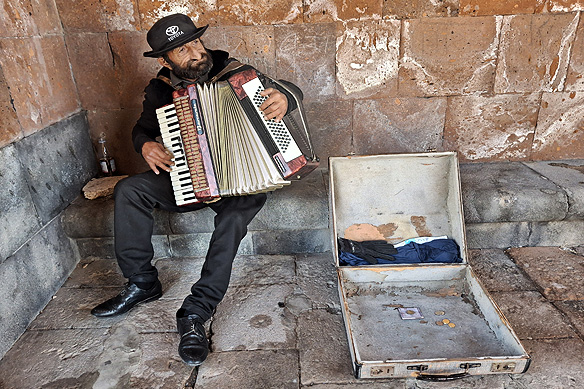
Yerevan today is filled with museums, art galleries, roadside cafes, and buskers churning out fabulous music. Come nighttime, the city transforms into a riot of curated lighting, with fountains dancing to classics.

Here is a 3-day itinerary for Yerevan, a city swarming with intrepid travellers eager to explore its heady mix of Soviet and Armenian charms.

Have you been to Yerevan? What did you like most about it? Do share in the comments. I would love to read them. 🙂 Continue reading

travel shorts: khachkars, markers of armenian christianity

There are over 50,000 khachkars in Armenia. You will see them everywhere. At ancient monasteries and modern cathedrals, along the highways encircling the Armenian Highlands, in medieval cemeteries, inside every museum whether state-of-the-art or plain old-school, and next to frigid mountain lakes.

Indigenous to Armenia, the UNESCO-listed khachkar, literally meaning ‘cross-stone,’ is, yes, a stone with a cross. 🙂 But look closely, and you will soon notice each piece is unique in its details. No two are alike. Continue reading

film in a frame: the eclectic world of sergey parajanov’s collages

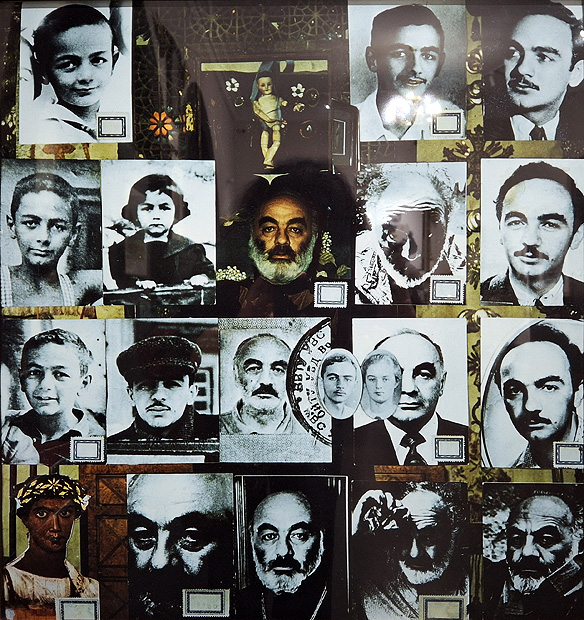
I Am 60 Years Old, 1984.

I Am 60 Years Old, 1984.

When one’s life pans out like a movie, can one’s art be far behind?

Described as a magician in the world of cinema, Sergey Parajanov’s movies stand out for their tableaux sheathed in visual poetry. There are no clearly defined narratives or dialogues in the four globally acclaimed films he made in his lifetime. Instead, in its place are near-static scenes lush with colour and symbolism which explore the stories within us rather than outside of us.

Born to Armenian parents in Tbilisi in 1924, Parajanov’s first love was a Tatar Muslim woman Nigyar Kerimova. Soon after their marriage in 1951 she was murdered by her brother for marrying a Christian and converting to Christian Orthodoxy. When 32, Parajanov fell in love with 17-year-old Ukrainian Svetlana Sherbatiuk. The marriage ended in divorce.

Unlucky in love, but lucky in life? It was not to be so with Parajanov. Fame merely brought him more misery. His refusal to conform to Soviet Union ideals and the Socialist Realism style led him to being imprisoned twice. The second time around, when released, it was on condition that he be forbidden from living in Moscow, Leningrad [St. Petersburg], Kiev or Yerevan, nor be allowed to make films. The ban lasted for 15 years.

Bereft of the freedom to create films, it was in the dark squalor and aching hunger of the gulag camps that he turned to making collages. He described his collages as ‘compressed films.’ The most poignant are his seemingly simple boxed dolls which hold lifetimes in their narratives, made from pieces of sack he would pick up whilst doing manual labour. Continue reading

global travel shot: the pagan temple that became a christian country’s favourite

Image

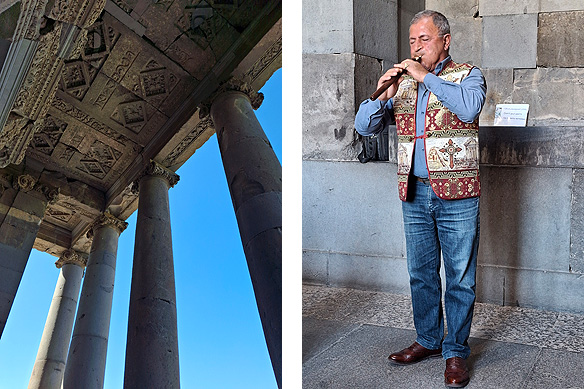
When I walked into Garni Temple’s Cella one October morning there was a 2,000-year-old UNESCO-listed duduk performance taking place inside the stone confines to the unbridled joy of a rapt audience. Once the show was over, I somehow managed to get the temple all to myself for a few long moments.

Garni Temple is the only one of its kind in all of Armenia and [now defunct] Soviet Union. The fact that it still stands—a rare pagan Greco-Roman remnant in the world’s first Christian country despite wars, religious upmanship, atheism, and even an earthquake—is a miracle.

Two thousand years old, scholars differ on its exact purpose and age. Is it a temple to the Zoroastrian sun god Mihr built in 77 AD by the Romanized Armenian King Tiridates I or a Roman tomb of the 2nd Century? Either way, its soaring 24 basalt Ionic columns reaching out to a ceiling draped in reliefs of grapes and vine leaves, perched above nine 12-inch-high steps is an evocative magnificent otherworldly sight.

Seated on the stone floor by the empty altar, it was just me and the echoes of those who had passed through the sanctuary two millennia ago. And that remote yesterday from the distant annals of time, briefly became my today.

Welcome to my Armenia series, dear Reader. ❤

the top 11 cultural highlights of tsarist, imperialist, communist moscow

No list of world cities is considered complete without the mention of Moscow. Immaterial of whether it was in the Middle Ages or now in the 21st Century. Irrespective of whether it is in times of peace. Or conflict.

Spread over seven hills like Rome, Moscow was determined from the outset to outdo Kyiv. Kyiv was the historical capital of Kievan-Rus as Russia was called till the 13th Century Mongol raid. A higher cathedral, longer city-walls, taller city-gates. Moscow had to be better, and grander than its precursor.

What started off as a wooden Kremlin [fortress] built by Prince Yuri Dolgorukiy in 1156, went on to become the citadel of the Tsars, headquarters of the USSR, and now the office and residence of the world’s largest country’s Head of State.

Moscow has remnants from everyone who ruled Russia from its crenelated walls. The Tsars gave it its grand cathedrals, Red [in Russian is another word for ‘beautiful’] Square, and a fortified stone Kremlin. They then burnt their own city to the ground in 1812 to drive Napoleon’s army out, and rebuilt it in an Empire [Baroque and Neoclassical] style. The Soviets after them gave the city its enormous streets, palatial metro system, and Stalin’s ‘Seven Sisters.’ Modern Moscow threw in the Moscow International Business Centre’s futuristic steel and glass skyscrapers into the mix.

It is a massive city in which an eclectic past and present jostle side-by-side, never far from a Christian Orthodox church or the performing and fine arts.

Here are Moscow’s top 11 cultural highlights from its very many eras. Wishing you travels which widen and deepen our intellect, hearts, and souls. Always. 🙂

Continue reading

photo essay: st. petersburg, where the pragmatic met the poetic

If there is one man who single-handedly changed Russia’s course for keeps, it would be Peter I, better known as Peter the Great. His rule spanning 43 years opened Russia to Europe. By the time he died aged 52, he had made Russia Europe.

Peter the Great came to power early. He was just 10 when he became co-Tsar of all Russia, sharing the throne with his half-brother Ivan V in 1682. Once Ivan V died in 1696, there was no stopping Peter.

A giant, both physically, and metamorphically, he set about putting his vision of a European outward-looking Russian empire, built on marine trade and naval battles, into action. His capital St. Petersburg, which he built from scratch in 1703 on the marshlands of the Neva Delta in the Baltic Sea, was to be his launchpad for these dreams.

Multi-talented, he was just as adept at building ships as he was at stitching a pair of shoes. He was also equally comfortable executing in cold blood those guilty of wilful treason, including his own son Alexei Petrovich, as of intense loyalty to his friend Alexander Menshikov, a commoner, and deep love for his second wife Catherine I, a laundress from Poland-Lithuania.

After his death, for almost a century Russia was ruled by a string of women from St. Petersburg. First his widow Catherine I, then his niece Anna Ioannovna, followed by his daughter Elizabeth I, and finally Elizabeth I’s nephew’s wife Catherine II aka Catherine the Great. This period came to be known as the Petticoat Period, with each Empress embellishing the city with splendid palaces, monuments, and bridges in the Baroque and Neoclassical styles by French and Italian architects, which one sees today.

The arts thrived here. And so did literature. In its 300-year-old history, St. Petersburg has been home to some of Russia’s greatest writers. Alexander Pushkin, the founder of modern Russian literature, Fyodor Dostoyevsky who churned out one masterpiece after the other, Nikolai Gogol who doggedly destroyed romantic illusions, Anna Akhmatova, a rare poetess in a male-dominated field, and Vladimir Nabokov, author of ‘Lolita.’

These 300 years also saw St. Petersburg have its fair share of name changes reflecting changing geo-politics. From 1914 to 1924 it went by the name Petrograd, and from 1924 to 1991 it was known as Leningrad in honour of Lenin, during which for 2 years, 4 months and 19 days [from 1941 to 1944] it was subjugated to one of the deadliest sieges in history, but never captured. After the collapse of the Soviet Union in 1991, the city reverted to its original name St. Petersburg [meaning St. Peter’s City] given by Peter the Great. St. Peter’s City, because the keys the saint held to the heavens, herein represented the keys to the West.

Here is a photo essay of St. Petersburg which started off on a pragmatic note and ended up being sheer poetry, punctuated with quotes from its writers whose favourite muse was their city. ❤ Continue reading

travel diaries: moscow to vladivostok, sleepless on the trans-siberian railway

Siberia. View from my train window.

Siberia. View from my train window.

PROLOGUE

The Trans-Siberian Railway. From Moscow to Vladivostok. 9,289 kilometres across the vast expanse of Russia, and eight time zones. The longest railway line in the world. Now, how can one resist a journey of such epic proportions!

I had first heard about the railway service laid out between 1891 and 1916 by two Tsars—Alexander III and his son Nicholas II—when I just started working. Something inside me then and there decided I had to undertake this voyage. No, not because I am a train buff. Hardly. But because then, and today, a few decades later when the dream is being realized, it is the epitome of travel.

Dear Diary, here’s my 14 days of travel on the Trans-Siberian Railway with stops at the historical cities en-route. A journey that turns out to be one of my most authentic travel experiences to date. ❤ Continue reading

karelia: when russia met finland

Surrounded by 1,650 islands, the 22 Aspen shingle domes tumbling down the Church of the Transfiguration on Lake Onega’s Kizhi Island seems straight out of a fairytale. Just when you expect a goblin to peep out from behind a carved gable, the church bells on the nearby bell tower break into a peal of lilting musical notes. Inside the church itself built of pine logs in 1714, a four-tiered wooden iconostasis with 102 icons recounts tales of prophets and feasts in colourful gilded, recently restored glory.

Together with the equally unique nine-domed Church of the Intercession built in 1764 and 19th Century Bell Tower, it forms the Kizhi Pogost, a UNESCO-listed ensemble of medieval Russia’s grandest wooden churches. They are evocative of the country’s archetypal onion-domed cathedrals, but are made completely out of wood, sans any nails except to hold the domes’ shingles in place, in keeping with local building traditions. There are other buildings on the island including the tiny 14th Century Resurrection of Lazarus Church, and numerous houses, barns, and windmills.

Kizhi Island is the centrepiece of the Republic of Karelia, a region which has found itself amidst a tug-of-war between neighbouring Finland and Russia through much of its history. This has resulted in a heady mix of Russian Orthodoxy laced with rituals and superstitions rooted in Finnish folklore which stubbornly live on.

Though Peter the Great [r. 1682 – 1725] and Catherine II [r. 1762 – 1796] turned Karelia’s iron-rich fields into a ‘factory’ at Petrozavodsk to produce ammunition for their wars against the Swedes and Turkey respectively, and the Soviets made it the site for their infamous White Sea Canal gulag camp, Karelia still retains its goblin Finnish charm. Look closely, it is hiding under the eaves of those quaint wooden homes and mythical churches scattered across the verdant isles and meadows.


Church of the Intercession and Church of the Transfiguration. Continue reading