travel guide: the six untold treasures of kazakhstan’s silk road heritage

Tucked away in the remote wind-swept folds of southern Kazakhstan are the ruins of a string of medieval Silk Road cities. A thousand years ago, these crumbling remains with their grand Sufi shrines were flourishing centres of trade, attracting merchants from far and wide; their glories held in awe across the golden steppes.

Welcome to Kazakhstan’s Silk Road heritage and its evocative treasures: The lost cities of Otrar and Sauran, and the cities of Turkestan, Taraz, and Shymkent which resolutely stood their ground.

The Silk Road, parts of which are UNESCO World Heritage Sites, was a trade route that operated from 114 BC to 1450 AD. Named after the primary product traded, the route comprised of a network of trails which cut across Central Asia, connecting the Far East with the Mediterranean. During its 1,600 years of existence, Chinese silk, along with spices, porcelain, and tea from the East were exchanged for horses, honey, and wine from the West.

It was a harsh terrain. Relentless. Fortified cities sprung up throughout the 6400-kilometre-long stretch to counter the bandits and uncertainty. Inside them, the traded goods changed hands, many times over, before reaching their destinations.

These cities were not just centres of trade, but also hubs of cultural exchange. A melting pot of ideas, philosophies, language, and faith. It is through the gatherings within their walls that Buddhism travelled from India to make a permanent home for itself in the Far East and Islamic science and knowledge fed into the western Renaissance.

Come along with me as I take you on a visual tour of this less visited, medieval side of Kazakhstan. On a journey back into time. πŸ™‚

1. Mausoleum of Khoja Ahmed Yasawi, the jewel in Medieval Kazakhstan’s crown

Mausoleum of the 12th Century Sufi saint Khoja Ahmed Yasawi is Tamerlane's labour of love and the prototype for Timurid architecture.

Mausoleum of the 12th Century Sufi saint Khoja Ahmed Yasawi is Tamerlane’s labour of love and the prototype for Timurid architecture.

Continue reading

36 hours in almaty

What is the connection between apples and Almaty?

Gotcha!

The answer is: Almaty, the capital of Kazakhstan until 1997, is the birthplace of the apple. πŸ™‚

Though Kazakhstan’s largest city has grown, both figuratively and literally, beyond its apples, its name still carries this legacy with elan. ‘Alma’ means apples and ‘ata’ means father or origin.

Surrounded by the Trans-Ili Alatau Mountains in south-east Kazakhstan, the city has had its fair share of history and avatars. From a prehistoric Saka settlement to a trading centre on the Silk Road, and in more recent years from being Verny, a Russian colonial outpost to Alma-Ata, capital of Kazakh SSR [Soviet Socialist Republic] within the Soviet Union.

In its last set of avatars, Almaty served as the capital of independent Kazakhstan from 1991 to 1997 and, thereafter, has stayed as the country’s vibrant commercial and cultural hub.

Of all of Kazakhstan’s cities, Almaty feels the most European with its wide leafy boulevards edged with open-air cafes, plenty of restful green urban spaces dotted with over 120 sparkling fountains, and a happening scene supported by numerous theatres, art galleries, and concert halls.

Though most travellers use Almaty mainly as a base to explore south-east Kazakhstan’s stunning national parks, the city does warrant a gentle exploration of its charms as well. 36 hours should do the trick in the sprawling metropolis that has earned the moniker ‘Southern Capital.’ Here are those 36 hours. ❀️ Continue reading

astana aka nur-sultan, the brand new capital for an ancient heritage

An eight-month pregnant young woman grabbed my phone from my hands, spoke to the cab driver at the other end in Kazakh, stood with me till he arrived, and left only after bundling me into the gleaming white vehicle.

I will never forget her and her serene warm face. I had been struggling to communicate my pickup location across language barriers with my cab driver on a massive multi-lane street in Astana. It was dark. I was clueless. And then she came along. Out of the blue.

That is Kazakhstan for you where people are so helpful, you do not even need to ask for help.

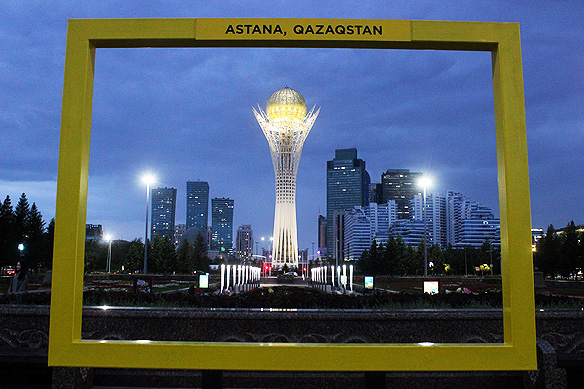
If you ever wondered what a modern city would look like, if created from scratch, where hearts such as hers are a common occurrence, then make your way to Astana, Kazakhstan’s capital since December 1997. Astana literally means β€˜Capital City.’

And if like me, you had read that Kazakhstan’s capital was Nur-Sultan, and were a bit confused what was its correct current name. It is still Astana.

For around four years, from 2019 to 2022, Astana was renamed Nur-Sultan in honour of the country’s first President Nursultan Nazarbayev [1991 – 2019].

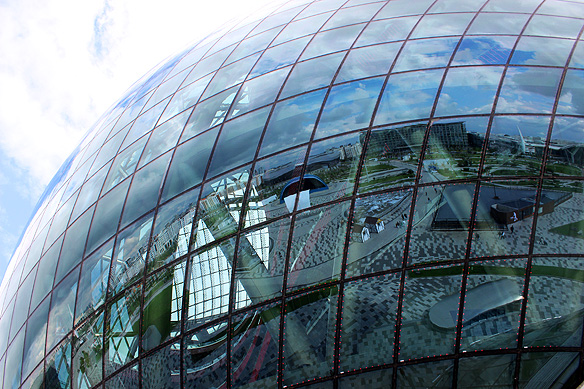
The city, located in the north-centre of the country in the middle of nowhere, has been around since 1830 when it went by the name Akmoly. It, however, really came into its own when the empty area adjoining it was transformed into a futuristic capital by Japanese architect Kisho Kurokawa in 1998. All those fantastically fabulous buildings one sees in the city-centre are government offices, including the supreme court.

Selected through a competition that was thrown open to the finest, most talented urban planners and architects in the world, his ‘new’ capital on the banks of Ishim River is meant to epitomize Kazakhstan’s vision for the future and its mythical past.

Continue reading

kazakhstan’s ‘golden man,’ stories told and untold

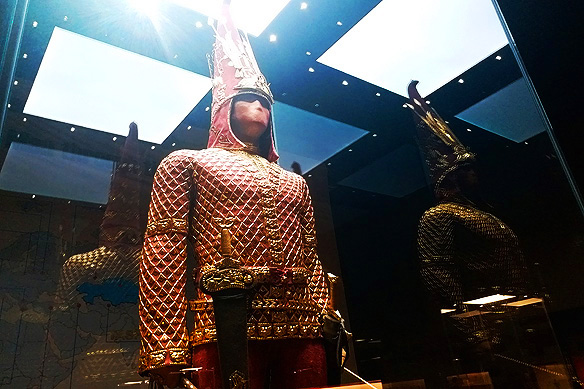
The Golden Man.

Ubiquitous with Kazakhstan, look closely and you will find him everywhere. Atop Almaty’s Independence Monument, in promotional cut-outs during events such as the recently held World Nomad Games, in state museums across the country, and both commemorative and currency coins.

He is the most celebrated son of Kazakh soil.

An 18-year-old Saka warrior prince [or princess] who lived in the 4th Century BC, his burial mound was found in April 1970. Purely by chance, as is usually the case. Inside the heap of rubble was a skeleton sheathed in over 4,000 pieces of pure gold from top to toe, holding weapons ready to go to war. The burial was the first in Central Asia, and with the largest gold hoard, to be discovered intact and not plundered. Ever.

Though the most famous, he is, however, not Kazakhstan’s only ‘Golden Man.’ Nine more have been unearthed after him, including four women, who like him were also draped in gold ornaments. Each with a unique story that is theirs alone.

Welcome to my photo essay on the Golden Man, where I share stories with you about him. Some told. Some untold. So, next time that you see him, he is no more a stranger, but almost a friend. 😊 Continue reading

kazakhstan’s natural wonders where lakes, canyons, and a dune meet

Kazakhstan, the world’s ninth largest country, is not all golden steppe land. The country boasts some of the most incredible geographical wonders as well, especially in its southern recesses.

Accessible from the country’s former capital Almaty, they consist of an eclectic array of lakes and canyons which would leave even the most jaded traveller starry-eyed. Yes, they are that beautiful. To ensure they stay beautiful, they are protected under the UNESCO national network of biosphere reserves.

Unless you have the luxury of unlimited time in the country, along with your own transport, it would not be possible to strike them all off a bucket list. Do not even try!

Those that are accessible, not because of any seamless public transport, but rather courtesy of a handful of day trips, are luckily the best of the lot.

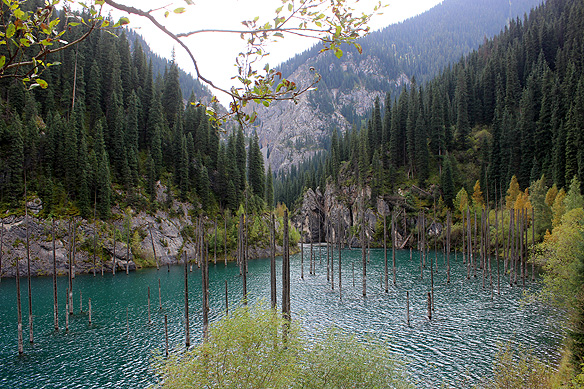
When it comes to lakes, Lake Kaindy, literally meaning both β€˜birch tree’ lake and β€˜landslide’ wins hands down. And it is not simply for its scenic beauty with bare birch tree trunks rising from deep turquoise-blue waters as a result of yes, you guessed right, a landslide. It also trumps the popularity list because of the adrenalin-filled journey needed to reach it.

This comes in the form of a hair-raising offroad adventure across rivers and boulders in Soviet-era vans accompanied with loud Russian rap, followed by a steep downhill walk to the lake’s shores. You could of course just hike the whole way or take a horse ride, but naa, that would be so tame.

Continue reading

travel shorts: kazakhstan’s bronze age gallery with 5,000 petroglyphs

In search of the Arpauzen petroglyphs in southern Kazakhstan.

In search of the Arpauzen petroglyphs in southern Kazakhstan.

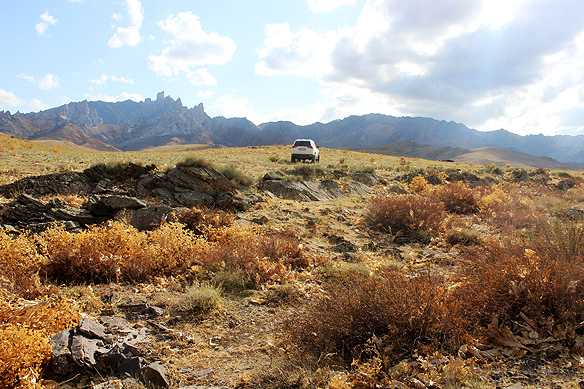
I wish I had some form of 360-degree vision and could see nature’s entire spread around me at the same go. On one side, the Prisyrdarya Karatau Mountains‘ dark craggy peaks encircled the isolated silent valley swathed in wild tulips and golden heather. On the other, colossal black chunks of rock glistening in the afternoon sun cascaded down the slopes. Pinch me, I whispered to myself. Is this really for real!

But this was all just half its magic …

“Come, look here. There are etchings of two double-humped Bactrian camels and a hunter with a bow and arrow.” My guide, Islam’s excited voice broke into my reverie, and the otherwise pin drop silence punctuated with the sound of our footsteps on crackling sun-dried tangled gorse, and neighing of wild horses grazing a mere stone’s throw away. Continue reading

secrets of ussr’s polygon nuclear test site

Coast, Hope, Moscow 400, Semipalatinsk-21, Station Terminal.

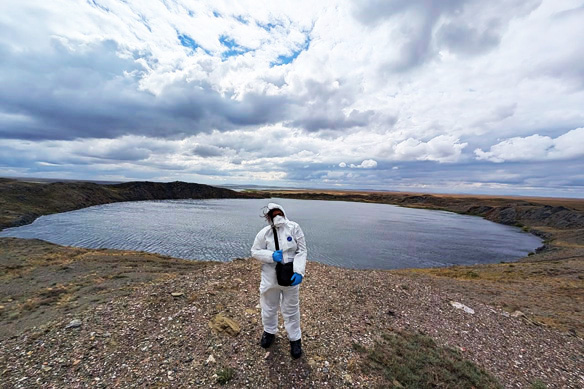
No, these are not names of multiple places. Instead, they are the multiple names of one single place, now known as Kurchatov, which for over four decades was not to be found on any public map. Located in present-day north-east Kazakhstan, the names were a trap to maintain its secret whereabouts and mislead potential spies at a time when the region was still part of the USSR.

As if this were not enough, those brought here through stringent checkpoints were routed via Moscow. The city’s residents, mainly nuclear scientists, truly believed they were still somewhere near the Soviet Union capital, even though their new homes lay 3,400 kilometres away. Continue reading