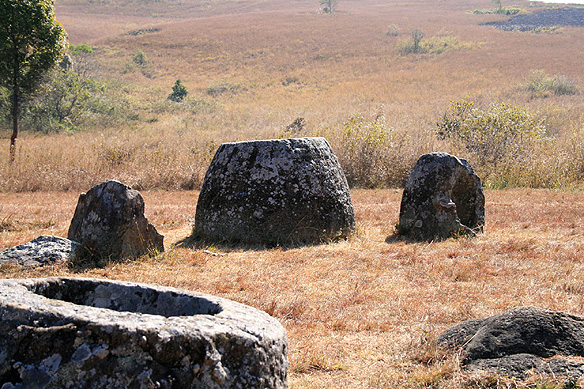
laos 4: phonsavan—dead cats, freezing nights and the plain of jars

plainofjars1

I will never forget Phonsavan. It is a strange town—in the middle of absolutely nowhere an entire congregation of ugly cement and brick buildings flung far away from wide expanses of brown, barren, dusty roads.

It took me nine long gruelling hours to reach this remote outpost, driving endlessly through convoluted winding roads hugging blue-green hills high up in the skies till I could taste my breakfast in my mouth over and over again. Moral of the ride: Never have bacon and egg bagels before driving off to nowhere!

Phonsavan is the main town of Xieng Khouang province, one of the poorest provinces of an already poor country. The town was established in the 1970s and sprawls out from a meaningless centre with no plan or direction. Public transport is limited and sporadic. It is illegal to rent your own vehicle here. None of the streets are named or at least the names are not used. There are no public phones and the weather is bitingly, freezingly, heartlessly cold. Phonsavan is neither friendly nor unfriendly. It just doesn’t care at all. Continue reading
laos 3: sacred chants and harmony in luang prabang

lpbuddha

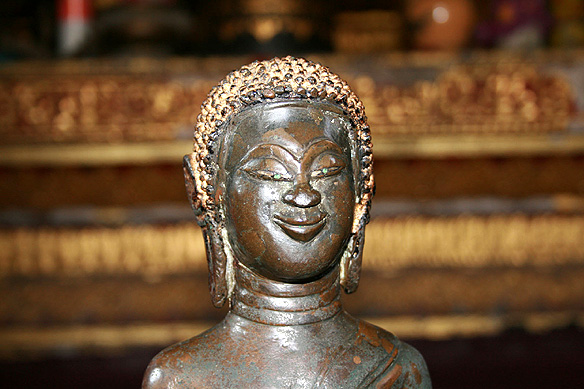
Luang Prabang resonates with sacred chants and harmony. The various layers of life in this charming, medieval, religious town blend seamlessly into each other to create a complete whole. From the saffron robed monks going about their daily tasks to the local Lao whose lives revolve around the wats; from the night market which sells indigenous handicrafts to the thronging tourists, to the tourists themselves, mature and sensitive to the spirit of Luang Prabang. Nothing jars here. Nothing irks. Every aspect of this palm fringed, sleepy, former royal capital by the Mekong is in peace with itself. Continue reading

laos 2: vang vieng, a backpacker’s and non-backpacker’s paradise

vangvieng1

Room with a view
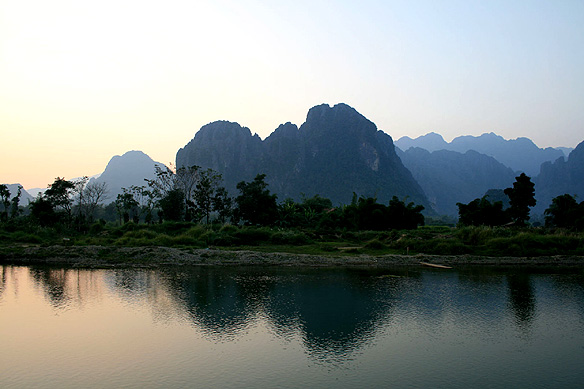
Vang Vieng’s main claim to fame is the view from my hotel room. It is beautiful. The blue green karst hills towering over the Nam Song river is like a Chinese silk painting; the mountains most dramatic and spectacular at sunrise and sunset when the mist and blackness of the night lift to reveal nature in all its pristine beauty.

Vang Vieng’s other claim to fame is as a backpacker’s paradise. There are thousands of young Americans and Europeans whiling away their days here, floating endlessly in hollow tubes down the river and downing countless bottles of beer along the way. There are so many of them that they form their own little commune, watching reruns of ‘Friends’ at the restaurants, chatting on the internet, and partying late into the night, high on cheap whisky. It is not a pretty sight—a foreign self-absorbed world totally unconnected to Laos or the Lao people. But maybe I am just old fashioned in my ideas of travel … 🙂 Continue reading

laos 1: vientiane, first-last impressions

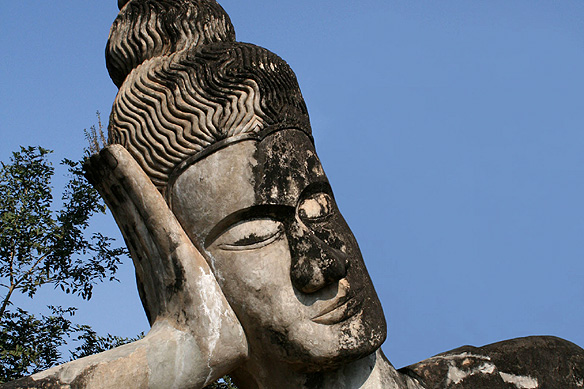
vientbuddhapark

First impressions
I have to remind myself that I have been in Laos for less than 36 hours. It feels like a very long time. Everything and everyone is welcoming and simple. No traffic, no noise, no cell phones, no crowds, no garish modernisms. The pace quieter, the days longer, the moments richer. Continue reading

to travel 1,000 miles is like reading 1,000 books: confucius

The vast mystery that is China demands attention. A journey to this land opens to visitors a geographical, historical and cultural encyclopedia that offers a breathtaking exploration of various worlds within one world.

China is the world’s third largest country, after Russia and Canada. Its most mountainous terrain rises in the west with Tibet and the mighty Himalayas. At 8,847 meters, Mount Everest is the world’s highest peak. China’s lowest point, the Turpan Depression, 154 meters below sea level, is scooped out in its vast north-west. The great mountainous highlands of west China, together with the forbidding deserts of Gobi and Taklimakan in the north acted as a huge barrier to China’s expansion. The land increasingly flattens out the farther east you travel. The vast majority [90 percent] of the population lives along China’s coast or in the fertile lands that line the Yangtze river, Yellow river, Pearl river and the Mekong river. Most of the cultivable land is irrigated by these river systems. Two-thirds of the land is too mountainous, arid or otherwise unsuitable for agriculture. China’s coastline is an affluent bundle of Special Economic Zones [SEZs] and thriving ports. Continue reading

china 11: hong kong, fragrance harbour

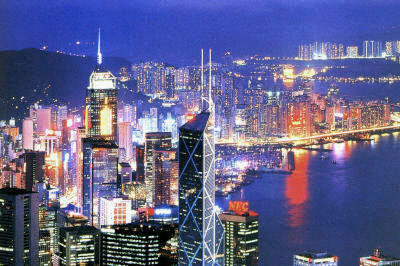
hongkong1

Hong Kong, situated at the estuary of the Pearl River Delta, was once the home of simple fishing villages. After more than a century of cultural and traditional exchange, Hong Kong is now one of the world’s greatest cities, where east truly meets west. Hong Kong meaning “Fragrance Harbour” derives its name from a practice dating back 500 years ago. Fishermen in the harbour used to burn sandalwood incense sticks at dawn and dusk; the fragrance hanging over the harbour led to its name. Continue reading

china 10: buddha is a mountain and mountain is buddha; and kunming

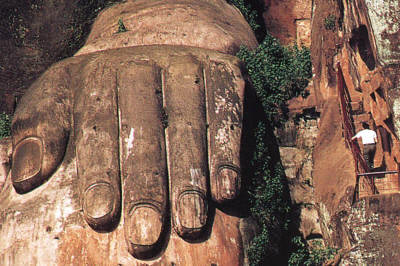
leshan1
The colossal red-stoned statue of Buddha at Leshan

I am back in China from Tibet. Back in Chengdu and on my way to Leshan straight from the airport. It is raining, wet and misty. Leshan, presiding over the confluence of two rivers which sweep past the foot of Lingyun hill, is a huge statement of faith and site of the world’s largest carved stone Buddha. Sculpted from the rock face, the effigy is a staggering 71 meters in height and is even more impressive for having been made over 1,200 years ago during the Tang dynasty. The Buddha’s head is 15 meters high; his ears come in at a lengthy 7.5 meters, and his sizeable feet can hold an audience of 100 people, while he looks down with his three meter wide eyes. Continue reading

tibet: travel and tibetan culture essentials

[As told to me by my guide Tenzin, and the monks I met in the monasteries.]

Facts and Figures

Known as the roof of the world, Tibet is surrounded by four of the world’s ten highest mountains and covers an area of 1.2 million square kilometers. It shares an approximately 3,500 kilometer international border with India, Nepal, Bhutan and Myanmar, and is encircled by China to the north and east. The 3rd largest virgin forest in the world with countless evergreen trees lies within the kingdom. The central area of Tibet, namely Lhasa, Shigatse, Gyangtse and Tsedang enjoy mild weather all year round. The maximum rainfall in Tibet is 290mm. It hardly ever snows in winters due to the dry weather. Sunshine is plentiful. Since most places are 3,600 meters and above sea level, heart pounding, shortness of breath, slight nose bleeding and headaches are normal responses caused by lack of oxygen and low air pressure. Acclimatization is recommended on day 1.

Tibetan cuisine is pretty basic, consisting mainly of Tsampa (roasted barley flour) and endless bowls of butter tea. Steamed meat dumplings called Momo and wind dried raw meat (yak, beef, or mutton) are popular. Drinks include Chang, a fortified barley beer, and butter tea which is a salty black tea mixed with yak butter. Continue reading

tibet 6: the rest of lhasa … drepung, sera, norbulingka

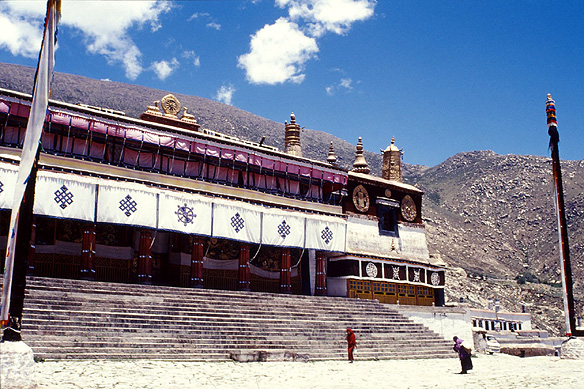
drepung1

Drepung Monastery, the ‘Rice Heap’

Drepung monastery, the largest and richest monastery in Tibet, was built in 1416 by a disciple of Tsongkhapa, founder of the Yellow Hat sect, under the patronage of a noble family, and enlarged by the 5th Dalai Lama later. Its name means ‘Rice Heap’ in Tibetan. The monastery covers an area of more than 200,000 square meters. At its peak, it had over 10,000 monks. Continue reading

tibet 5: potala palace, the home of avalokiteshwara

potala1

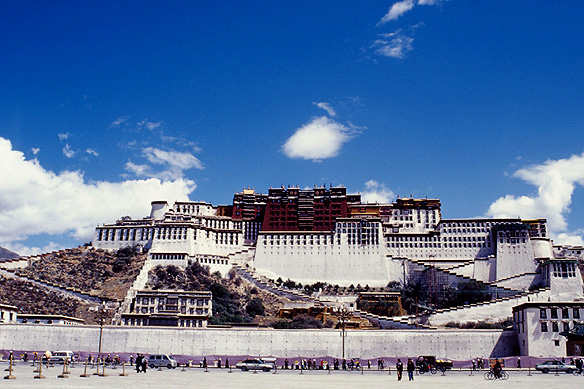
Rising above the holy city of Lhasa, the white walls and golden roofs of the Potala (BudalaGong) seem to grow out of the hill on which it stands. Now a museum, the palace is a labyrinth of rooms, interconnected with countless doors, corridors and stairways, galleries painted or draped with richly coloured silks, and filled with around 200,000 statues. The Potala served both as a monastery and government office. But above all, it was the residence of the Dalai Lamas, the god kings who ruled Tibet for more than 500 years, each one believed to be an incarnation of Avalokiteshwara, the Buddhist embodiment of compassion. The Dalai Lama is the head of the Yellow Hat sect of Tibetan Buddhism. A Mongolian phrase, Dalai Lama means ‘ocean of wisdom’. The 14th Dalai Lama was only 16 when Tibet was occupied by the Chinese in 1951, under whom he ruled in a limited capacity until 1959, after which he fled to India with 80,000 followers. Continue reading