jaffna: the unexplored north of sri lanka

Twenty-six years of civil war is a long time. A whole generation grows up exposed to the horrors of war, stripped of their right to education, health-care, and utilities. It is hard for one living in a ‘secure’ country to even fathom such dreadfulness day in and day out, year in and year out.

Sri Lanka’s LTTE-Sinhalese civil war started on 23 July, 1983 and ended on 19 May, 2009, during which an estimated 40,000 civilians died according to a UN Experts Report. Those who could leave, left the country. Root causes of the civil war were a series of anti-Tamil riots following independence in 1948 and the 1956 Government Act which recognized Sinhalese as the only official language.

Fuelled further by the government’s citizenship and education policies, it led to the creation of the LTTE or Tamil Tigers, as they were known, and their demand for a separate Tamil state ‘Tamil Eelam.’

Suicide bombers were a trademark of the Tamil insurgency. Even India, Sri Lanka’s neighbour, could not be immune to it. India’s ex-Prime Minister Rajiv Gandhi was assassinated in 1991 by a 22-year-old female LTTE suicide bomber.

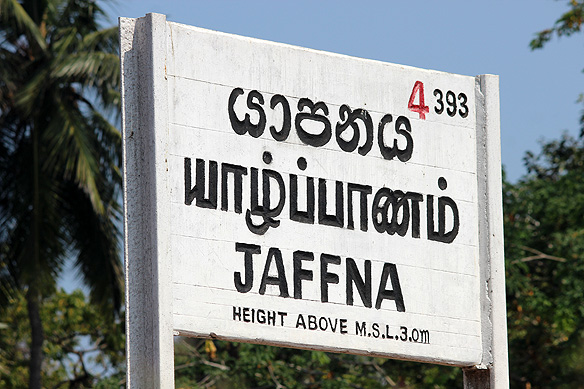
Jaffna [Yalpanam in Tamil] on the northern tip of Sri Lanka, was the epicentre of this civil war which spread across the island’s northern and eastern coastlines. Mutilated factories, bombed homes, and walls pock-marked with gunshots are still scattered throughout the city and its surrounds. An echo of its turbulent past.

Three things, by some miracle, have survived from the nearly three decades of fighting: One, the region’s places of worship—magnificent colourful Hindu temples, poignant grand churches, and sacred Buddhist sites—two, its bygone colonial ruins, and three, a bunch of remote sleepy isles on the Palk Strait in the Indian Ocean. Continue reading →
the sigiriya frescoes: king kassapa I and his 500 damsels

477 AD. Anuradhapura, Sri Lanka.

29-year-old Prince Kassapa I was filled with a deep burning desire to be king. So deep, it seemed to completely engulf him. To be the ruler of Anuradhapura, Sri Lanka’s ancient historical spiritual heart. How wondrous would that be!

And he would have been. Could have been. Except for one problem. His mother was the non-royal wife of Moriya King Dhatusena. The rightful heir to the coveted throne was his young half-brother Moggallana, offspring of his father’s chief consort.

Not to be deterred, Kassapa I, also known as Kashyapa I, decided to lead a palace coup with the help of Migara, the army commander who had a personal grudge of his own against the king. Young Moggallana, meanwhile, managed to escape, and took refuge in South India.

When Kassapa demanded to know the location of his father’s treasury, his imprisoned father responded saying Anuradhapura’s water tank was his one-and-only treasure. Miffed on hearing this, Kassapa had his father entombed alive.

For the rest of his life, Kassapa’s subjects and rivals, as well as the local Buddhist monks, would call him Pithru Ghathaka Kashyapa meaning Kashyapa the Patricide. It was a label he would not be able to shake off even after death.

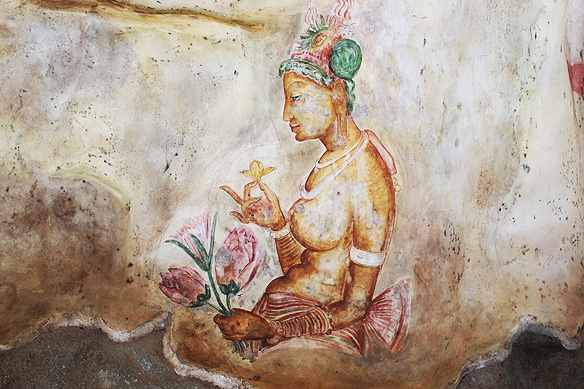
In a bid to start afresh, away from public disgrace and the threat of a possible future retaliation by Moggallana, Kassapa moved his capital 75 kilometres south. Here, deep in Sri Lanka’s tropical plains stood a 180-metre-high monolith volcanic rock pillar with unhindered 360-degree views for miles on end. Continue reading →

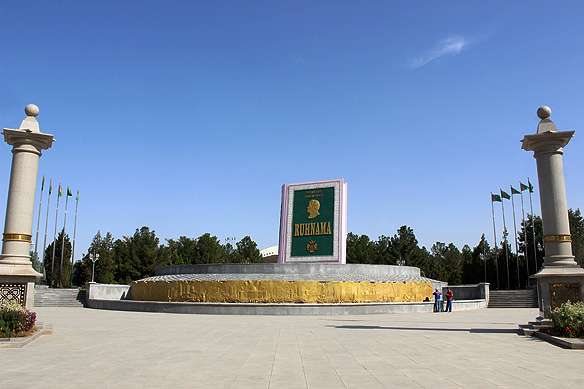
photo essay: unravelling turkmenbasy, the rukhnama, and ashgabat


To know Ashgabat, Turkmenistan’s capital, is to know the country’s first President and dictator Saparmurat Niyazov. And to know the Rukhnama, his autobiography and ‘words of wisdom’ for his people, is to know both. 🙂

Here is a photo essay of the three, with excerpts from the Rukhnama [the first and second volumes]. For no other three—a man, his book, and a city—are more closely intertwined than Turkmenbasy [Niyazov], the Rukhnama, and Ashgabat.

“When you read Rukhnama, you shall be purified, justified; your life and existence shall have a justification; your objectives and intentions shall be fulfilled. Your existence among the Turkmen shall be accepted!”

Continue reading →

11 memorable experiences only to be had in turkmenistan

Tourist number: 1933.

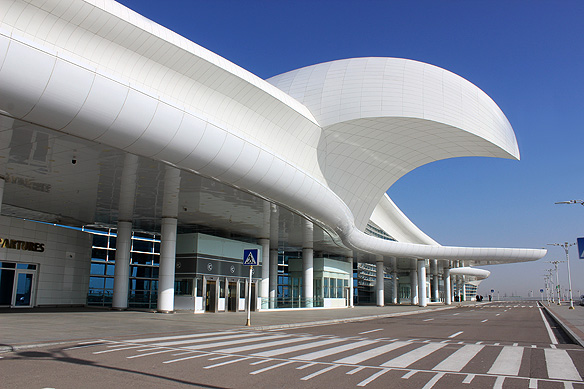
It is the early hours in the morning of 1 October, and I am at the gleaming falcon-shaped marble-encased airport in Ashgabat, capital of Turkmenistan. I ask the official at the visa counter what does this line on my entry stamp mean. He explains that 1,932 tourist visas had been issued in 2023 before mine. I am 1,933rd. This does not include the 3-to-7-day transit visas, by-the-way.

With a silly grin plastered on my face, I tell him he has no idea how much it means to have that sticker on my passport. Many months of planning and three back-to-back flights, from Goa to Muscat to Dubai to Ashgabat, and I am finally, finally here.

I guess my enthusiasm is contagious. The otherwise poker-faced official gives a little smile and wishes me a happy stay. I respond with a beaming grin.

Outside, shifting lights on the airport’s facade recreate a falcon’s flapping wings. Continue reading →

time-travel and dinosaur plateaus in remote north-east turkmenistan

Lebap Province in north-east Turkmenistan is as remote as it gets in this least visited country. Filled with moonscapes, a dinosaur plateau scalloped with around a couple of hundred, 150-million-year-old footprints of Megalosaurians during the Jurassic Period, deep canyons, and grottoes dedicated to saints and wishes, it is untouched by tourism. No-one speaks English here either.

To put things in context, Turkmenistan does not allow tourists to travel independently through the country. Neither can one simply travel to any random part of the country that tickles one’s fancy. There are designated places one is allowed to explore, and when out of Ashgabat, one must be accompanied with a licensed local guide.

Not many people visit Turkmenistan. The average number is less than 10,000 annually excluding the 3-to-7-day transit visas. Even fewer make it to its remote north-east. One of those rare ones was me. 😀

Here is my photo diary on this part of the world. I hope it inspires you to take the road less travelled, in this case time-travel to Lebap Province!

Continue reading →

travel guide: turkmenistan’s 3 legendary unesco-listed treasures

For a history buff, Turkmenistan is what wish-lists are made of. Its historical sites comprise three of the greatest world cities of the past which served as the capitals of some of the region’s most powerful empires in the ancient and medieval world, namely, the Great Seljuks, Khwarezmshahs, and Parthians.

All three of these cities are UNESCO World Heritage Sites today: Merv in the south-east, Konye Urgench in the north, and Old Nisa near the capital Ashgabat.

Welcome to my travel guide on these legendary metropolises’ fantastic histories and breathtaking monuments. Places very few visit, in one of our world’s Least Visited Countries. ❤

MERV: ‘QUEEN OF THE WORLD’ AND CAPITAL OF THE GREAT SELJUKS

Coronation of Seljuk Sultan Ahmad Sanjar [r. 1118 – 1157]; Jami' al-Tawarikh by Rashid al-Din, Tabriz, Persia, 1307 AD.

Coronation of Seljuk Sultan Ahmad Sanjar [r. 1118 – 1157]; Jami’ al-Tawarikh by Rashid al-Din, Tabriz, Persia, 1307 AD.

Often described as ‘the wandering city,’ Merv is Turkmenistan’s grandest UNESCO World Heritage Site, both in scale and age: 1,236 hectares [including the buffer zone] and 4,500 years. Listed in 1999, it is also the oldest and best-preserved oasis city along the Silk Road in Central Asia. Continue reading →

travel shorts: kyrk giz grotto, if ribbons and mud could stick

This slideshow requires JavaScript.

Take a long piece of cloth or ribbon, add a blob of mud to it, and hurl it high onto the ceiling of the grotto. If it sticks, your wishes will come true. If the ribbon falls flat on the ground, well you can either give up, or try again. 🙂

It is a ritual which people from across Turkmenistan carry out at the 50-metre-high grotto in Lebap Province, in remote north-east Turkmenistan. Starting a new job, getting married, or want a baby—it would not be amiss to make a pilgrimage here first. Continue reading →

at turkmenistan’s darvaza: the gates of hell

Wouldn’t you agree that some sites are synonymous with the country in which they are? Especially the iconic, larger-than-life epic ones. For instance, think of India, and the Taj Mahal leaps to mind. Likewise, think of South Africa, and it is Table Mountain. The list goes on.

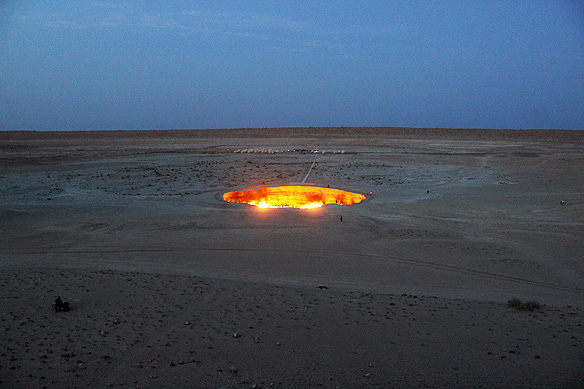
For Turkmenistan, it is Darvaza, the ‘Door to Hell’ or ‘Gates of Hell,’ a burning inferno in a massive pit, deep in the Karakum Desert.

And yes, it is an appropriate synonym. No, not the Hell part. That is the touristy moniker.

Darvaza encapsulates the country’s recent history, geography, and economy all rolled into a bizarre visual spectacle, befitting a country that is different from any other. In Turkmenistan’s official documentation, the site is called ‘Shining of Karakum.’ 😊

Two-hundred-and-sixty kilometres north of its capital Ashgabat, the 70-metre-wide, 30-metre-deep methane gas crater has been burning non-stop since 1971. Its raging flames whip into the air, becoming more menacing, yet beautiful, as the desert is engulfed in total darkness at night.

Neither a natural wonder nor of any particular historical significance, Darvaza is the result of, simply put, an oil exploration gone astray. Continue reading →

travel diaries: from bamyan to herat via the minaret of jam

Be still, dear wild dancing heart! I chide it that it’s being ridiculous. I am no novice traveller. I have travelled all my life, been to countless countries, places many have not even heard of.

“But this is the first time to the Minaret of Jam,” it whispers gleefully.

Yes, true. And I let it dance away, and smile at it fondly. If it were not for this crazy heart of mine, I would be leading a pretty dull life.

Dear reader, I am about to start a 7-day road trip across Afghanistan’s remote heartland to see its most glorious treasures, including the 12th Century Minaret of Jam. The latter, the very reason why I had travelled all the way to Afghanistan in the first place.

It will take me one-and-a-half days through nothingness to reach the minaret, and then another one-and-a-half days off-road driving to reach civilization, namely Herat.

Here’s to once-in-a-lifetime journeys! ❤ Continue reading →

persian herat and its hidden wonders

Right at the very end of the battered and bruised road, cutting across the country from east to west, is the Persian historical city of Herat. Not many travellers come this far. It is way too out, perched near Afghanistan’s western border with Iran. Yet, it has always been of great importance, as is revealed by its architectural and cultural treasures to those who take the trouble to reach it.

Herat’s been around for a long time; 6th Century BC records describe it as a Persian city which went by the name Aria. Yes, the same pronunciation as my surname. 🙂

Its strategic location on the Great Silk Road and the banks of the Hari River made it particularly appealing to conquerors and rulers. Alexander the Great defeated Herat’s Persian Achaemenids in 330 BC and put up a majestic citadel to celebrate his victory. He was followed by the Abbasid Caliphs in the 8th Century, Ghurids in 1175, the Mongol Genghis Khan who destroyed everything in 1221, the Kartids who then rebuilt it, and the Timurid Tamerlane who destroyed it once again in 1380.

When Tamerlane’s favourite son Shahrukh Mirza decided to move his capital from Samarkand to Herat, he was determined to make Herat the grandest city in the region. A vision shared by his wife Gawhar Shad and later descendent Husayn Bayqara.

The result was a city of much beauty and grace whose praise was extolled far and wide. Of its many buildings, 830 ‘cultural sites’ are still believed to survive today, warranting it a place in UNESCO’s tentative list in 2004.

It is a difficult combination. War and conservation. However, despite all the odds, both UNESCO and the Aga Khan Trust for Culture have consistently worked on Herat, ensuring its treasures, hidden from the world at large, manage to survive.

Come along with me on a virtual tour of Timurid Herat, the city on the Hari River, to see why it was called the ‘Pearl of the Khorasan’ for the longest time! Continue reading →