travel shorts: pattadakal, a marriage of sorts

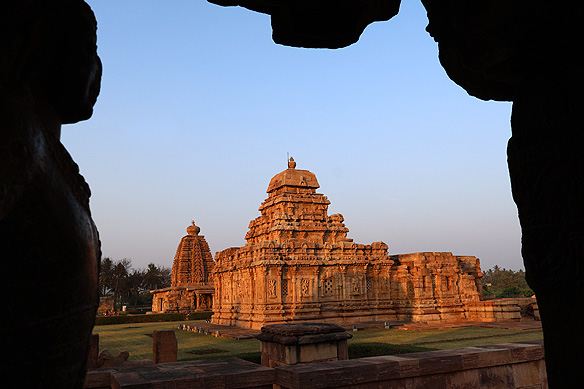
Anyone who is acquainted with the idea of India, will also be familiar with the great north-south divide. It encompasses ethnicity, language, culture and in a deeply religious nation, temple architecture. Yet, in a narrow strip atop the Deccan plateau, one gets to witness a marriage of sorts in the latter that is completely unique to the subcontinent.

Pattadakal, a UNESCO-listed 7th-8th Century World Heritage Site displays this north-south eclectic mix at its finest. The enclosed part of the site is made up of eight temples—three of which are models, one a ‘project work,’ and four designed as full-fledged functional places of worship.

The Virupaksha Temple in the last group, with its sophisticated amalgamation of north and south elements, has been in continuous use since its consecration in 740 CE. It was commissioned by Lokamahadevi, a powerful Chalukya Queen, to commemorate her husband’s victory over the Pallava kings of the South.

If you have been wondering about my terminology, it is because Pattadakal, along with Aihole, were akin to a ‘laboratory’ where architects and artisans under royal decree experimented with temple architecture.

How about a corridor through which the local populace could circumambulate the holy sanctum which was otherwise out of bounds? A Nandi to mark the temple site? Perhaps a kalash finale atop the roof symbolising the meeting of heaven and earth? This investigational process, carried out over a couple of centuries culminated in Pattadakal’s most sophisticated edifices. Where the north and south architectural styles, till then side by side in platonic comradery, also merged in a hybrid blend for a while.

Scroll on to see some more images of this site. ❤ Continue reading
india’s classical masterpiece: the ellora caves

Be prepared to be bowled over.

No matter how many incredible photographs or videos you may have seen or paragraphs of eloquent text in guide books and articles you may have read, the real thing will.still.take.your.breath.away.

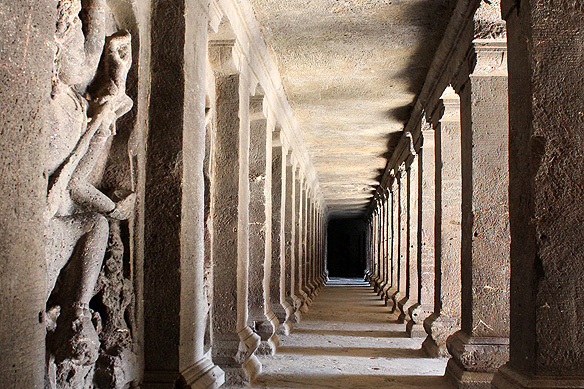
The Ellora caves are grander and more magnificent, yet full of intricate detailing, than you may ever have imagined.

Three ancient Indian religions are housed here. Three arts converge here. The site, spread over a two-kilometre long basalt massif, is one of the world’s largest rock-cut monastery-temple cave complexes with more than a hundred caves. And if that were not enough, these ‘caves’ were excavated out of living rock over a millennium ago, between 550 and 950 AD to be exact, with chisel and hammer, to create ethereal art and architecture in its wake.

Come, let me take you on a virtual tour of India’s Classical masterpiece and a UNESCO World Heritage Site since 1983. And in the process, inspire you to also make the journey to the Ellora caves in person. For what is life, but moments which take our breath away. 🙂 Continue reading

the painted and sculpted caves of ajanta

This slideshow requires JavaScript.

If you were ever of the opinion that Buddhist art was all about asceticism and restraint, think again. The caves at Ajanta, in the Indian state of Maharashtra, are a lavish statement to the contrary as I discovered earlier this month on a five-day trip exploring the region in and around Aurangabad. But then, isn’t that what travel is meant to do? Break perceptions. 🙂

Imbued with sensuality borrowed from its sibling, Hinduism, ancient Buddhist art in its parent country is filled with nudes performing graceful mudras, figures wrapped in erotic embraces, and faces marked with raw emotion. Interspersed in this human carnival are serene, silent, meditating Buddhas, perfectly at peace in their company.

The mix of spiritual with secular, ordinary with sublime are common traits in Indian aesthetics. Why then should Buddhist art have been any different! Continue reading