A thousand years of Chinese rule, followed by a thousand years of independence. Except for a misfit seventy years under the French, somewhere in-between.
Hanoi’s story is like no other.
After being a Chinese territory from 179 BC onward, it finally threw off the yoke in 1010 when the first indigenous Vietnamese dynasty [Ly Dynasty] made Hanoi its capital. Since then, multiple local dynasties stuck to the tradition, apart from the Nguyen dynasty who moved their capital to Hue. The later French occupation followed suit, and chose Saigon in the south as their base, but made Hanoi capital of French Indochina from 1902 to 1945.
By the time Hanoi took back its mantle of being a political and administrative seat in 1954, Vietnam had ousted the French and part of the country was communist. Today, Hanoi is the capital of one of only five officially communist countries in the world, balancing Marxism-Leninism socialism with a market-oriented economy.
The result of this eclectic past and present has created a culturally rich city where contradictory layers coexist. Ancient Confucian temples, Buddhist pagodas, and a sprawling royal citadel which doubled up as both a medieval fortress and a 20th Century war bunker. Colonial houses replete with wooden shutters and a towering French stone cathedral, surrounded by local eateries jostling for space on footpaths and railway tracks. A communist-styled marble memorial for an embalmed ‘Uncle Ho,’ and sombre Lenin statue in a city square. It would not be too far off the mark to say there is something for every ideology in Hanoi!
Small wonder then that there are stories galore in this Vietnamese city tucked away in the country’s north. Some repeated often. Some which only the locals know. And some, midway between the two, which intrepid curious travellers stumble upon.
Shall we begin? 🙂
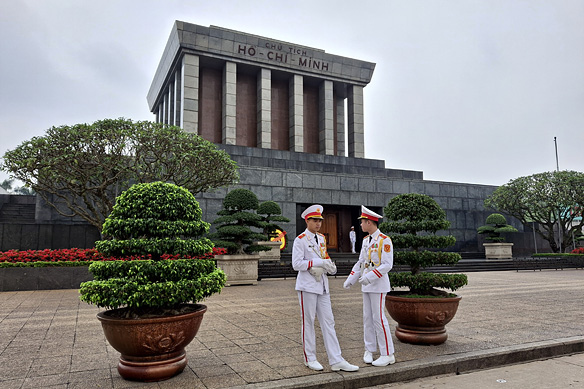
Hanoi’s most iconic landmark is the Ho Chi Minh Mausoleum where visitors silently file past the embalmed corpse of Vietnam’s beloved Uncle Ho. If it was not for him, the French may not have left or the country not united. He had wanted a simple cremation after his death. Instead, he got a gigantic marble mausoleum, like those accorded other communist stalwarts: Lenin and Mao. Continue reading

 rama toshi arya's blog