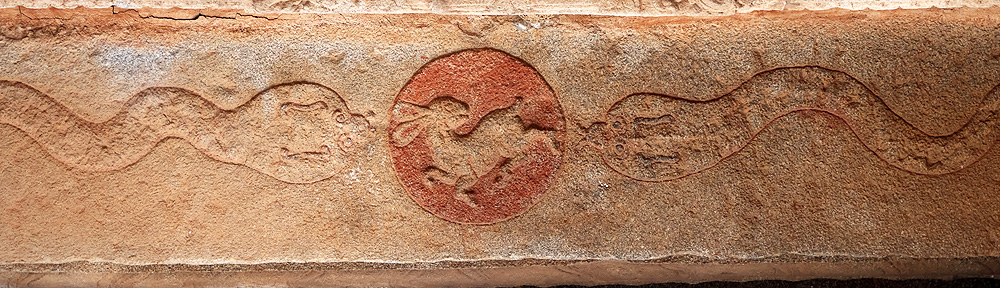
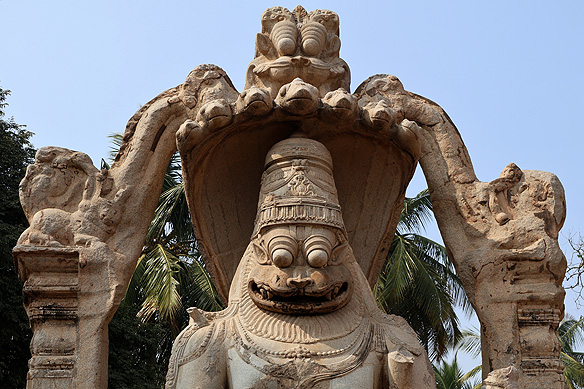
photo essay: hampi, stories told and untold

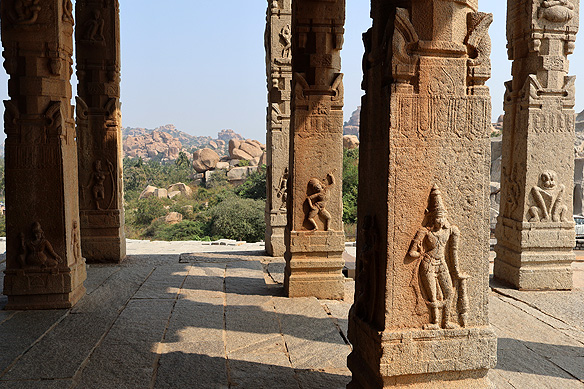
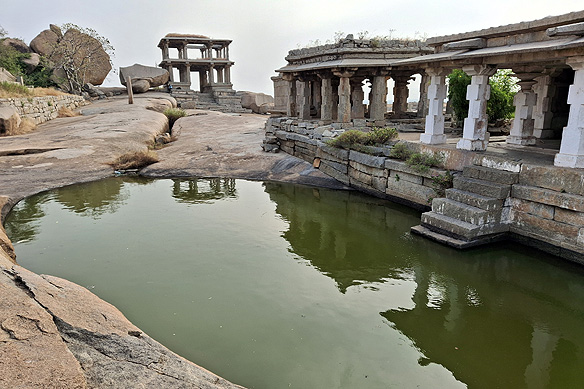
Don’t mistake the swarms of visitors at Hampi as tourists. Not all of them are. Most of them are pilgrims. For in Hampi, nestled in a surreal boulder-strewn landscape in north Karnataka, each stone is sacred.

Irrevocably tied to the Hindu epic Ramayana, Hampi traces itself back to a mystical past. Anegundi, the expanse across Hampi’s Tungabhadra river, was then known as the vanar [monkey] Kishkindha kingdom ruled by King Sugriva. In the epic, Sugriva’s commander Hanuman and army of monkeys helped Rama rescue his wife Sita from the demon Ravana.

Fast forward a few millennia from otherworldly mythology to historical facts substantiated by Kannada inscriptions and journals of Italian merchant Nicolo di Conti [1420], Persian diplomat Abdur Raazaq [1442], and Portuguese traveller Domingo Paes [1520].

Hampi, was now the capital of the wealthy, secular, and immensely powerful Hindu Vijayanagar empire. The richest city in the Indian subcontinent and the second biggest city in the world, it ruled a realm that encompassed modern-day Karnataka, Telangana, Andhra Pradesh, and Tamil Nadu.
Continue reading

aihole, cradle of indian temple architecture

Indian temple design did not arrive at in a day. Surprised? 🙂

More surprising is where its evolution took place.

The floor-plans and superstructures one takes so much for granted today took shape in a tiny village in north Karnataka over a period of two hundred years of vigorous, yet brazen experimentation.

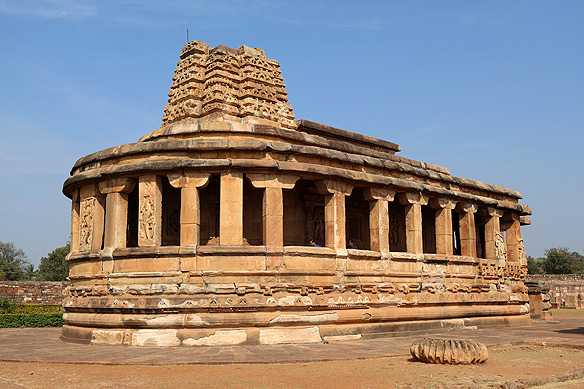
Known as the ‘cradle of Hindu temple architecture,’ Aihole, the first capital of the Early Chalukya Kingdom [6th to 8th Century] served as a laboratory for the construction of sacred sites.

From rock-cut cave temples to apsidal-shaped monumental structures to one akin to a cozy homely hut. From the ‘northern’ high curved Nagara-style and ‘southern’ pyramidal stepped Dravida-style superstructures to the hybrid ornate Vesara model typical of the Deccan. They all came into being here.

There are 15 prototypes of sandstone standalone and rock-cut cave temples in Aihole’s over 125. Each a masterpiece built by architects 1,500 years ago who designed fearlessly and were ready to break stereotypes.

It was a feat made possible by the prevailing rulers’ openness and willingness to experiment as they reigned over the Deccan, a region sandwiched between the north and south of the Indian subcontinent.

Currently on the UNESCO World Heritage Tentative List for its role in temple architecture evolution, many of Aihole’s edifices owe their names to a more recent and lax naming ceremony. Durga Temple is not dedicated to the goddess, but refers to a later Durg or watchtower built on its roof. Lad Khan temple, Aihole’s oldest temple, is so named because when discovered by the Archaeological Survey of India, it was known as where a Mr. Lad Khan once lived. A gentle reminder of Indian plurality. 🙂 And the Ravana Phadi rock-cut cave temple has less to do with Ravana and more to do with Shiva.

Next time you walk into a Hindu temple, surrounded by a familiar standardized floor-plan and superstructure, just remind yourself it is a design which won the lottery and got pushed into the future. There were many others in the original basket where these came from. And if you are curious about them, here are some of the candidates.

Continue reading

travel shorts: pattadakal, a marriage of sorts

Anyone who is acquainted with the idea of India, will also be familiar with the great north-south divide. It encompasses ethnicity, language, culture and in a deeply religious nation, temple architecture. Yet, in a narrow strip atop the Deccan plateau, one gets to witness a marriage of sorts in the latter that is completely unique to the subcontinent.

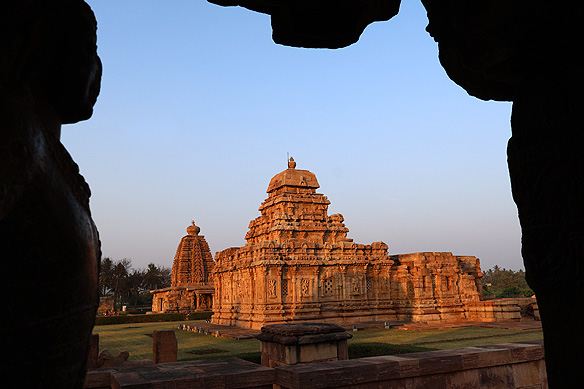
Pattadakal, a UNESCO-listed 7th-8th Century World Heritage Site displays this north-south eclectic mix at its finest. The enclosed part of the site is made up of eight temples—three of which are models, one a ‘project work,’ and four designed as full-fledged functional places of worship.

The Virupaksha Temple in the last group, with its sophisticated amalgamation of north and south elements, has been in continuous use since its consecration in 740 CE. It was commissioned by Lokamahadevi, a powerful Chalukya Queen, to commemorate her husband’s victory over the Pallava kings of the South.

If you have been wondering about my terminology, it is because Pattadakal, along with Aihole, were akin to a ‘laboratory’ where architects and artisans under royal decree experimented with temple architecture.

How about a corridor through which the local populace could circumambulate the holy sanctum which was otherwise out of bounds? A Nandi to mark the temple site? Perhaps a kalash finale atop the roof symbolising the meeting of heaven and earth? This investigational process, carried out over a couple of centuries culminated in Pattadakal’s most sophisticated edifices. Where the north and south architectural styles, till then side by side in platonic comradery, also merged in a hybrid blend for a while.

Scroll on to see some more images of this site. ❤ Continue reading

travel diaries: four caves, a lake, a seeker and badami

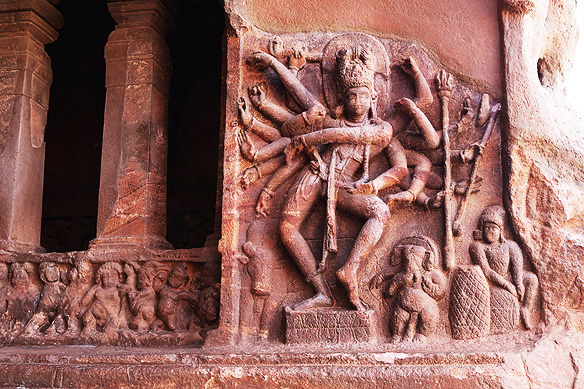
One of Badami Cave Temples' most impressive sculptures: Shiva as the 18-armed Nataraja doing the Tandava Nritya—the cosmic dance of creation, preservation, and destruction.

One of Badami Cave Temples’ most impressive sculptures: Shiva as the 18-armed Nataraja doing the Tandava Nritya—the cosmic dance of creation, preservation, and destruction.

One is never far from the gods in India. They are everywhere. Carved out of living rock. Carved into living rock. As far back as even 578 CE.

It is just after lunchtime, and I am at the foot of a gigantic red sandstone escarpment. Hundreds of school-children are racing down the steep uneven steps hewn into the cliff’s face. Their teachers shout behind them to slow down. Not that their wards pay any attention to the ominous warnings. Dressed in shiny tracksuits, they run in and out of the cavernous halls, doubled over in unstoppable giggles.

Slicing their way through this human avalanche are staid family groups. Their elderly matriarchs stomping ahead, undeterred by limps or wobbly canes.

Aaj bahut bheed hai [It is very crowded today],” I observe to the security guard at the gate. “Roz aisa hai. Season hai na aaj kal [It is like this every day. It is the season nowadays],” he smiles back happily.

In a few months these cliffs will be deserted again, first under the scorching summer sun and then because of the monsoons which would make the stone steps a veritable death trap.

Yet such ominous weathers rarely affected pilgrims in the distant past. 1,400 years ago.

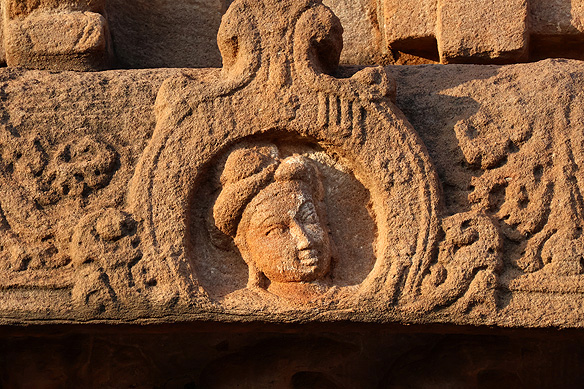
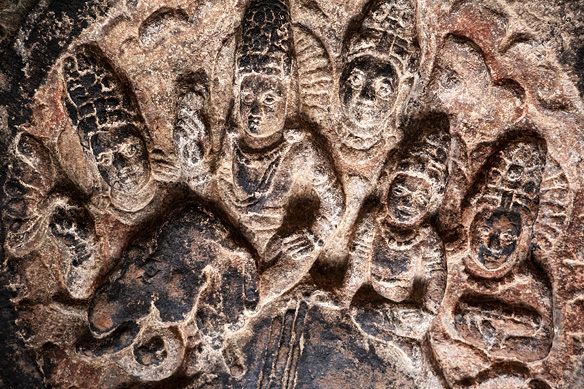
Portrait of a man in Ancient India. Ancient Hindu temples, by virtue of their depiction of both the sacred and secular, offer a fascinating insight into the then prevailing norms and societies.

Portrait of a man in Ancient India. Ancient Hindu temples, by virtue of their depiction of both the sacred and secular, offer a fascinating insight into the then prevailing norms and societies.

Continue reading

travel diaries: in search of champa, vietnam’s ancient hindu kingdom

It is still dark. The sun, groggy-eyed as it squints through the heavens punctuated by a sole star.

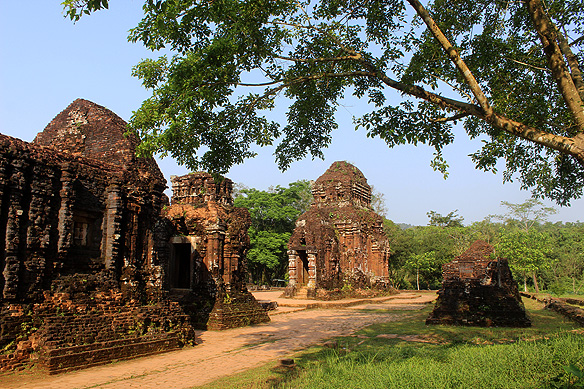
I am on my way from Hoi An to My Son Sanctuary—the temple ruins of an ancient Hindu kingdom which called this part of Vietnam home for 1,600 years. You may ask, but why so early? Because some places are best seen at sunrise. When it is just them, you, and the centuries of silence in-between. This silence then starts talking, regaling stories. Some voraciously. Some hinted at with a smile. Don’t you agree? 😊

An hour later, walking through the site’s lush green meadows, I pass scores of my country-folks. Perplexed, I am about to stop one of them and ask the reason, when a large placard explains their presence. They are archaeologists from the Archaeological Survey of India carrying out restoration work in association with the Vietnamese government. It makes sense. Who else could understand the remnants of a millennia-old Hindu kingdom better, even if it wore a different mantle on a foreign ground.


My Son Sanctuary, a UNESCO-listed World Heritage Site, is one of the most important ancient religious sites in south-east Asia. Continue reading

kullu manali and their 11 loadstones

Loadstone: Noun. A person or thing that is the focus of attention or attraction. In aplenty. In other words—Kullu and Manali.

– – –

Two of India’s most popular hill stations’ names are often taken in the same breath. Even though they are separated by some 40-odd kilometres.

Welcome to Kullu Manali. Two towns located on the verdant Kullu valley in India’s Himachal Pradesh with the ice-blue Beas river gurgling past them.

Free of a colonial overprint, or the culture and faith of an invading ruler, these two towns have in the past, as well as today, continue to epitomize Himachal history, traditions, and heritage. In all its unadulterated richness.

Gods are in abundance here, and so are centuries-old beliefs. The lines between mythology and mundane reality are blurred with characters from the epics Mahabharata and Ramayana popping up everywhere. Ancient sages, mythical heroes, demons, and the proverbial Noah [in Hinduism’s case Manu] who set forth from his ark to kick-start the lineage of mankind. They are all somehow associated with the Kullu valley which has earned itself the moniker ‘Valley of Gods.’

There’s also tall graceful fir trees, rivers fed by melting glaciers punctuated with hot water springs, and wooden homes which have housed many a generation of pahari [mountain] folks inside their weathered walls.

You will need at least a few days to get acquainted with Kullu and Manali’s sites. Hotels and taxis are easily available. Let me not go into them here. Rather let this post be a roadmap of what makes these two towns attract pilgrims and tourists in their droves, always. ❤ Continue reading

part 1: the spiti trilogy: kinnaur, the verdant side of life and himachal

Sangla valley—Sangla means 'Pass of Light' in Tibetan language. Because the gods live in the mountains.

Sangla valley—Sangla means ‘Pass of Light’ in Tibetan language. Because the gods live in the mountains.

I have always seen myself as an ocean person. I love the rhythm of crashing waves, the smell of salt in the sea air, the white foam breaking into froth around my feet, and tugging me along as it leaves.

And then I went to the Lahaul and Spiti valleys and everything changed inside of me. I became a mountain soul. Those who have been there will understand what I mean.

The Lahaul and Spiti district in India’s northern state of Himachal Pradesh is one of the most beautiful places I have travelled to. Remote and untouched, its offroad route is accessed through neighbouring Kinnaur district if coming in from the Shimla side. When exiting, it continues to Manali to form a loop. Kinnaur and Lahaul are both verdant and green. Sandwiched between them, Spiti, in stark contrast, is a high mountain barren desert perched on the soaring Himalayan range, wild and windswept.

Starting with today, I will be posting a photo diary trilogy of Kinnaur, Spiti, and Lahaul over the coming three weeks. Care to join me and let your soul fall in love with the mountains too? ❤

Note: Lahaul and Spiti used to be two separate districts and were merged into one in 1960. For the purpose of this trilogy, they are treated separately because of their geographic distinctiveness.

Continue reading

exploring sri lanka’s coastal towns: from galle to trincomalee

Indian Ocean from the Galle Fort ramparts just after sunset.

Indian Ocean from the Galle Fort ramparts just after sunset.

For a country whose length and width are merely 435 kilometres and 240 kilometres respectively, Sri Lanka, the tear-drop-shaped Buddhist island in the Indian Ocean has a remarkable variety of coastal towns.

Starting at windswept Galle with its Dutch colonial vibes in the south-west, next in line is the cosmopolitan financial capital Colombo. Then on to Negombo, the sunny Catholic fishing town in the west, to Jaffna in the north which till recently was completely out of bounds to all and sundry. And finally, Trincomalee in the north-east steeped in ancient Tamil culture against the backdrop of surf-worthy waves.

Come along and explore with me Sri Lanka’s five coastal gems, their unique heritages, and what not to miss. ❤

Table of Contents:

Continue reading

jaffna: the unexplored north of sri lanka

Twenty-six years of civil war is a long time. A whole generation grows up exposed to the horrors of war, stripped of their right to education, health-care, and utilities. It is hard for one living in a ‘secure’ country to even fathom such dreadfulness day in and day out, year in and year out.

Sri Lanka’s LTTE-Sinhalese civil war started on 23 July, 1983 and ended on 19 May, 2009, during which an estimated 40,000 civilians died according to a UN Experts Report. Those who could leave, left the country. Root causes of the civil war were a series of anti-Tamil riots following independence in 1948 and the 1956 Government Act which recognized Sinhalese as the only official language.

Fuelled further by the government’s citizenship and education policies, it led to the creation of the LTTE or Tamil Tigers, as they were known, and their demand for a separate Tamil state ‘Tamil Eelam.’

Suicide bombers were a trademark of the Tamil insurgency. Even India, Sri Lanka’s neighbour, could not be immune to it. India’s ex-Prime Minister Rajiv Gandhi was assassinated in 1991 by a 22-year-old female LTTE suicide bomber.

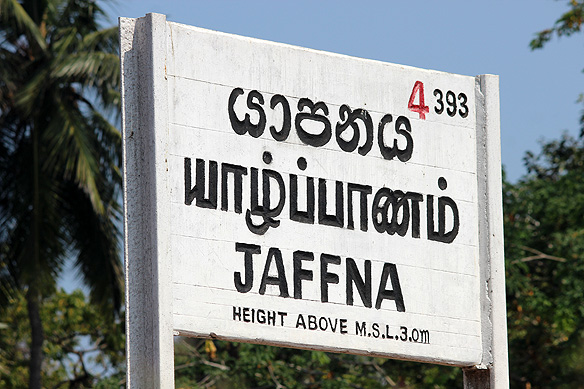
Jaffna [Yalpanam in Tamil] on the northern tip of Sri Lanka, was the epicentre of this civil war which spread across the island’s northern and eastern coastlines. Mutilated factories, bombed homes, and walls pock-marked with gunshots are still scattered throughout the city and its surrounds. An echo of its turbulent past.

Three things, by some miracle, have survived from the nearly three decades of fighting: One, the region’s places of worship—magnificent colourful Hindu temples, poignant grand churches, and sacred Buddhist sites—two, its bygone colonial ruins, and three, a bunch of remote sleepy isles on the Palk Strait in the Indian Ocean. Continue reading

pushkar: where the gods and seekers meet

Pushkar.

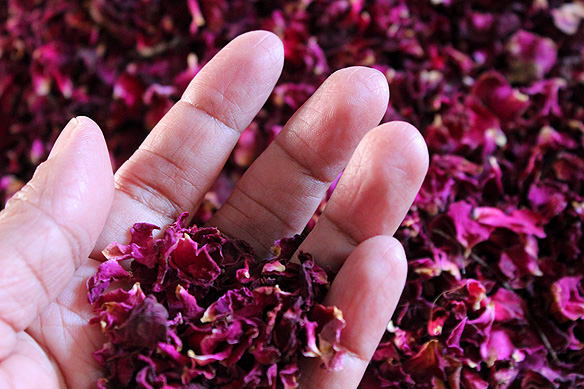
No Hindu pilgrimage is believed to be complete without a stop at Pushkar, Rajasthan’s rose garden. A polestar for the seeker within since ancient times, it is apt that the little town’s rose essences have been exported far and wide through the centuries.

Not that Pushkar’s spirituality washes over one like a massive tumultuous wave, creating an instant transformation. Nope. Nothing like that at all. It is instead subtle and gentle, with a consistent, tangible peace hanging around the 52 ghats and 500 or so temples which line its very soul—Pushkar Sarovar, Sarovar meaning ‘Lake’.

Yet, this devout peaceful haven, a mere two-and-a-half-hour drive from Jaipur, is inexorably tied to an eclectic mix of myths and traditions which range from a first wife’s wrath to being the seat of the Hindu god of creation. Continue reading