travel guide: the six untold treasures of kazakhstan’s silk road heritage

Tucked away in the remote wind-swept folds of southern Kazakhstan are the ruins of a string of medieval Silk Road cities. A thousand years ago, these crumbling remains with their grand Sufi shrines were flourishing centres of trade, attracting merchants from far and wide; their glories held in awe across the golden steppes.

Welcome to Kazakhstan’s Silk Road heritage and its evocative treasures: The lost cities of Otrar and Sauran, and the cities of Turkestan, Taraz, and Shymkent which resolutely stood their ground.

The Silk Road, parts of which are UNESCO World Heritage Sites, was a trade route that operated from 114 BC to 1450 AD. Named after the primary product traded, the route comprised of a network of trails which cut across Central Asia, connecting the Far East with the Mediterranean. During its 1,600 years of existence, Chinese silk, along with spices, porcelain, and tea from the East were exchanged for horses, honey, and wine from the West.

It was a harsh terrain. Relentless. Fortified cities sprung up throughout the 6400-kilometre-long stretch to counter the bandits and uncertainty. Inside them, the traded goods changed hands, many times over, before reaching their destinations.

These cities were not just centres of trade, but also hubs of cultural exchange. A melting pot of ideas, philosophies, language, and faith. It is through the gatherings within their walls that Buddhism travelled from India to make a permanent home for itself in the Far East and Islamic science and knowledge fed into the western Renaissance.

Come along with me as I take you on a visual tour of this less visited, medieval side of Kazakhstan. On a journey back into time. 🙂

1. Mausoleum of Khoja Ahmed Yasawi, the jewel in Medieval Kazakhstan’s crown

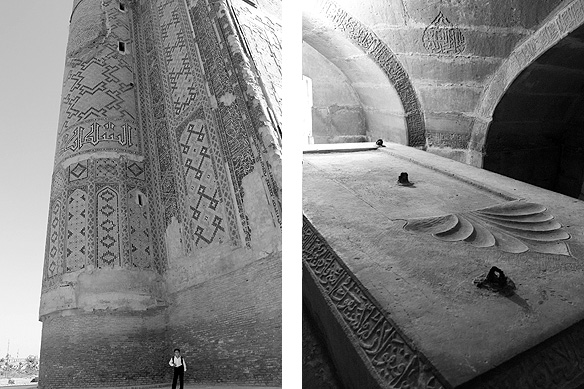
Mausoleum of the 12th Century Sufi saint Khoja Ahmed Yasawi is Tamerlane's labour of love and the prototype for Timurid architecture.

Mausoleum of the 12th Century Sufi saint Khoja Ahmed Yasawi is Tamerlane’s labour of love and the prototype for Timurid architecture.
Continue reading

#6 colossal sikandra: 7 reasons why agra should be on every travel bucket list

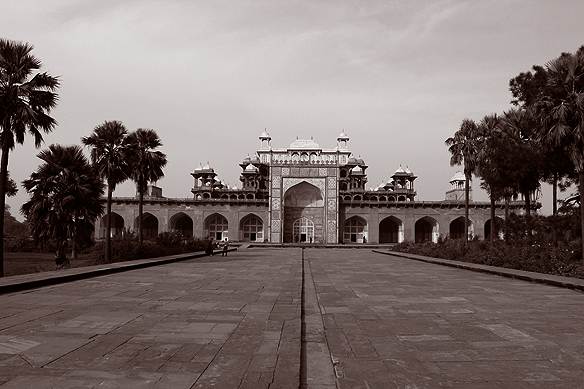
After getting all sentimental at Shah Jahan’s expression of love for his beloved, departed wife and marvelling at the artistic nuances of Nur Jahan’s token of devotion towards her doting parents, I am ready to be bowled over by Sikandra, Akbar’s tomb for his own self.

Here was a monument made by, and for, one of India’s greatest rulers—befitting his stature and achievements. I wondered what it was going to be like. Continue reading

shakhrisabz, warlord tamerlane aka temur the lame’s hometown

shakhrisabz1
shakhrisabz2

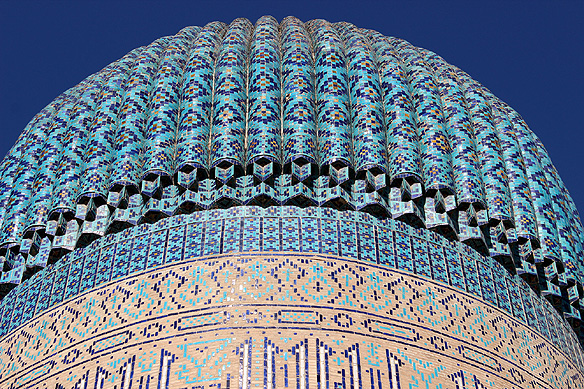
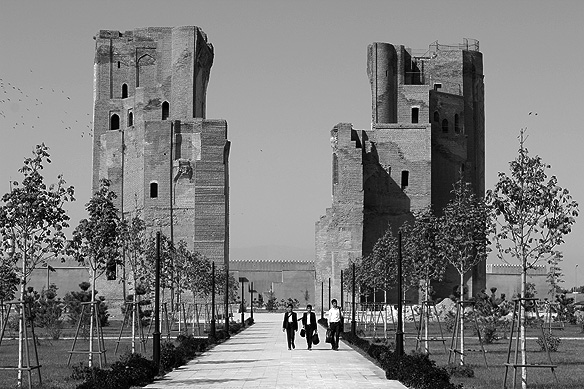
The grandeur of the Ak-Saray Palace and the simplicity of his own intended tomb—both in Shakhrisabz—perhaps best describe Amir Temur the person, better known as Tamerlane [Temur, the lame]. Complex, multi-faceted, termed history’s most callous butcher, conqueror of southern, western and central Asia, he was the founder of the Timurid dynasty, and the great-great-great-grandfather of Babur, founder of the Mughal Empire in India. He lived from 1336 – 1405 AD.

Ahmad ibn Arabshah, Temur’s Arab biographer, had to say this of him when the latter was 70 years old:

“Steadfast in mind and robust in body, brave and fearless, firm as rock. He did not care for jesting or lying; wit and trifling pleased him not; truth, even were it painful, delighted him … He loved bold and valiant soldiers, by whose aid he opened the locks of terror, tore men to pieces like lions, and overturned mountains. He was faultless in strategy, constant in fortune, firm of purpose and truthful in business.”

Continue reading

the golden journey to samarkand

uzbekistan_samarkand1

[I traveled to Uzbekistan for 11 days in September 2015. My below post first appeared as a travelogue in Hindustan Times, one of the largest newspapers in India, in both its print and online editions. The online edition can be read here. The post remains a personal favourite, and I wanted to share it with you. 🙂 ]

– – –

‘Ishani!’ I can feel scores of eyes bore into me. There is the blatant stare, the questioning glance, the shy surreptitious gaze. They are all invariably accompanied with the word ‘Ishani’ whispered in hushed tones. The wide-cheek-boned faces soon, thereafter, break into warm welcoming grins and I hear the magical word again, ‘Ishani’. Aah, I get it. It’s a greeting! Ishani to you too, my dear.

I have just arrived in Nukus, a remote, Russian-ised town in north-west Uzbekistan where I am to start my 11-day journey across a country I have dreamt about, bucket listed and hankered to visit since I read the poem The Golden Journey to Samarkand by James Elroy Flecker:

“We are the Pilgrims, master: we shall go
Always a little further …
White on a throne or guarded in a cave
There lives a prophet who can understand
Why men are born.”

Continue reading