72 hours in ho chi minh city

Aah, the buzz of Ho Chi Minh City, better known simply as HCMC, as thousands of scooters whiz past towering colourful tube-houses. Whether you are here in search of elegant Saigon or Uncle Ho’s namesake, looking for Vietnamese modern art or Soviet brutalism, fancy a street-side noodle soup or the perfect quiche in a quiet patisserie, you won’t be disappointed in this fastest growing city on Vietnam’s southern end sliced by the Saigon river.

No other south-east Asian city has quite captured the imagination of travellers the way HCMC has done. And continues to do.

Part of a unified Vietnam under the Nguyen Lords and Nguyen Dynasty, the city on the fringes of the Mekong Delta became a French colonial stronghold from 1862 to 1954. Next in line was its role as the capital of US-backed South Vietnam. After being ripped apart by decades of war, the city finally fell to communist North Vietnam on 30 April, 1975, paving the way for a re-unified nation.

On 2 July 1976, Saigon was renamed Ho Chi Minh City, as a mark of respect to the man who had dreamt of a free and reunited Vietnam, and the dream that came true.

The city has seen it all, at close quarters. Yet there is no bitterness or anger or melancholy whatsoever. No vengeance or self-pity. Instead, it seems to waltz better, with a more experienced step and twirl.

One could easily spend a week in this frenzied fast-paced populous city which never seems to sleep, and still not be bored of it. Where does one start? How about 72 hours to see the best it has to offer? And then maybe a few more days to relish it further. ❤️

[Title photo: Detail, Central South and North Spring Garden by Nguyen Gia Tri, Lacquer on Wood, 540 cm x 200 cm, 1969 – 1989, HCMC Museum of Fine Arts.]

Table of Contents:
Continue reading

travel guide: hue, capital of vietnam’s last royal dynasty

Welcome to my travel guide on royal Hue.

Often reduced to an overnight visit enroute to colourful Hoi An or sidelined completely for Vietnam’s buzzing metropolises and beach cities, Hue is where Vietnamese history and culture bask in full authentic glory.

For 143 years, from 1802 to 1945, the city on the banks of the Perfume river in the middle of the country served as the capital of the Nguyen dynasty, Vietnam’s last royal ruling family. Prior to this, Hue had been the capital of their predecessors—the Nguyen Lords, a feudal noble clan, since 1558.

The Nguyen empire marked a period of dramatic flux in the country’s history. Starting off as an isolationist Confucianism-driven kingdom of unified Viet Nam, it morphed into a military might to reckon with, on to an eclectic marriage of European and Vietnamese cultural elements, before being ousted in 1945.

Thirteen Nguyen emperors ruled from Hue’s Imperial Citadel during these years—a fortress-cum-administration centre-cum-royal residence. It is where military decisions to conquer neighbouring lands, followed by agreements to relinquish the same lands to French colonial rulers were drawn and sealed.

In and around the city, seven of Hue’s 13 emperors designed and built their grand tombs to be remembered by. These reflected not just their personalities, philosophies, and aspirations as rulers, but also the prevailing geopolitical scenarios.

Whilst the UNESCO-listed Imperial Citadel and royal tombs took care of the Nguyen emperors’ lives and afterlives, patronage of spiritual places continued unabated. An age-old royal practice, it ensured the gods were kept happy and added a touch of divinity to dynastic rule.

Yes, Hue has all this and even more!

Dear Reader, I hope you find this travel guide useful as I take you along Hue’s imperial history, connecting its rich and varied monuments to the city’s incredible story. ❤

Table of Contents:

Continue reading

travel shorts: dragons of the unesco-listed ha long bay and trang an landscape

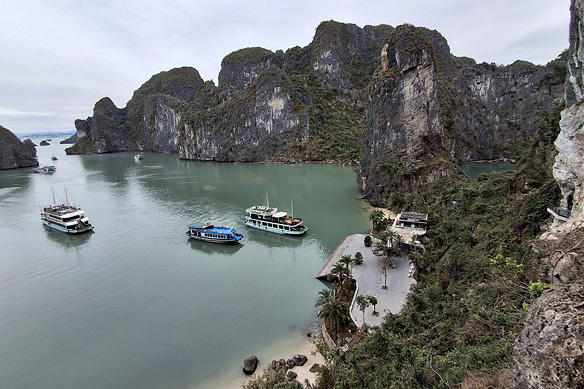
Once upon a time, thousands of years ago, Vietnam’s hamlets on its east coast were in grave danger. A fleet of foreign invaders were approaching. Defeat seemed imminent. They called upon Jade Emperor, the supreme deity in Taoism, in desperation.

In answer to their prayers, he sent the Mother Dragon to help them. She and her children plunged into the waters spewing fire, jade, and emeralds to ward off the enemies. These jewels instantly solidified into 1,133 sea mountains spread over 65,650 hectares creating an impregnable barrier on the sea. With the invaders now battered and trapped in the rocky outcrops, the Vietnamese were able to drive them away.

This mythical place came to be known as Ha Long Bay. Meaning ‘Bay of the Descending Dragon.’ It was listed as a UNESCO World Heritage Site in 1994. No, not because of the dragons, but for its unique geological formations and marine landscape.

What happened to the dragons? They decided to stay on in the mortal world and continue to guard the Vietnamese.


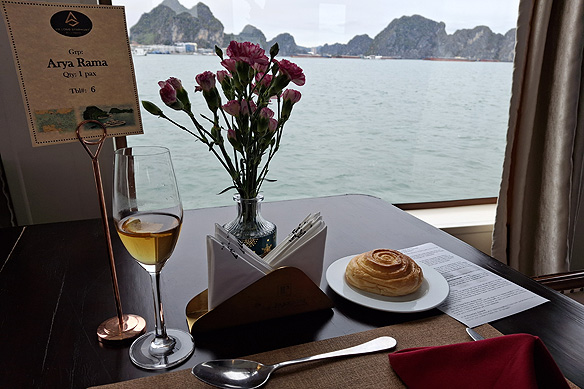
Welcome to Ha Long Bay. My table with a view. 🙂 Continue reading

global travel shot: hanoi’s train street

Image

Think Vietnam, think Hanoi and the one place that might spring to mind [courtesy all the endless social media reels and selfies] is Train Street. Been to Hanoi and not been to Train Street? Shucks, the Hanoi visit does not count then. What is of more critical import nowadays though, warranting endless threads, is the do-or-die question: Is Train Street open?

For the uninitiated, Train Street is a 0.85-kilometre-long narrow road lined with open-air cafés in Hanoi’s Old Town in which railway tracks slice through a busy neighbourhood. At regular intervals trains whistle past, forcing households, café-owners, and their guests to stow furniture away and huddle behind doors. Once the train has gone, life carries on as usual—right next to the tracks, and yes, over the tracks.

Following a series of incidents caused purely out of tourists’ own negligence, access to Train Street has been closed with frowning security guards now resolutely seated behind bulky barriers.

But remember it is a ‘Street.’ Hence, there are still parts that can be accessed. For instance, in Google Maps, instead of ‘Train Street,’ if you type in ‘Train Street Coffee,’ voila, you will be in the company of travellers who had managed to crack the code. Sipping Vietnamese coffee, seated right next to the tracks. Please, however, do follow the rules. Which translate to: duck when the train arrives; it is not selfie time. 🙂

PS. Yes, I did see the train pass. Five minutes before I took the above picture!

– – –

[Note: This blog post is part of a series from my travels to Vietnam for three weeks in March 2025. To read more posts in my Vietnam series, click here.]

photo essay: hoi an, vietnam’s unesco-listed city of lanterns

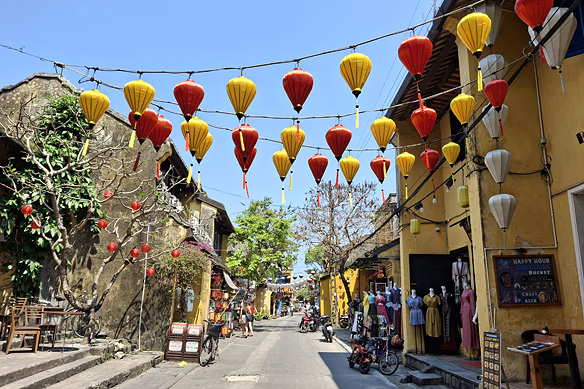
Imagine a whole town swathed in deep red and yellow silk lanterns. Across tree-lined streets and narrow alleys, on shopfronts and cutesy cafes. A centuries-old town with yellow tube houses that stretched between lanes, and a wide placid river that gently lapped against its banks.

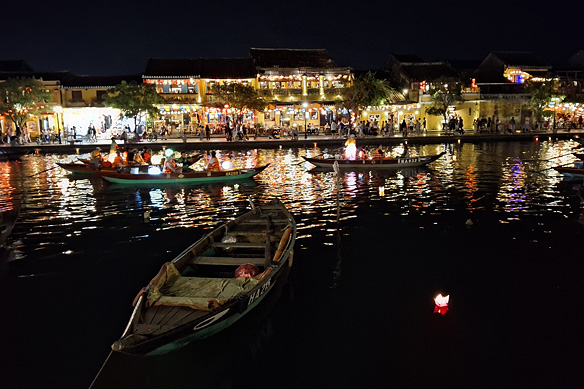
If during the day Hoi An is a fairytale, at night it is as if those very fairies had waved a wand and created magic. Don’t be surprised if you catch yourself wondering if it was all for real. After all it is the 21st Century. How did this exquisite time capsule manage to survive. Especially one that was authentic, and not contrived.

Frozen somewhere in the 17th and 18th Centuries, UNESCO-listed Hoi An’s very name recounts its story. Hoi An means the ‘peaceful meeting place.’ Four hundred years ago, this idyllic riverside town became an international trading port in southeast Asia. Merchant vessels and traders from Japan, China, Europe, and India converged on its waterfronts and streets exchanging goods and ideas. Hoi An was their ‘peaceful meeting place.’

However, when neighbouring Da Nang started to grow as a port in the 19th Century, Hoi An’s fortunes fell and the town was forgotten. No one saw any merit in pumping money into building over its yellow trading tube homes and colourful assembly halls in the name of development. It was this very neglect which turned out to be Hoi An’s blessing in disguise and the reason for its revival, thanks to help from a completely unexpected quarter—Kazimierz Kwiatkowski, a Polish architect and conservationist.

If Hoi An is on every traveller’s bucket-list today, it is because Kwiatkowski spent years towards getting it listed as a UNESCO World Heritage Site. Hoi An never forgot the favour. A memorial in his honour stands in Kazik Park in the Old Town today.

Continue reading