global travel shot: the pagan temple that became a christian country’s favourite

Image

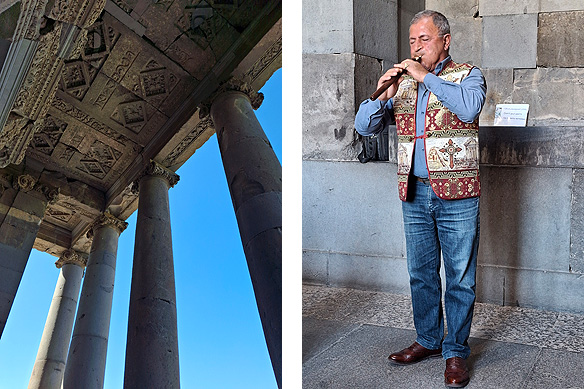
When I walked into Garni Temple’s Cella one October morning there was a 2,000-year-old UNESCO-listed duduk performance taking place inside the stone confines to the unbridled joy of a rapt audience. Once the show was over, I somehow managed to get the temple all to myself for a few long moments.

Garni Temple is the only one of its kind in all of Armenia and [now defunct] Soviet Union. The fact that it still stands—a rare pagan Greco-Roman remnant in the world’s first Christian country despite wars, religious upmanship, atheism, and even an earthquake—is a miracle.

Two thousand years old, scholars differ on its exact purpose and age. Is it a temple to the Zoroastrian sun god Mihr built in 77 AD by the Romanized Armenian King Tiridates I or a Roman tomb of the 2nd Century? Either way, its soaring 24 basalt Ionic columns reaching out to a ceiling draped in reliefs of grapes and vine leaves, perched above nine 12-inch-high steps is an evocative magnificent otherworldly sight.

Seated on the stone floor by the empty altar, it was just me and the echoes of those who had passed through the sanctuary two millennia ago. And that remote yesterday from the distant annals of time, briefly became my today.

Welcome to my Armenia series, dear Reader. ❤
global travel shot: hanoi’s train street

Image

Think Vietnam, think Hanoi and the one place that might spring to mind [courtesy all the endless social media reels and selfies] is Train Street. Been to Hanoi and not been to Train Street? Shucks, the Hanoi visit does not count then. What is of more critical import nowadays though, warranting endless threads, is the do-or-die question: Is Train Street open?

For the uninitiated, Train Street is a 0.85-kilometre-long narrow road lined with open-air cafés in Hanoi’s Old Town in which railway tracks slice through a busy neighbourhood. At regular intervals trains whistle past, forcing households, café-owners, and their guests to stow furniture away and huddle behind doors. Once the train has gone, life carries on as usual—right next to the tracks, and yes, over the tracks.

Following a series of incidents caused purely out of tourists’ own negligence, access to Train Street has been closed with frowning security guards now resolutely seated behind bulky barriers.

But remember it is a ‘Street.’ Hence, there are still parts that can be accessed. For instance, in Google Maps, instead of ‘Train Street,’ if you type in ‘Train Street Coffee,’ voila, you will be in the company of travellers who had managed to crack the code. Sipping Vietnamese coffee, seated right next to the tracks. Please, however, do follow the rules. Which translate to: duck when the train arrives; it is not selfie time. 🙂

PS. Yes, I did see the train pass. Five minutes before I took the above picture!

– – –

[Note: This blog post is part of a series from my travels to Vietnam for three weeks in March 2025. To read more posts in my Vietnam series, click here.]

global travel shot: homeboys in dubai

Image

Me: “Kahaan se hai aap?” [Where are you from?] I call out to the group of men working at the Dubai Creek. Their blue salwar kameezes had caught my eye and I was photographing them from across the road.
“Dera.”
Me: “Dera Ishmail Khan?”
“Nahin, Dera Ghazi Khan.” [No, Dera Ghazi Khan.]
Me: “Main bhi.” [Me too.]

For a while I am stunned. Dera Ghazi Khan in Punjab province, Pakistan, is where my ancestors are from. It is a medieval city, founded in 1530 by Ghazi Khan, a Balochi chieftain, and has its own dialect. From the 16th to 18th Centuries, it was part of Mughal empire’s Multan province. When British India was partitioned in 1947 as part of independence, my family came to the other side of the newly created border as refugees. I have never been able to cross the border back, even briefly, because of political differences between the two nations since then.

I had also never met anyone from my hometown outside my immediate family and Delhi’s refugee community—ever. There are not that many of us, namely, Dera Ghazi Khan Hindus. And here was a group from “back home,” laughing and chatting with me across a glistening tarmac road in Dubai. I wondered if they were distant relatives. Those eyes reminded me of my father’s.

For many years now, I have been travelling to Dubai and via Dubai. From a time it had not yet become a city of glass and steel, and life centred around the Deira instead. I have often been asked what do I like so much about the city. My answer is in the group of young men I met today. Dubai for me will always be the place where two arms of a warring family hug each other in camaraderie, away from the glare of politics back home. Here, their pasts and differences have been put to rest. 🙂

global travel shot: seeing eye-to-eye with the sri lankan leopard at wilpattu

Image

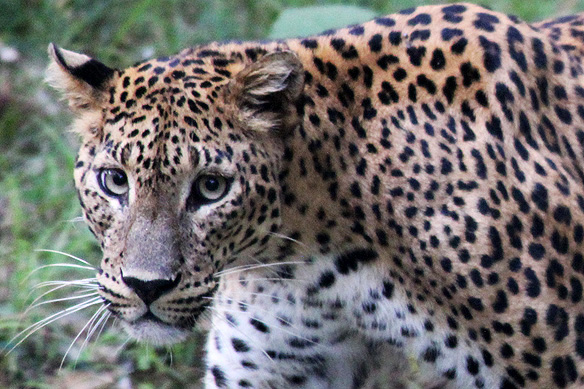
It was a bit hard for me to decide which to be more in awe of. The surreal deep red earth covered in lush jungle and sparkling pools [villu as they are locally called]. Or the Sri Lankan Leopard that sauntered past me, a mere hour into the game drive. Both, the leopard and I stared at each other. At some level, I guess, we saw eye-to-eye. He was the actual star of the show.

Wilpattu National Park on Sri Lanka’s north-west coast is not the country’s most popular game reserve. But, hands down, it provides the most authentic experience.

At 2 percent of the country’s land mass, it is Sri Lanka’s largest reserve. It is also one of the oldest—established in 1938 with around 40 Sri Lankan Leopards prowling through the heart of the national park. There are also Sri Lankan elephants, sloth bears, and a prolific bird-life, who I, however, think, fall a little short in comparison to the graceful feline. None of them stare back as piercingly as the latter.

– – –

[Note: This blog post is part of a series from my solo independent travels to Sri Lanka. To read more posts in my Sri Lanka series, click here.]

global travel shot: yangykala canyon in western turkmenistan

Image

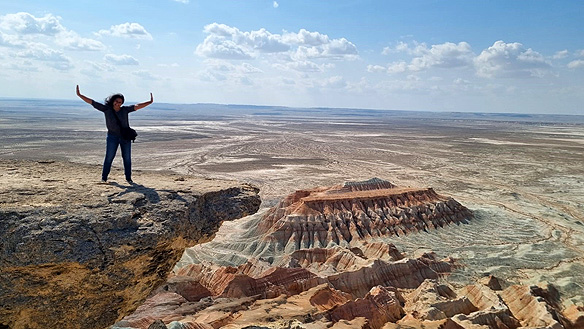
In October this year, I did two fabulous and least visited countries back-to-back: Turkmenistan and Afghanistan. Thirty days of spectacular human, cultural, and geographical terrain. For the traveller in me, it was 30 days of paradise!

The picture above is at Crocodile’s Mouth in Yangykala Canyon, Western Turkmenistan. Some millions of years ago the canyon was the prehistoric Tethys Sea’s ocean floor. Then continents collided and oceans receded, revealing miles and miles of this surreal desolate landscape in all its glory. And yes, I am standing on the edge of a crumbling limestone overhang. At times, I can be pretty brave too. 🙂

P.S. This image was taken by Dondon, a world traveller I met when visiting Turkmenistan.

travel shorts: hazrat-e mazar, afghanistan’s most sacred site

Image

This slideshow requires JavaScript.

One of Islam’s most sacred sites lies in northern Afghanistan, a mere 55 kilometres from the Uzbekistan border. It is a blue-tiled mosque which glistens like a jewel, changing colour through the day, and home to countless pristine white pigeons.

Whilst the Shi’a sect of Islam believe that Ali, Prophet Muhammad’s cousin and son-in-law, is buried in Najaf, Iraq, the Sunni sect regard Hazrat-e Mazar in Mazar-e Sharif as Ali’s actual tomb.

Both, the city Mazar-e Sharif and its spiritual centrepiece Hazrat-e Mazar, date back to the 12th Century.

There is an interesting Afghan legend as to how the tomb came to be here. Continue reading

india travel shot: jantar mantar, a slice of jaipur in delhi

Image

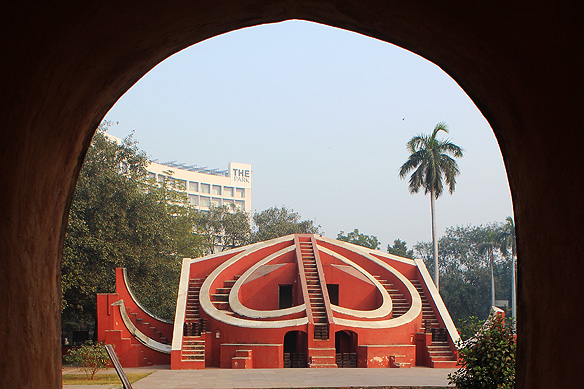
Deep in the heart of New Delhi’s central business district, Connaught Place, is a remnant of the Princely State of Jaipur. Surprised?

Known earlier as Jaisinghpura Village, this patch of land formed part of Jaipur’s territories from the 16th Century right up to the year 1911. When Maharaja Sawai Jai Singh II built a monumental observatory to measure time in Delhi, on the invitation of the Mughal Emperor in 1724, he was technically building it on his own land.

He named his futuristic structures to measure the movement of the heavens Jantar Mantar, meaning instruments and formulae. So chaffed was he by his invention, he repeated it in his own capital, Jaipur, and three other cities in the following years.

Fast forward to 1911: Sir Edwin Lutyens decides this area is to be the site for the new Imperial capital, New Delhi. But it is already occupied. So, the British government buys it off from Jaipur, relocates all the villagers [to nearby Karol Bagh], and razes their homes to the ground. Except for the monuments and places of worship that stand on it.

Hence, surrounded by high-rises is a fenced area of green with a medieval observatory, along with Hindu [Hanuman Mandir and Bhairav Mandir], a couple of Jain temples, and a Sikh temple [Bangla Sahib Gurudwara], all dating back to Jai Singh’s reign.

These have become so much a part of Delhi’s heritage, the fact that they are actually remnants of the Princely State of Jaipur are all but forgotten. 🙂

– – –

Note: Yash Gupta, a conservation architect at Intach, leads a fabulous 2-part walk through Jaisinghpura based on his research of the area.

india travel shot: shimla’s toy train

Image

Imagine—a cross between a train and a car, a rail motor car as it is called, hurtling over towering Roman arched bridges and through tunnels dug deep into dense rocky hills, past pristine forests and verdant valleys. 103 tunnels and 969 bridges to be exact, of which the world’s highest multi-arch gallery bridge is one. Every now and then it stops at quaint railway stations in little villages. Care for a bite?

The fantastical contraption in the image above, straight out of the pages of British Raj in India, is part of the UNESCO World Heritage Site ‘Mountain Railways of India’ since 2008. No trip to Shimla could be deemed to be complete without the inclusion of a journey in it in the itinerary. Not 120 years ago. And not now. Continue reading

global art shot: kampani kalam, when east met west

Image

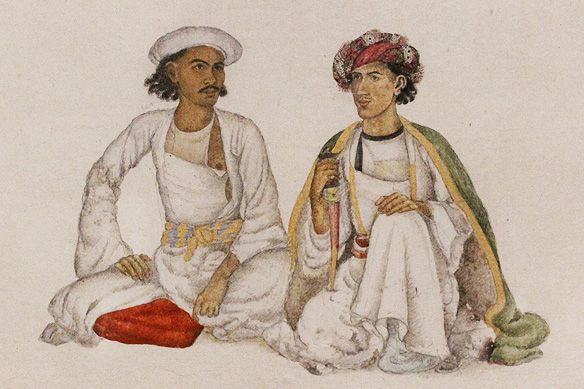
Two friends seated in discussion. Way back in the year 1810-12 in Delhi. Two very real, very ordinary people. Just like you and me. And if it weren’t for an art form that went by the name Kampani Kalam in the local Indian lingua franca, or Company Paintings in English, these two gentlemen would have been forgotten in the pages of time.

But they survived. The two, not meeting my eye, but seemingly fully aware of being the focus of my attention last Sunday, were part of a special exhibition at Delhi’s National Museum. Some two hundred other paintings hung around me, but this hung in the spectrum of time. Their true-to-life faces, their elaborate local costumes, even the hair on their arms and chest.

Through them, I could travel back 210 years. In a flash. Continue reading

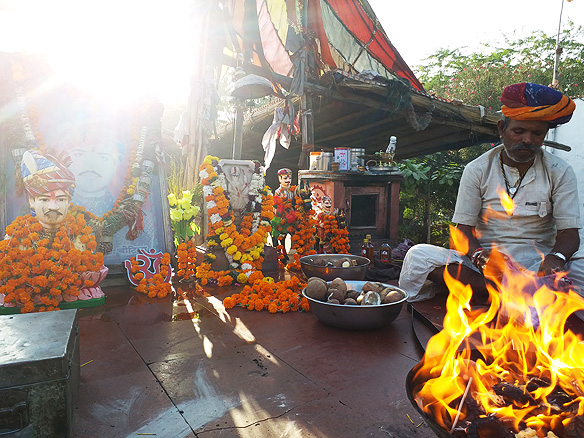
india travel shot: a temple for a rajput biker and his enfield

Image

Last year, during the months of October-November, I travelled across Rajasthan by road with different cabs for each leg of my 35-day journey. I soon started to notice one constant element across the taxis’ dashboards. They had a framed photo of a young turbaned gentleman, either perched on it or hanging from the rear-view mirror. My first thought was: he must be a relative of the driver. But when the photograph kept cropping up in almost every cab, I was confused. All the drivers could not exactly be related to the same man.

So, I asked, though I really did not want to sound nosy or offend anyone.

What emerged was a story which, I mused, could only happen in India! But before I share the story, I was also told there was a special site associated with the turbaned gentleman and it was on the highway connecting Jodhpur with Udaipur. When I asked rather hesitantly if one could stop at it, my then driver laughed. “Whether you like it or not, your driver will stop there.” Continue reading