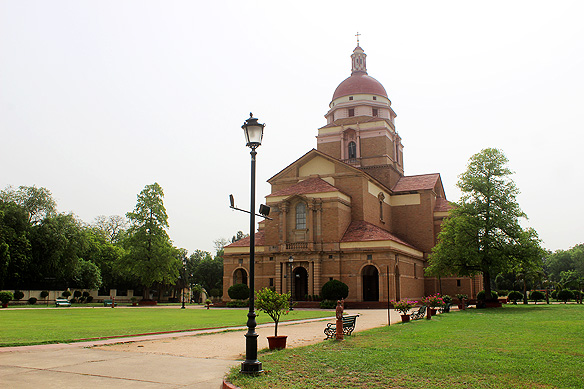
new delhi’s most beautiful church: cathedral church of the redemption

On a quiet tree-lined lane aptly called Church Lane, a stone’s throw from Rashtrapati Bhawan the president’s estate, is New Delhi’s most beautiful church.

Most people in the city, and to the city, are clueless about its existence. Much like I was, and would have been, if it wasn’t for a chance conversation on one of the heritage walks I have been taking since I came to Delhi.

Delhi’s Sultanate and Mughal-era chapters, with their magnificent monuments and dramatic stories, tend to be all-consuming. Yet, the years the British Crown used the city as the capital of their ‘Jewel in the Crown’, from 1931 to 1947, churned out edifices just as spectacular. [Prior to Delhi, Calcutta had been their capital.]

Take for instance Herbert Baker’s North and South Block Secretariat Buildings, Edwin Lutyens’ Viceroy’s House now the Rashtrapati Bhawan, their joint endeavour the Parliament House, and Henry Alexander Medd’s splendid stone church for the Englishman in Delhi—the Cathedral Church of the Redemption. Continue reading

india travel shot: a temple for a rajput biker and his enfield

Image

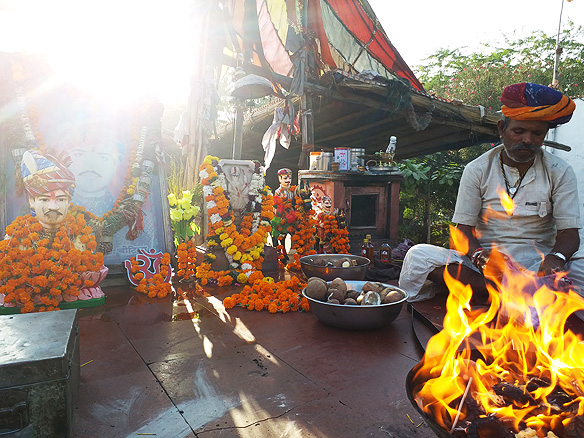
Last year, during the months of October-November, I travelled across Rajasthan by road with different cabs for each leg of my 35-day journey. I soon started to notice one constant element across the taxis’ dashboards. They had a framed photo of a young turbaned gentleman, either perched on it or hanging from the rear-view mirror. My first thought was: he must be a relative of the driver. But when the photograph kept cropping up in almost every cab, I was confused. All the drivers could not exactly be related to the same man.

So, I asked, though I really did not want to sound nosy or offend anyone.

What emerged was a story which, I mused, could only happen in India! But before I share the story, I was also told there was a special site associated with the turbaned gentleman and it was on the highway connecting Jodhpur with Udaipur. When I asked rather hesitantly if one could stop at it, my then driver laughed. “Whether you like it or not, your driver will stop there.” Continue reading

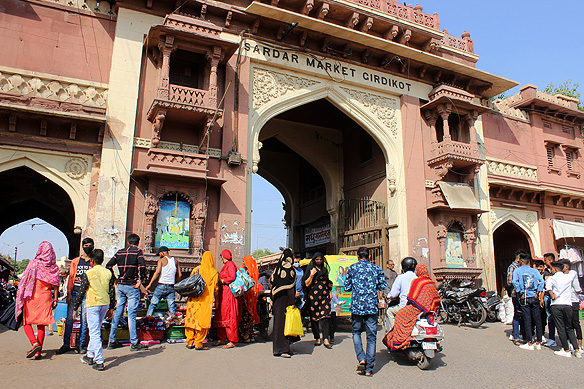
36 hours in jodhpur, capital of the kingdom of marwar

“The work of angels, fairies and giants … built by Titans and coloured by the morning sun … He who walks through it loses sense of being among buildings. It is as though he walked through mountain gorges.”
~ Rudyard Kipling, English author, 1900

Kipling was referring to Mehrangarh Fort in the above lines. Jodhpur city’s magnum opus.

It is hard to separate the two. The Fort and the City of Jodhpur.

Jodhpur, or Jodhana as the locals refer to it or Blue City as tourists know it, was established as a result of the fort. Yet, it was the city which sustained the citadel, towering 122 metres above it, for 550 years.

Deep in the heart of the scorching arid Thar Desert, the ensemble seems to be straight out of a fantastical fable. Narrow twisting lanes encircle the foothills of the precipitous rocky outcrop topped with Mehrangarh Fort chiselled out of the rock. Except that it is all for real.

The year was 1459. Rao Jodha, the 15th Rathore clan ruler of the Marwar Kingdom was convinced the old capital Mandore was not safe anymore and set out to find a new one, which he did. A crag with endless views across the plains. He called his new city Jodhpur, after himself.

Priests and traders soon flocked to the city to provide religion and commerce. Rao Jodha’s descendants and their queens not only added palaces to the fort, but also temples and stepwells in the bustling streets below. There was no looking back now. Though the old city has expanded well beyond its city walls and gates to become Rajasthan’s second largest city, its historical heart is easily explored on foot or a tuk tuk.

Here’s a 36-hour itinerary to discover Jodhpur’s wonders. Day 1 for the Have-To’s and Day 2 to feel its pulse. Wishing you happy travels, because some places still appear to be straight out of a fairy-tale. 🙂 Continue reading

stepwells and temples of jodhpur’s old city

Should you find yourself in Jodhpur, one of Rajasthan’s most stunning cities, it is but natural to want to rush off to explore all its tantalizingly magnificent sites. But hey, hold on. Want to get a pulse of the real Jodhpur as well, the one lived by the locals, sans any tourists? You will need to look elsewhere—in its stepwells and temples. That’s where local life pulsates in all its glory.

And that’s what this post is about.

Continue reading

off the travel radar: the secret treasures of historic nagaur

Some 145 kilometres north-east of Jodhpur, translated to a three-hour car ride away, is Nagaur. Tourists are few and far between here. The most you may come across are a handful in a whole day. They are the ones who decide to do a pit-stop in Nagaur en-route from Jaipur or Pushkar to Bikaner.

Yet, its treasures are no less majestic and larger than life than any other city in Rajasthan. And maybe, because of it being off the tourist radar, it is that much more appealing.

Nagaur, the sleepy, quiet town on the ancient trade routes linking Gujarat, Sindh and Multan, is named after the Nagavanshi kings who ruled this area from the 4th to 7th centuries. Nagavanshis claimed descent from Nagas, a semi-divine race of part-serpent part-human beings who resided in the underworld.

It was crucial for Nagaur’s rulers to defend their trading hub since the town was surrounded by miles of flat ground. The Nagavanshis, followed by the Chauhans, Muslims, and from the 18th Century onward, the Rathore Rajputs all built and rebuilt the city’s most impressive and prominent landmark: the Nagaur Fort or Ahhichatragarh meaning the Fort of the Hooded Cobra. Continue reading

art focus – three dimensions of divinity – thanjavur art revealed

This slideshow requires JavaScript.

What can one person do? A lot. Never underestimate the efforts of a single individual.

The above thought kept going inside my head, in a loop, as I was reminded of other feats achieved by individual collectors. Such as Dr. Kelkar’s mind-boggling collection of 21,000 artifacts at the Kelkar Museum in Pune and the Jung family’s quirky walking sticks collection at the Salar Jung Museum in Hyderabad.

Meanwhile, right here in Mumbai, myths, legends, epics, temple layouts, local deities, stories of Hindu gods and goddesses, and 1,300-year-old poet-saints filled the museum walls wherever I looked.

I was standing amidst two centuries of an art style unique to India: The Thanjavur style of painting. Sheathed in jewelled colours and gold leaf, the masterpieces from the classical cities of Thanjavur and Mysuru, glinted and shone in the soft light. Calm in the face of my hard-to-hide awe.

It would be safe to surmise they were used to humans being bowled over by their resplendent beauty. After all, it had been part of their job. They had spent their lifetimes adorning sacred temples and shrines, in the company of gods. Continue reading

lal mandir to jama masjid: the magic of chandni chowk during ramadan

Don’t these jalebis look mouth-watering! They’re fresh from the boiling sugary syrup they’d been dunked into, at the Old Famous Jalebi Wala in Chandni Chowk. And no, the ‘old’ and ‘famous’ are not adjectives but are part of the street-side kiosk’s name. 😊

It is Ramadan, and I have always wanted to explore Chandni Chowk during Islam’s month-long fasting in which come night, this neighbourhood in Old Delhi bursts into one big celebration. Built by Mughal Emperor Shah Jahan and designed by his favourite daughter Jahanara Begum in 1650, it was the main market of Shahjahanabad, Shah Jahan’s capital city in Delhi.

But I was a bit hesitant. The usual qualms. It’s an unfamiliar area. It’s super crowded. Is it safe? Continue reading

travel diaries: a mughal wazir’s tomb in day and night

Another tomb!

I’d once read that in London, at the turn of the 20th Century when the British Raj was planning to move its capital from Calcutta to Delhi, a British newspaper had called Delhi the ‘graveyard of dynasties’.

It was in reference to the countless tombs of the Muslim dynasties and their key officials, first those of the Delhi Sultanate and then the Mughal Empire, who had ruled Delhi for 660 years. These tombs dot every nook and corner of the city. Some are grand and ostentatious. Some humble and tiny. But they are everywhere.

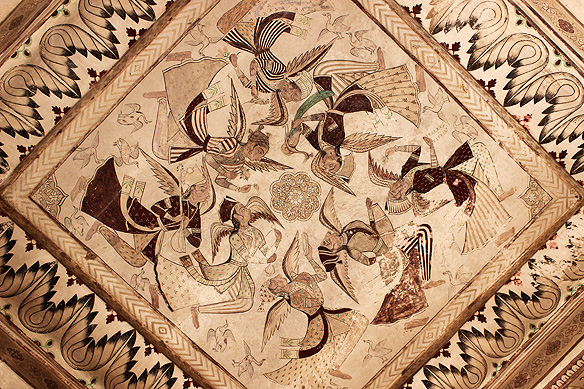
Many have crumbled over time and been replaced with the fast-burgeoning, steel and concrete ‘New Delhi’. I wonder how many there would have been, say a hundred years ago, or at the closing chapter of the Mughals in 1857, as I gasped in awe at the ceiling inside.

Where was I? In a tomb. Continue reading

global travel shot: baha’i temple, a marble lotus in full bloom

Image

Be like the Lotus. Be the Lotus.

The Baha’i Temple in New Delhi, a gigantic 27-petalled blooming lotus in concrete and marble, is a gentle reminder of a key life lesson at the core of religions that have birthed in India. A life lesson which repeatedly states the importance of rising above the chaos of life and to bloom, like a lotus, unblemished. A popular term being: detachment. Lofty life goals, but one can try.

It is also one of my favourite places of worship in the world. A masterpiece in modern engineering. Peaceful and meditative. Four times a day, brief excerpts from Hinduism, Buddhism, Islam, Christianity, and the Baha’i scriptures are read out, together. In tandem with the essence of the Baha’i faith that all religions are equally worthy.

There are over 7 million followers worldwide of the 19th Century Baha’i religion which was founded in Iran and has its holiest site in Israel. Its largest number of followers are in India. No surprises, since India is no stranger to syncretism, at times willingly, at times reluctantly, and often unconsciously. Another lofty life goal—syncretism—but one can try. 🙂

sunder nursery: delhi’s loveliest secret

[Updated on 2 June, 2022. This post was first published on 4 April, 2022. I went back to Sunder Nursery for a night heritage walk led by Sair E Hind in May. This updated post includes images of Sunder Nursery at night.]

Red Fort. Check. Humayun’s Tomb. Check. Qutab Minar. Check. A walk through Chandni Chowk. Check … and one gets deluded into believing that Aah, one has seen it all, done it all in Delhi.

Could one be further from the truth?

Delhi’s loveliest secret, hidden from prying tourist hordes, is Dilliwale’s [Delhiites] favourite place to have an uninterrupted yoga session, a picnic with close family and friends, or an organic brunch at a weekend farmers’ market. All in the company of blooming flowers, hundred-year-old wise trees from around the world, and exquisite Mughal-era UNESCO-listed monuments.

Sounds too good to be true, doesn’t it? But isn’t that what lovely, best kept secrets look like. Continue reading