travel guide: the six untold treasures of kazakhstan’s silk road heritage

Tucked away in the remote wind-swept folds of southern Kazakhstan are the ruins of a string of medieval Silk Road cities. A thousand years ago, these crumbling remains with their grand Sufi shrines were flourishing centres of trade, attracting merchants from far and wide; their glories held in awe across the golden steppes.

Welcome to Kazakhstan’s Silk Road heritage and its evocative treasures: The lost cities of Otrar and Sauran, and the cities of Turkestan, Taraz, and Shymkent which resolutely stood their ground.

The Silk Road, parts of which are UNESCO World Heritage Sites, was a trade route that operated from 114 BC to 1450 AD. Named after the primary product traded, the route comprised of a network of trails which cut across Central Asia, connecting the Far East with the Mediterranean. During its 1,600 years of existence, Chinese silk, along with spices, porcelain, and tea from the East were exchanged for horses, honey, and wine from the West.

It was a harsh terrain. Relentless. Fortified cities sprung up throughout the 6400-kilometre-long stretch to counter the bandits and uncertainty. Inside them, the traded goods changed hands, many times over, before reaching their destinations.

These cities were not just centres of trade, but also hubs of cultural exchange. A melting pot of ideas, philosophies, language, and faith. It is through the gatherings within their walls that Buddhism travelled from India to make a permanent home for itself in the Far East and Islamic science and knowledge fed into the western Renaissance.

Come along with me as I take you on a visual tour of this less visited, medieval side of Kazakhstan. On a journey back into time. 🙂

1. Mausoleum of Khoja Ahmed Yasawi, the jewel in Medieval Kazakhstan’s crown

Mausoleum of the 12th Century Sufi saint Khoja Ahmed Yasawi is Tamerlane's labour of love and the prototype for Timurid architecture.

Mausoleum of the 12th Century Sufi saint Khoja Ahmed Yasawi is Tamerlane’s labour of love and the prototype for Timurid architecture.
Continue reading

salalah: middle east’s anomaly

Tucked away on the Arabian Peninsula’s south-east coast is the Middle Eastern’s favourite getaway. Salalah.

Its very mention brings about a soft sweet smile to their otherwise calm controlled air, and a sparkle to dark eyes.

“Aah, Salalah!” followed with unbridled joy that I will be making the journey across a thousand kilometres from Muscat to this ‘haven.’

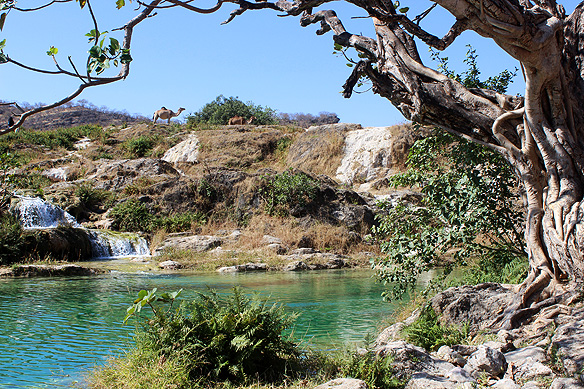
For two months in a year, July and August to be precise, Salalah in Southern Oman is engulfed in dense moist cloud and fog, with a light drizzle that amounts to less than a monthly average of an inch. This season is lovingly called ‘khareef,’ even though the term technically means autumn.

During these two monsoon months the barren shrivelled lunar landscape morphs into gushing waterfalls, turquoise-blue rivers, and lush green vegetation, replete with coconuts and bananas.

Whilst the rest of the Middle East swelters at 50 degrees, its populace flock to this anomaly in droves. Carnivals brighten the choppy sea-shores, and long queues together with packed car-parks peak to a frenzy.

Not your cup of tea?

Salalah is just as delightful in December when like the rest of Oman, it enjoys perfect weather. Continue reading

travel guide: turkmenistan’s 3 legendary unesco-listed treasures

For a history buff, Turkmenistan is what wish-lists are made of. Its historical sites comprise three of the greatest world cities of the past which served as the capitals of some of the region’s most powerful empires in the ancient and medieval world, namely, the Great Seljuks, Khwarezmshahs, and Parthians.

All three of these cities are UNESCO World Heritage Sites today: Merv in the south-east, Konye Urgench in the north, and Old Nisa near the capital Ashgabat.

Welcome to my travel guide on these legendary metropolises’ fantastic histories and breathtaking monuments. Places very few visit, in one of our world’s Least Visited Countries. ❤

MERV: ‘QUEEN OF THE WORLD’ AND CAPITAL OF THE GREAT SELJUKS

Coronation of Seljuk Sultan Ahmad Sanjar [r. 1118 – 1157]; Jami' al-Tawarikh by Rashid al-Din, Tabriz, Persia, 1307 AD.

Coronation of Seljuk Sultan Ahmad Sanjar [r. 1118 – 1157]; Jami’ al-Tawarikh by Rashid al-Din, Tabriz, Persia, 1307 AD.

Often described as ‘the wandering city,’ Merv is Turkmenistan’s grandest UNESCO World Heritage Site, both in scale and age: 1,236 hectares [including the buffer zone] and 4,500 years. Listed in 1999, it is also the oldest and best-preserved oasis city along the Silk Road in Central Asia. Continue reading

the complete travel guide to balkh: ancient bactria and silk road’s fabled city

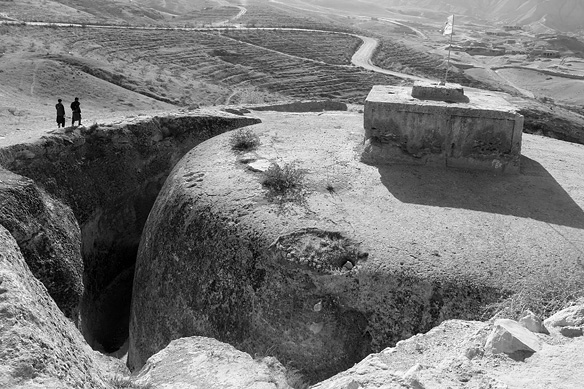
Of all the cities that has survived the annals of time, Balkh, the capital of ancient Bactria [6th Century BC to 6th Century AD] in northern Afghanistan, is perhaps the most evocative.

Volumes have been written on its wars when it was the capital of Bactria, and thereafter, a part of post-Bactrian empires. Art and literature have had a constant muse in its colourful personalities, Alexander the Great and Roxanna, and their marriage which paved the course of history. One of the oldest religions in the world, Zoroastrianism, was founded by one of Balkh’s very own citizens, Zoroaster.

But its greatest claim to fame, and subsequently its greatest legacy, came from its simultaneous role as Silk Road’s fabled city. For 1,600 years, from 130 BC – 1453 AD, Balkh was not just a confluence of commodities, but also of religions, ideas, and knowledge. Continue reading

top 15 memorable things to do in kabul, afghanistan’s capital

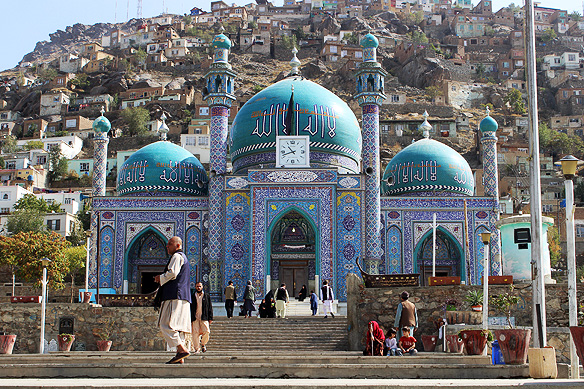
Afghanistan’s capital, Kabul, is not your regular city. Hemmed in by the Hindu Kush Mountains and Kabul River, it is beautiful. And broken.

The city traces itself back some 3,500 years and was a strategic trading centre on the Silk Road linking India with the Hellenic world. Over the centuries, the Who’s Who of Central Asia’s rulers and empires have ruled over it.

One of its earliest turning points was in the 9th Century when it was conquered and Islamised by the Abbasid Caliphate. Prior to this, Kabul was politically and culturally a part of India with a Buddhist and Hindu populace and rulers. Another major turning point was in 1776, when it officially became the capital of ‘Afghanistan,’ a nation the country’s founding father Ahmed Shah Durrani had established a decade earlier. Continue reading

bikaner: the forgotten jewel of the thar desert

Encircled by Rajasthan’s harsh and dusty Thar Desert is the medieval city of Bikaner. Once upon a time Bikaner was one of the most powerful cities on the Great Silk Road, opulent and exotic, its people wealthy beyond compare. Silks, spices, precious metals, and opium were traded here. Culture and ideas from east and west met and merged within its streets. But when trade routes shifted and other centres were created by the vagaries of time—Bikaner was forgotten. But never destroyed.

Wise enough to realise that the gains of peace were more enduring than the booty of war, diplomacy and the desert kept Bikaner safe from battles and conquests. There are no mutilated temples in Bikaner. Nor abandoned crumbling forts and palaces. Neither have modernism and commercialism dived through the desert yet to deafen its individuality. Off the tourist circuit, Bikaner is rarely visited, and when so, only by the intrepid.

Rajasthan’s forgotten jewel in the Thar Desert traces itself back to 1488. Prior to it, the area was a desolate wasteland called Jangladesh. And it may have remained a wasteland were it not for the ambitions of a young Rajput prince. Continue reading

global travel shot: silk road opulence in bikaner

Image

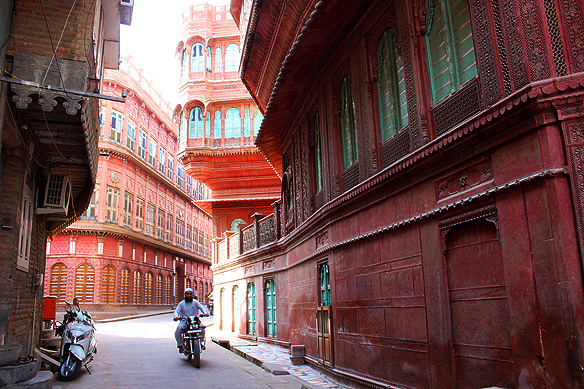
Ever wondered what the homes of the Great Silk Road merchants looked like? Please look at the image above this paragraph. All the monumental edifices lining the pronged road belonged to one such family—the three Rampuria brothers—the wealthiest merchants in Bikaner.

A small princely state deep in the deserts of northern Rajasthan, Bikaner’s strategic location on the Great Silk Road promised, and delivered, immense wealth to its people through the taxes imposed on the wares that passed through it and access to markets for Indian commodities. Silk, spices, precious stones, metals, and opium made the people of Bikaner into billionaires of their era. Continue reading

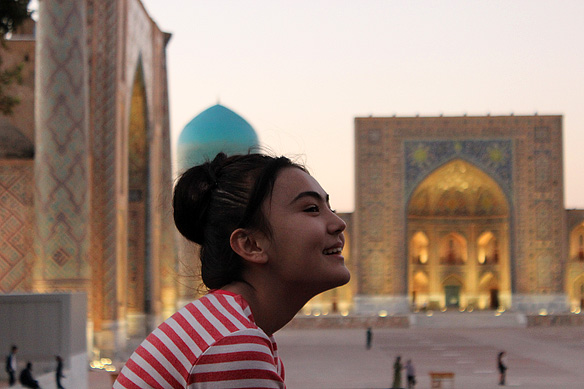
the spectacular treasures of samarkand

Registan, Samarkand

We travel not for trafficking alone;
By hotter winds our fiery hearts are fanned:
For lust of knowing what should not be known,
We take the Golden Road to Samarkand.

~ James Elroy Flecker

One cannot claim to be a traveller, and not have made the journey to Samarkand. Or at least have thought of it, fantasised about it. It would be blasphemy.

Samarkand is everything the traveller searches for, within and outside of oneself. It reveals secrets about life held gently amidst its spectacular edifices in blue and gold. The romantic exotic tile-clad mosques, madrasahs, tombs, bazaars and squares transpose one back 500 years in time to a grand fairy-tale city, deep in arid windswept Central Asia. On a philosophical note, Samarkand is the semi-mythological place of “justice, fairness, and righteousness” in Islamic Classical literature.

Much like Flecker’s reference to it, a lust for knowing more about ourselves and these ideals, makes the passage to Samarkand one of those non-negotiable, mandatory journeys one just has to take. 🙂 Continue reading

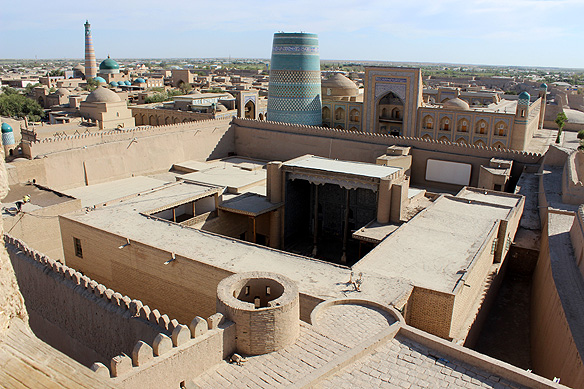
khiva: pearl of the great silk road and khanate of khiva

khiva1

Khiva. The very word conjures up a vision of towering minarets and ancient mosques clustered together in a small, medieval, walled town in the midst of golden desert sands. Don’t you agree? The reality, even after centuries, is no different.

I arrived at this mystical city—tired, dusty, hungry—after a long day’s drive through the expanse of Khorezm, the Zoroastrian viloyet of Uzbekistan. As I opened my hotel bedroom window, distracted with memories of forts and dakhmas, a dusk-dappled Khodja Minaret, a mere stone’s throw away from my room, welcomed me to its home. It was one of those Aah-ah moments which I guess I will keep with me all my life. 🙂 The reason I had travelled miles to cover this journey washed over me. I smiled back at the minaret, and whispered “Rahmat [Thank you].” Continue reading