global travel shot: seeing eye-to-eye with the sri lankan leopard at wilpattu

Image

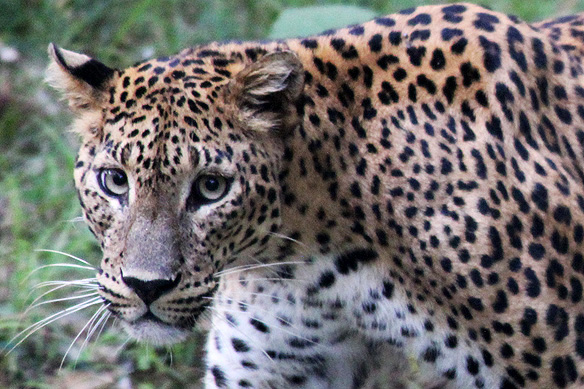
It was a bit hard for me to decide which to be more in awe of. The surreal deep red earth covered in lush jungle and sparkling pools [villu as they are locally called]. Or the Sri Lankan Leopard that sauntered past me, a mere hour into the game drive. Both, the leopard and I stared at each other. At some level, I guess, we saw eye-to-eye. He was the actual star of the show.

Wilpattu National Park on Sri Lanka’s north-west coast is not the country’s most popular game reserve. But, hands down, it provides the most authentic experience.

At 2 percent of the country’s land mass, it is Sri Lanka’s largest reserve. It is also one of the oldest—established in 1938 with around 40 Sri Lankan Leopards prowling through the heart of the national park. There are also Sri Lankan elephants, sloth bears, and a prolific bird-life, who I, however, think, fall a little short in comparison to the graceful feline. None of them stare back as piercingly as the latter.

– – –

[Note: This blog post is part of a series from my solo independent travels to Sri Lanka. To read more posts in my Sri Lanka series, click here.]
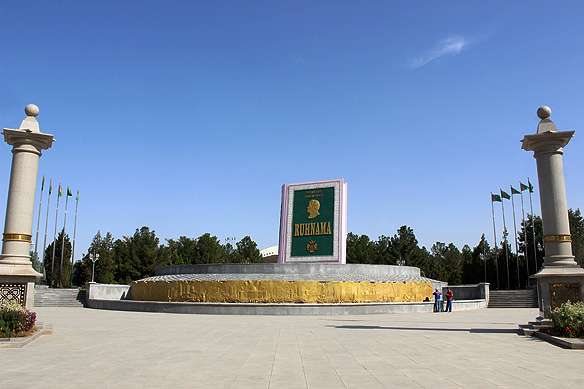
photo essay: unravelling turkmenbasy, the rukhnama, and ashgabat


To know Ashgabat, Turkmenistan’s capital, is to know the country’s first President and dictator Saparmurat Niyazov. And to know the Rukhnama, his autobiography and ‘words of wisdom’ for his people, is to know both. 🙂

Here is a photo essay of the three, with excerpts from the Rukhnama [the first and second volumes]. For no other three—a man, his book, and a city—are more closely intertwined than Turkmenbasy [Niyazov], the Rukhnama, and Ashgabat.

“When you read Rukhnama, you shall be purified, justified; your life and existence shall have a justification; your objectives and intentions shall be fulfilled. Your existence among the Turkmen shall be accepted!”

Continue reading

time-travel and dinosaur plateaus in remote north-east turkmenistan

Lebap Province in north-east Turkmenistan is as remote as it gets in this least visited country. Filled with moonscapes, a dinosaur plateau scalloped with around a couple of hundred, 150-million-year-old footprints of Megalosaurians during the Jurassic Period, deep canyons, and grottoes dedicated to saints and wishes, it is untouched by tourism. No-one speaks English here either.

To put things in context, Turkmenistan does not allow tourists to travel independently through the country. Neither can one simply travel to any random part of the country that tickles one’s fancy. There are designated places one is allowed to explore, and when out of Ashgabat, one must be accompanied with a licensed local guide.

Not many people visit Turkmenistan. The average number is less than 10,000 annually excluding the 3-to-7-day transit visas. Even fewer make it to its remote north-east. One of those rare ones was me. 😀

Here is my photo diary on this part of the world. I hope it inspires you to take the road less travelled, in this case time-travel to Lebap Province!

Continue reading

travel shorts: kyrk giz grotto, if ribbons and mud could stick

This slideshow requires JavaScript.

Take a long piece of cloth or ribbon, add a blob of mud to it, and hurl it high onto the ceiling of the grotto. If it sticks, your wishes will come true. If the ribbon falls flat on the ground, well you can either give up, or try again. 🙂

It is a ritual which people from across Turkmenistan carry out at the 50-metre-high grotto in Lebap Province, in remote north-east Turkmenistan. Starting a new job, getting married, or want a baby—it would not be amiss to make a pilgrimage here first. Continue reading

at turkmenistan’s darvaza: the gates of hell

Wouldn’t you agree that some sites are synonymous with the country in which they are? Especially the iconic, larger-than-life epic ones. For instance, think of India, and the Taj Mahal leaps to mind. Likewise, think of South Africa, and it is Table Mountain. The list goes on.

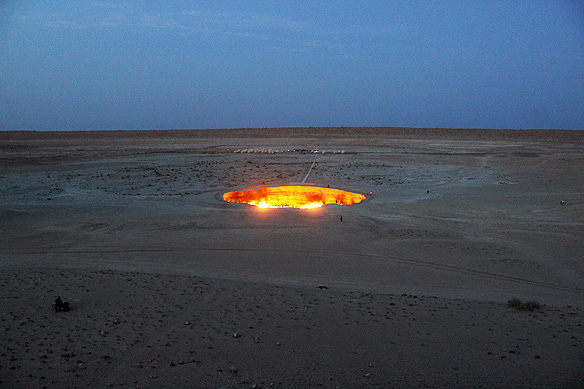
For Turkmenistan, it is Darvaza, the ‘Door to Hell’ or ‘Gates of Hell,’ a burning inferno in a massive pit, deep in the Karakum Desert.

And yes, it is an appropriate synonym. No, not the Hell part. That is the touristy moniker.

Darvaza encapsulates the country’s recent history, geography, and economy all rolled into a bizarre visual spectacle, befitting a country that is different from any other. In Turkmenistan’s official documentation, the site is called ‘Shining of Karakum.’ 😊

Two-hundred-and-sixty kilometres north of its capital Ashgabat, the 70-metre-wide, 30-metre-deep methane gas crater has been burning non-stop since 1971. Its raging flames whip into the air, becoming more menacing, yet beautiful, as the desert is engulfed in total darkness at night.

Neither a natural wonder nor of any particular historical significance, Darvaza is the result of, simply put, an oil exploration gone astray. Continue reading

art focus – fold/unfold – sonia khurana

sonia_khurana1

Folding:
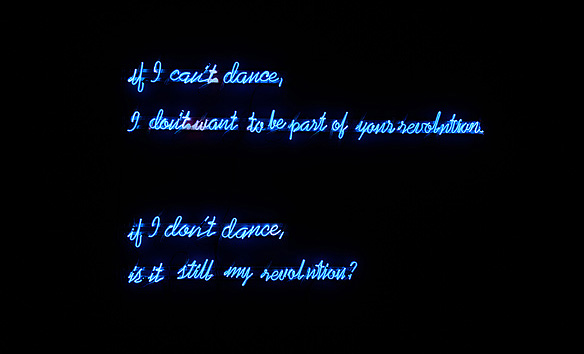
Fold, repeat, fold
folding—or doubling—of my thought into yours.
“The inside is nothing more than the fold of the outside”
: announces the fold.

The above lines and a cacophony of text, word, image, and thought spanning nearly 20 years meet me as I walk into the dimmed art gallery in a quiet bylane in Mumbai’s historic Fort district. The halls are shrouded in darkness with jewel-like LCD screens emitting video art of unabashedly personal, intimate, narcissist, and at times erotic conversations of the artist with herself.

I find myself thinking out aloud: this is what it must be like to step into one’s innermost recesses—where demons and angels reside. Where battles are fought between our limitations and desires, and the uncrowned unvetted winners bask in themselves. Continue reading

art focus – i am a landscape painter – archana hande

In respect to all, please know that these are historical photos, showing pictures, telling stories about those who are no longer with us.
I also acknowledge we are on Rann/ Forbidden Kingdom/ Wangai land; I take this opportunity to acknowledge all Elders, past and present.
Everyday everything goes back to the earth.

*The permission to narrate this story is given to me by the Family & Land.

~ Archana Hande

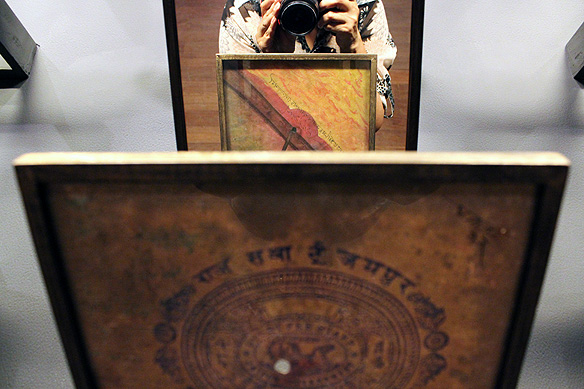
Archana Hande’s exhibition ‘I am a Landscape Painter’ is the story of Abdul Suthar, part true, part imagined. A Kutchch Muslim, Abdul leaves India, together with his camels, through the port of Kolkatta [Calcutta] for Australia. What he could have been, based on the choices that came his way, to where he eventually finds himself, deep in the 19th Century Goldfields trail, is recounted in Hande’s art through the landscapes he traversed. Continue reading

art focus – a summer mix – chemould prescott road

summermix_jitishkallat1

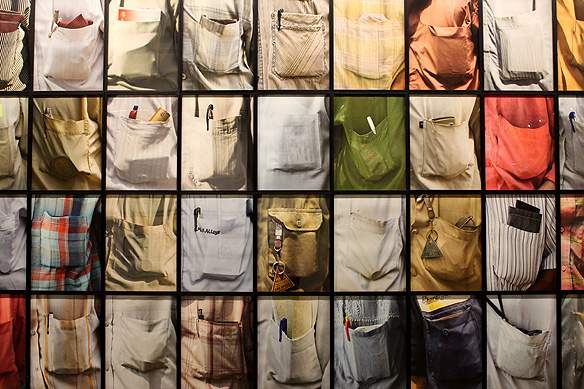
There is the office ID card, the fancy pen, loose change, cell phone, a hand written note. Closer inspection brings to the fore yet further details: the worn Tee, crisp office linen shirt, the crumpled uniform, and slowly the faceless personalities defined by their shirt pockets fill the gallery, and I am in their midst.

Every now and then a spray of raindrops showers the city outside, taking no one by surprise. I am at A Summer Mix, Chemould Prescott Road, an exhibition of 15 gallery artists’ personal commentaries, on a grey monsoon clad day. Continue reading

art focus – a terrible beauty – meera devidayal


Where is the lake? 

I was first introduced to video art in Cape Town, South Africa, at the National Art Gallery.

The video art of South Africa, as most of the country’s other modern art, finds itself emanating from the turmoil of its apartheid era, leaving the viewer ripped apart and then brought together into some semblance of wholeness. Video art, I learnt, was not meant as a once off viewing. Every time one watches it, a layer gets peeled, both in the narrative and in oneself, and the journey of exploration thus continues. Continue reading