the painted and sculpted caves of ajanta

This slideshow requires JavaScript.

If you were ever of the opinion that Buddhist art was all about asceticism and restraint, think again. The caves at Ajanta, in the Indian state of Maharashtra, are a lavish statement to the contrary as I discovered earlier this month on a five-day trip exploring the region in and around Aurangabad. But then, isn’t that what travel is meant to do? Break perceptions. 🙂

Imbued with sensuality borrowed from its sibling, Hinduism, ancient Buddhist art in its parent country is filled with nudes performing graceful mudras, figures wrapped in erotic embraces, and faces marked with raw emotion. Interspersed in this human carnival are serene, silent, meditating Buddhas, perfectly at peace in their company.

The mix of spiritual with secular, ordinary with sublime are common traits in Indian aesthetics. Why then should Buddhist art have been any different! Continue reading
rajgir, the ancient capital of magadha

To find a place not steeped in history, heritage or culture in India would be an anomaly. After living for eight years in the country I should be used to the cultural avalanche that typifies most things Indian by now.

After all, we are talking about 2 million years, 29 states, 7 union territories, and 9 practiced religions. But nope. Every time I come across a place, either firmly established as the country’s top sights or obscure and unknown on the road-less-travelled, I am overwhelmed. 🙂

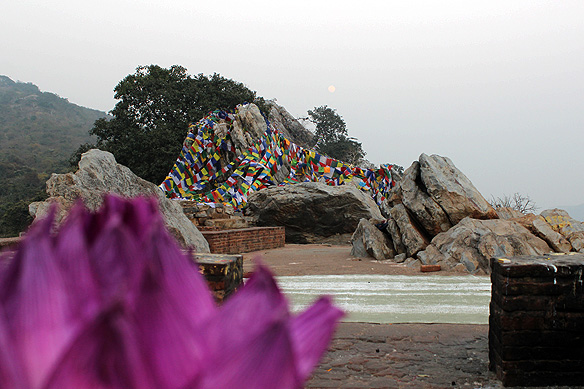
Take for instance my recent travels to Bodh Gaya. On doing my travel research one specific name kept popping up—Rajgir. It came highly recommended. Unsure of what exactly to expect, I added it to my itinerary with an overnight stay, but alas, I wish I had stayed longer.

Known in ancient times as Rajagriha, which translates to “house of king” or “royal house,” Rajgir, located between Bodh Gaya and Nalanda, was the first capital of ancient Magadha up until the 5th Century BC. But what was Magadha? Continue reading

buddha’s bodh gaya: the sacred hidden treasures of mahabodhi temple complex

“Is there some festival or special event taking place here today?” I whisper to the Buddhist monk seated next to me.

I am confused, and overwhelmed.

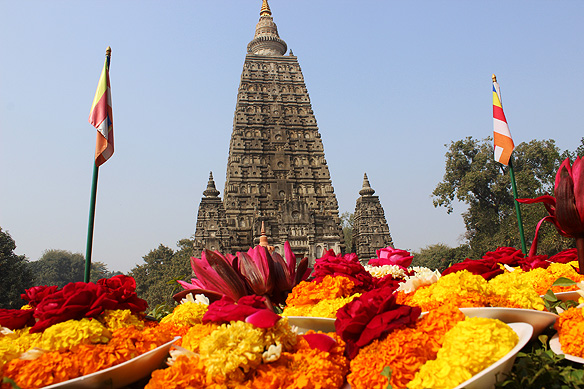
The entire Mahabodhi Temple Complex in Bodh Gaya, in the Indian State of Bihar, is draped with marigolds, lotuses, and roses. Hundreds of ochre and red-robed shaven-headed Buddhist monks and nuns prostrate in prayer in the grounds, and around the main temple. A handful of tourists quietly join the circumambulations around the main temple. I see pilgrims from Bhutan, Burma, Cambodia, China, Japan, Korea, Thailand, Tibet, and Sri Lanka in deep prayer. Most are dressed in their traditional attires. I see a few pilgrims from the West as well, no less in the purity of their faith. Groups chant with micro precision around me, not one voice out of sync, their mantras punctuated with the crescendo beats of rattle drums.

“No. Nothing special. It is like this every day all winter.” And he goes back to his meditation.

Nothing special. Just the extraordinary experience of being part of, and witnessing Buddhists from all corners of the world come and pay homage to the place where Buddha received enlightenment. 🙂 Continue reading

global travel shot: nalanda, the world’s first residential international university

Image

When writing the title of this post, I found myself in a bit of a quandary. Should I call it a global travel shot or an Indian travel shot? The former won.

The above image is of the red brick ruins of the world’s first residential international university—Nalanda Mahavihara—built in the Indian state of Bihar in the 5th Century AD. To be more specific, it is an image of the stupa marking the nirvana of Sariputra, Buddha’s famed disciple, within the university. A Sanskrit name, Nalanda means giver of lotus stalks; mahavihara translates to great monastery.

For 800 years, Nalanda, now a UNESCO World Heritage Site, attracted the brightest brains from all over the ancient world, from as far afield as Central Asia, China, and Korea. Hungry for knowledge, these scholars flocked to Nalanda’s doors to be met by a rigorous oral examination by its gatekeepers. Only those who passed were allowed to study inside the coveted walls. Many were turned away. Continue reading

36 hours in essaouira, where europe meets africa

The year is 1765. The place: A windy bay in Western Morocco. Sidi Mohamed Ben Abdallah, Morocco’s Sultan, has come up with the idea of building a fortified port-city by the sea to strengthen trade ties with Europe and the New World.

But with a difference. He decides to commission a Frenchman, Theodore Cornut to build it, using French military architectural elements. The city is populated with Africans, Amazighs, Arabs, and Europeans. A colony of Moroccan Jews are especially brought in to carry out the trade. And, thus, Essaouira meaning “the beautifully designed” is born. Continue reading

south africa 8: gauteng, johannesburg, the place of gold

gauteng1

Gauteng, place of gold

Four whole days in Gauteng! I’m a very happy woman. Yes, trust me, there is a lot to see and explore in this concrete jungle that is South Africa’s economic powerhouse. Gauteng actually means ‘place of gold’, a name that is evocative of its history and reason to be. The smallest yet wealthiest province in the country, covering a mere 1.4 percent of its total land area, Gauteng contributes 33.9 percent to South Africa’s GDP and 10 percent to the whole African continent’s GDP. In historical terms its name traces back to the discovery of gold in 1886 in Johannesburg.

I used to live here at one time and enjoyed it fully, that is apart from the traffic which is absolutely crazy. I know, everyone talks about the crime. I have, touchwood, never had a bad experience. And things are even better now with neighbourhood watches, plain-clothes police, and security cameras. Here is my take on Gauteng, not as a resident, but as a traveller. 🙂 Continue reading

south africa 6: kwazulu-natal adventure—from sani pass to its game reserves

sanipass1

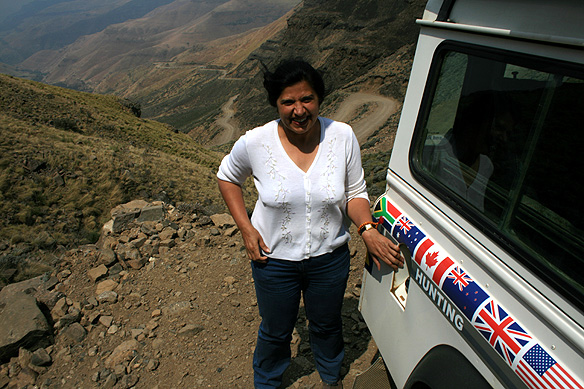
The thrill of Sani Pass

Aah, that adrenalin rush! That sense of adventure in exploring unchartered, gruelling terrains and then coming back to tell the tale. For many travelling to South Africa, and to me, it simply means the Sani Pass.

Once a rough mule trail, Sani Pass is now a notoriously dangerous mountain road to Lesotho via the Drakensberg Mountains which can only be traversed by a 4X4. Lying between the border controls of South Africa and Lesotho, the 8-kilometre-long gravel road through no-man’s land starts at 1,968 metres above sea level and ends near the summit at 2,873 metres. The journey is marked with steep ascents, hairpin bends appropriately named “suicide bend” and “big wind corner”, loose gravel, and beautiful views. Some walk this road. For the adventurous, the thrill is in the 4X4 drive. Continue reading

south africa 5: kwazulu-natal history—from rorke’s drift to kamberg to shakaland

isandlwana1
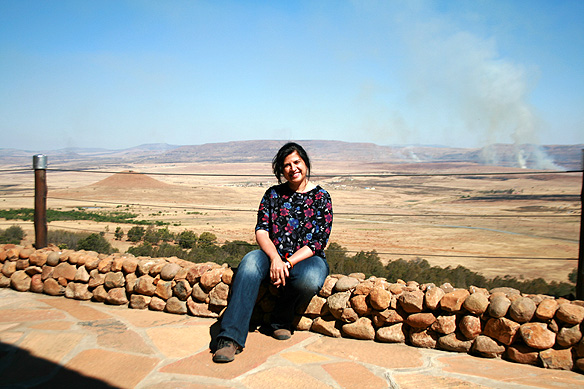
At the historic Anglo-Zulu battlefields in northern KwaZulu-Natal. What you see behind me, to the right, are sand storms in action. 

Day 1: Isandlwana and Rorke’s Drift: Where heroes were made

An endless expanse of dusty plains and stunted thorn trees sprawls for miles in front of me. We’ve been driving for five hours now. I’m on my way to Isandlwana and Rorke’s Drift and am told it is just beyond the last mound that shimmers in the horizon.

It is incredible that these barren expanses in the middle of nowhere, absolutely nowhere, were once the scenes of key battles fought during the Boer-Zulu, Anglo-Zulu and Anglo-Boer wars.

The few travellers who trickle up north to make this journey tend to be British, military buffs, or those tracing their family tree. But you don’t have to be any of them really. Isandlwana and Rorke’s Drift are a celebration of the human spirit during war, of courage against all odds. In the former, the valour was that of the Zulus. In Rorke’s Drift, the heroes were the British. Continue reading

iran 9: nain, abyaneh, kashan—travelling through the desert

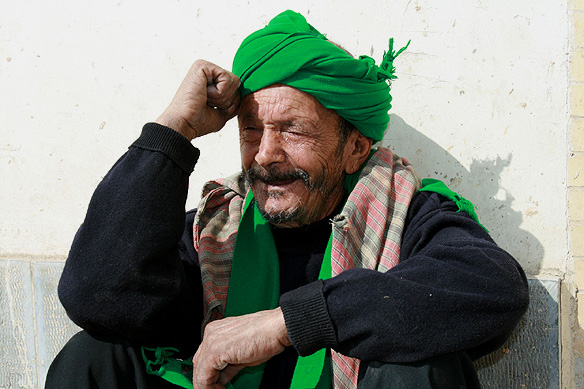
desertman1

I’ll be leaving in a couple of days; I have been in Iran for two weeks now. How easily we are able to change our habits. Two weeks and I now feel uncomfortable going out in public without my hejab, kebabs have become my staple diet, and salams and merci come easily. One more week here and I would be all chadored, going na na every time someone wanted to take a picture of me.

Travelling through miles of desert is an extraordinary experience. It also teaches you not to be fussy. Bathrooms are invariably behind a sand dune, at a little booth in a caravanserai, or in a thicket. So when you emerge you learn to check your front and backside as well so that there are no twigs sticking out of your hejab. It gives a whole new angle to the “going to the ladies” ritual.

There are two main deserts in Iran—Dasht-e Kavir and Dasht-e Lut—and they are both dotted with tiny little towns built around ancient mosques. Nain is the most charming with its carpets and 9th Century Jameh mosque decorated with stunning yet simple stucco-work. Continue reading

iran 7: the desert city of yazd

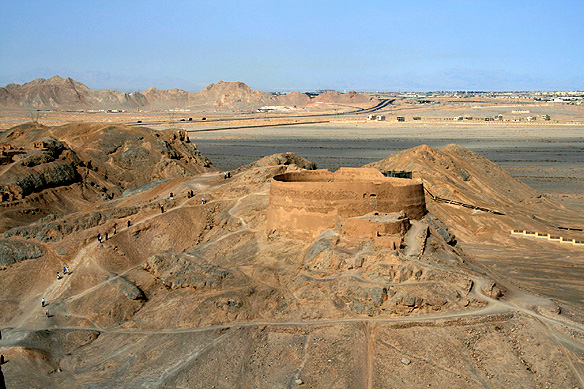
yazdtowers1

I am nearing Yazd. The landscape is stunning. Towering, barren, sedimentary mountains streaked with iron oxides flank both sides of the road. It has been a long day, driving through hundreds of miles of arid wilderness. As I wind my way through the burgeoning city, millions of street lights twinkle in the darkness in warm welcome.

– – –

Yazd is one of those not-to-be missed, no-matter-what, highlights of Iran. Wedged between two desolate deserts, it has long been a prosperous staging post on the caravan route between Esfahan and Central Asia. The city was an important center for Iran’s pre-Islamic religion, Zoroastrianism, and still has the largest Zoroastrian population in the country at 12,000. Continue reading