a self-guided walk through shimla, the british raj’s summer capital

1864. The British Crown was now directly in control of the Indian subcontinent. Five years had passed since they had squashed the Indian Mutiny. It had been a tough fight lasting nearly two years and two months, but they’d won in the end.

Summers in their new capital, Calcutta, were, however, brutal. Oh, how they longed for the grey overcast days back home, bathed in gentle drizzle.

Since the 1820s, the earlier British East India Company officers stationed in India had been escaping from the sun-baked plains to a hamlet in the middle hills of the Himalayas during such summers. The hamlet, comprising some 50 houses, was called Shayamala after a local Hindu goddess.

India’s new rulers decided to make this association more permanent. They renamed the hamlet ‘Shimla,’ and set up the British Raj’s ‘Summer Capital’ on its seven hills.

Every year, just before the sweltering heat clamped down on the Gangetic plains, the entire administrative machinery would move here, replete with traders, restaurateurs, and socialites. Once the heat cooled down, and snow started to peck its slopes, they would all move back again south-eastwards.

A mini-Britain was created in Shimla’s hills. Timber-strapped Tudor houses, soaring neo-Gothic churches, grand town halls, and a theatre for concerts and plays. On the Ridge, which offered rather splendid views, a bandstand was thrown in where military bands could play music and the gentry could indulge in leisurely strolls. Not too shabby now, perhaps they whispered to each other in relief.

Though it is now 77 years since the British have left, their summer capital’s remnants still dot Shimla, and more so on its main commercial pedestrian artery—Mall Road.

Here is a self-guided walk on what to watch out for should you ever be in the vicinity, with suggestions for eating and staying dating back to the colonial days. Take your time and savour its charms. After all, Shimla was always for the long haul. ❤

PS. Take the lift up to Mall Road, and on exiting the lift turn left towards Christ Church.

Continue reading

kullu manali and their 11 loadstones

Loadstone: Noun. A person or thing that is the focus of attention or attraction. In aplenty. In other words—Kullu and Manali.

– – –

Two of India’s most popular hill stations’ names are often taken in the same breath. Even though they are separated by some 40-odd kilometres.

Welcome to Kullu Manali. Two towns located on the verdant Kullu valley in India’s Himachal Pradesh with the ice-blue Beas river gurgling past them.

Free of a colonial overprint, or the culture and faith of an invading ruler, these two towns have in the past, as well as today, continue to epitomize Himachal history, traditions, and heritage. In all its unadulterated richness.

Gods are in abundance here, and so are centuries-old beliefs. The lines between mythology and mundane reality are blurred with characters from the epics Mahabharata and Ramayana popping up everywhere. Ancient sages, mythical heroes, demons, and the proverbial Noah [in Hinduism’s case Manu] who set forth from his ark to kick-start the lineage of mankind. They are all somehow associated with the Kullu valley which has earned itself the moniker ‘Valley of Gods.’

There’s also tall graceful fir trees, rivers fed by melting glaciers punctuated with hot water springs, and wooden homes which have housed many a generation of pahari [mountain] folks inside their weathered walls.

You will need at least a few days to get acquainted with Kullu and Manali’s sites. Hotels and taxis are easily available. Let me not go into them here. Rather let this post be a roadmap of what makes these two towns attract pilgrims and tourists in their droves, always. ❤ Continue reading

part 3: the spiti trilogy: lahaul, the mystical side of life and himachal

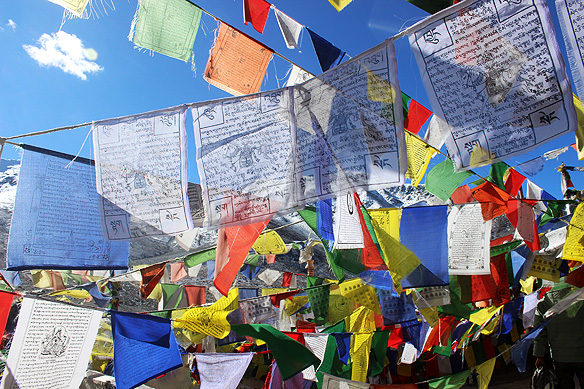
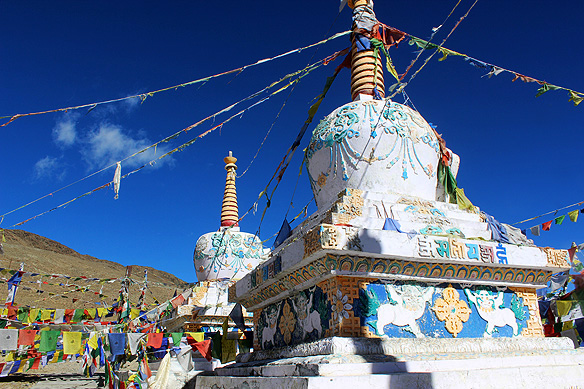
Prayer flags at Kunzum Pass. Because the gods live in the mountains.

Prayer flags at Kunzum Pass. Because the gods live in the mountains.

Welcome to part 3 of my photo diary trilogy on Kinnaur, Spiti, and Lahaul, high up in the Himalayas in India’s Himachal Pradesh.

If Kinnaur is all about the lush flourishing side of living, and Spiti the very opposite—about its barrenness, then Lahaul is the natural outcome of going through both sides of life. It is of tuning in with one’s inner self. I guess you could simply also describe it as meeting one’s Maker.

Here in Lahaul, Buddhist chants echo from monasteries perched atop peaks. Lakes contain deities and so do mountain passes. There is the sacred everywhere, and it is celebrated with much joy.

I would like to share my journey through Lahaul valley with you here. Maybe its magic captures your heart and soul too. 🙂

Continue reading

part 2: the spiti trilogy: spiti, the barren side of life and himachal

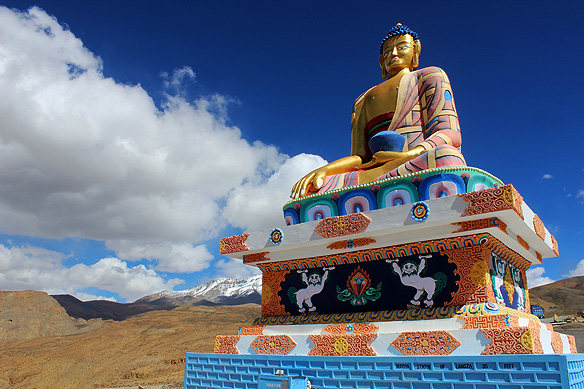
Buddha statue in Langza Village. Because the gods live in the mountains.

Buddha statue in Langza Village. Because the gods live in the mountains.

Welcome to part 2 of my photo diary trilogy on Kinnaur, Spiti, and Lahaul.

This week’s post is about Spiti, a cold desert biosphere in the rain shadow area of the Himalayas bordering Tibet. India’s monsoons do not reach here. Even if they do manage to squeeze their way past the soaring peaks, all they are able to muster is a drizzle. The summers are always dry. The winters are covered in thick snow and ice.

None of which is conducive to agriculture except if carried out on the banks of the Spiti river. The land is otherwise brown and barren, its moonscapes strewn with sand and boulders. Nestled in this arid bleakness are countless ancient monasteries, bedecked and bejewelled with Tibetan Tantric Buddhist iconography. These pockets of sanctity serve as places of refuge, giving strength and meaning beyond a difficult life.

Come along with me to Spiti.

Continue reading

part 1: the spiti trilogy: kinnaur, the verdant side of life and himachal

Sangla valley—Sangla means 'Pass of Light' in Tibetan language. Because the gods live in the mountains.

Sangla valley—Sangla means ‘Pass of Light’ in Tibetan language. Because the gods live in the mountains.

I have always seen myself as an ocean person. I love the rhythm of crashing waves, the smell of salt in the sea air, the white foam breaking into froth around my feet, and tugging me along as it leaves.

And then I went to the Lahaul and Spiti valleys and everything changed inside of me. I became a mountain soul. Those who have been there will understand what I mean.

The Lahaul and Spiti district in India’s northern state of Himachal Pradesh is one of the most beautiful places I have travelled to. Remote and untouched, its offroad route is accessed through neighbouring Kinnaur district if coming in from the Shimla side. When exiting, it continues to Manali to form a loop. Kinnaur and Lahaul are both verdant and green. Sandwiched between them, Spiti, in stark contrast, is a high mountain barren desert perched on the soaring Himalayan range, wild and windswept.

Starting with today, I will be posting a photo diary trilogy of Kinnaur, Spiti, and Lahaul over the coming three weeks. Care to join me and let your soul fall in love with the mountains too? ❤

Note: Lahaul and Spiti used to be two separate districts and were merged into one in 1960. For the purpose of this trilogy, they are treated separately because of their geographic distinctiveness.

Continue reading

india travel shot: shimla’s toy train

Image

Imagine—a cross between a train and a car, a rail motor car as it is called, hurtling over towering Roman arched bridges and through tunnels dug deep into dense rocky hills, past pristine forests and verdant valleys. 103 tunnels and 969 bridges to be exact, of which the world’s highest multi-arch gallery bridge is one. Every now and then it stops at quaint railway stations in little villages. Care for a bite?

The fantastical contraption in the image above, straight out of the pages of British Raj in India, is part of the UNESCO World Heritage Site ‘Mountain Railways of India’ since 2008. No trip to Shimla could be deemed to be complete without the inclusion of a journey in it in the itinerary. Not 120 years ago. And not now. Continue reading

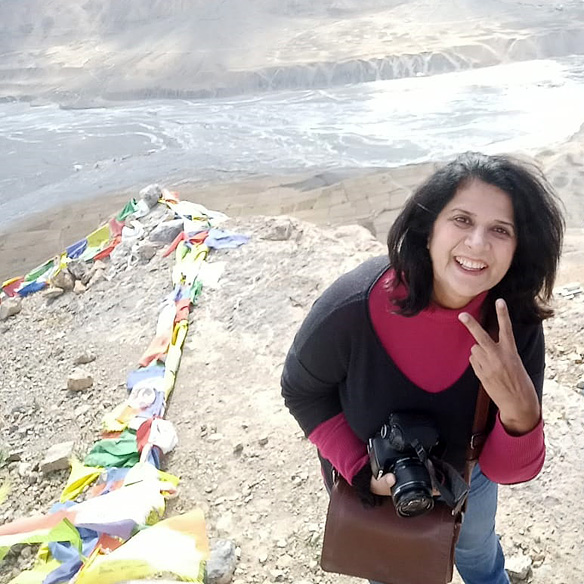
self-portrait: happy in spiti

Those of you who have been following my blog would be well aware that I rarely, if ever, post pictures of myself in my blog posts. The closest I get to is the inclusion of a photograph of my hand holding something I’d picked up at the site or that of my feet. There is neither a deep philosophical reason, nor an effort to create a sense of enigma, behind this. It is simply because I usually travel alone, and I am lousy at taking selfies.

So, when my driver offered to take a picture of me during a recent 15-day solo road trip though Kinnaur, Spiti and Lahaul, deep in the remote northern reaches of Himachal Pradesh, amongst the towering Himalayas, I jumped at it. It was a precious opportunity to make my joy whilst travelling to this part of the world achieve posterity. 🙂 Continue reading

36 hours in dharamshala, home of the dalai lama

A visit to Dharamshala is on every Indian traveller, and every traveller to India’s, bucket list. With Tibetan monasteries snuggled in cedar-clad hills, crooked narrow streets, and the mighty frozen Himalayas for a backdrop, the city offers unparalleled charm. Why, even its name is a winner. Dharam Shala means “spiritual dwelling.” 🙂

For two thousand years though, Dharamshala was a mere hamlet, ruled along with the rest of the Kangra valley by the Katoch rulers based in Kangra Fort. A tiny colonial hill-station during the British Raj, it catapulted to international fame when it was presented in May 1960 to the 14th Dalai Lama by the then Prime Minister of India, Jawaharlal Nehru, to serve as the former’s new headquarters. There has been no looking back for the settlement up in the Dhauladhar range since then.

Dharamshala’s sights can be broadly divided into three parts: All that is Tibetan, what little that is left of the British Raj, and Dharamshala’s past and present Indian heritage.

But hey, didn’t the Dalai Lama live in McLeod Ganj? Continue reading

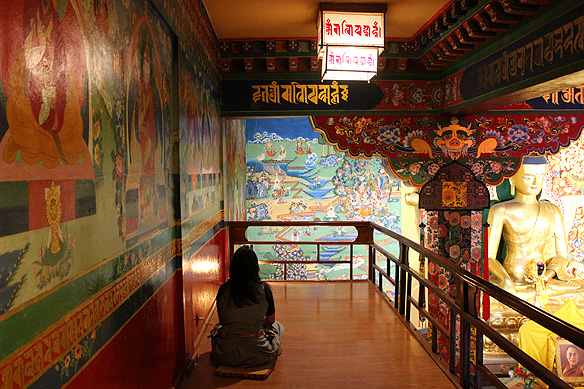
the ancient art of tibetan thangka painting in dharamshala

I was first introduced to the ancient Tibetan religious art form of thangkas in Gyangtse, in the heart of Tibet. It was the summer of 2004. I was travelling solo through Tibet—I had hired a 4X4, got a driver and a guide, and we drove through the majestic Himalaya mountains for seven days, stopping at monasteries, stupas, and temples on the way.

A four-day visit to Dharamshala this June, home to the 14th Dalai Lama and his government-in-exile brought all my memories of Tibet gushing back.

The street that faced the nine-tiered 15th Century octagonal Kumbum stupa in Gyangtse had been lined with stalls. The stupa, by the way, contained a staggering 77 chapels, 108 gates, 100,000 Buddhist paintings, and 1,000 sculptures of the Buddha. In the little shops in the street meanwhile, ancient Buddhist silk applique and cotton paintings, which I was told were called thangkas, were on sale along with other religious paraphernalia such as prayer wheels and prayer flags.

All the thangkas, I remember, looked more or less alike to me. They were filled with intricate mandalas or exotic gods and goddesses from the Tibetan Buddhist pantheon, were framed in rich satin brocade, and had a deep yellow ruffle on the top. Many were dusty. Most looked old. The yellow ruffle, I learnt much later on, opened into a pair of “curtains” which covered the painting. I also remember they were frightfully expensive. Needless to say, I did not buy any. Strange, because even after 15 years I remember them vividly. Continue reading

travel diaries: the true blue heroes of dharamshala

Meet Sunny from Chamba [left] and Rahul from Dharamshala [right]. Sunny is 23 and Rahul is just 18. They both work in a gift shop in McLeod Ganj.

Real heroes don’t wear shining armour. Neither do they strut across cinema or sport or on social media to the thundering applause of likes. Instead, real heroes live amongst us in our everyday lives, usually in anonymity. I met my two real, true blue heroes last week. 🙂

It all started with a mention of Dip Tse Chok Ling monastery whilst reading up about Dharamshala. The idea of a secluded monastery, perched half-way up the Dhauladhar range, wrapped in green forest was appealing. An alley, followed with a few hundred steps deep into the bowels of the valley, led me to it. On the way down, unfortunately, my hiking boots, perhaps at the end of their tether, gave way, and I had to pack my shoe’s sole in my camera bag. Continue reading