part 2: the spiti trilogy: spiti, the barren side of life and himachal

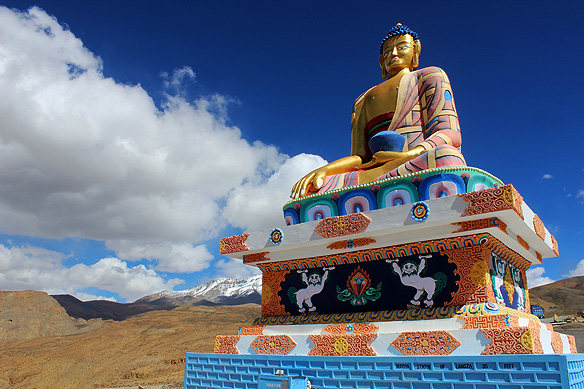
Buddha statue in Langza Village. Because the gods live in the mountains.

Buddha statue in Langza Village. Because the gods live in the mountains.

Welcome to part 2 of my photo diary trilogy on Kinnaur, Spiti, and Lahaul.

This week’s post is about Spiti, a cold desert biosphere in the rain shadow area of the Himalayas bordering Tibet. India’s monsoons do not reach here. Even if they do manage to squeeze their way past the soaring peaks, all they are able to muster is a drizzle. The summers are always dry. The winters are covered in thick snow and ice.

None of which is conducive to agriculture except if carried out on the banks of the Spiti river. The land is otherwise brown and barren, its moonscapes strewn with sand and boulders. Nestled in this arid bleakness are countless ancient monasteries, bedecked and bejewelled with Tibetan Tantric Buddhist iconography. These pockets of sanctity serve as places of refuge, giving strength and meaning beyond a difficult life.

Come along with me to Spiti.
Continue reading

part 1: the spiti trilogy: kinnaur, the verdant side of life and himachal

Sangla valley—Sangla means 'Pass of Light' in Tibetan language. Because the gods live in the mountains.

Sangla valley—Sangla means ‘Pass of Light’ in Tibetan language. Because the gods live in the mountains.

I have always seen myself as an ocean person. I love the rhythm of crashing waves, the smell of salt in the sea air, the white foam breaking into froth around my feet, and tugging me along as it leaves.

And then I went to the Lahaul and Spiti valleys and everything changed inside of me. I became a mountain soul. Those who have been there will understand what I mean.

The Lahaul and Spiti district in India’s northern state of Himachal Pradesh is one of the most beautiful places I have travelled to. Remote and untouched, its offroad route is accessed through neighbouring Kinnaur district if coming in from the Shimla side. When exiting, it continues to Manali to form a loop. Kinnaur and Lahaul are both verdant and green. Sandwiched between them, Spiti, in stark contrast, is a high mountain barren desert perched on the soaring Himalayan range, wild and windswept.

Starting with today, I will be posting a photo diary trilogy of Kinnaur, Spiti, and Lahaul over the coming three weeks. Care to join me and let your soul fall in love with the mountains too? ❤

Note: Lahaul and Spiti used to be two separate districts and were merged into one in 1960. For the purpose of this trilogy, they are treated separately because of their geographic distinctiveness.

Continue reading

the story of qutub minar

Prologue

Perhaps it would be more apt to title this post: Stories about Qutub Minar. As in plural.

Apart from being Delhi’s most iconic monument, it is steeped in multiple stories and a whole lot of firsts, making it unlike any other in the city. To top it, it is not the handiwork of any one ruler or dynasty, but is a collaborative effort spanning 800 years with even an East India Company officer adding his own bit to it—a Bengal-styled chhatri perched on top of the tower, which was thankfully brought down twenty years later.

So, here are Qutub Minar’s most famous stories. The spunk behind its stones. 😊 Continue reading

a heritage buff’s guide to the eight cities of delhi

Delhi, a city of 7 cities, 8 cities or 14 cities? It depends on which lens one is looking at the city from. But it surely is not one city!

India’s political centre has been around for a long time. 1,300 years as per historical records, in which it served as the capital city for different rulers over various periods.

Many set up their own capital, in their own name, for posterity’s sake in and around Delhi. For instance, Mubarak Shah, the second Sayyid dynasty ruler during the Delhi Sultanate period founded Mubarakabad in the 15th Century [included in the 14 cities list]; it is now a neighbourhood called Kotla Mubarakpur.

All together, 14 such cities were built over the centuries in this patch of strategically placed land in northern India with the fertile Gangetic plain to its east, the impenetrable Deccan plateau to the south, and the arid desert state of Rajasthan to the west. An area nourished by the river Yamuna and the monsoons.

Much smaller than present-day Delhi, these cities were often built a short distance away from an old one or incorporated earlier ones into its boundary walls, and at times even existed concurrently. Each of them has added a distinctive layer to Delhi, making Modern India’s capital quintessentially different from any other. Where else can you time travel across a millennium in an hour.

For this post, I am taking the ‘8 cities in a city’ theory. Seven historical cities in Delhi that still exist, and New Delhi, listed in chronological order.

It is a longish post. After all, we talking about 1,300 years and eight cities. 🙂 Hope you enjoy reading it as much as I enjoyed writing it.

Happy time travel! Continue reading

india travel shot: jantar mantar, a slice of jaipur in delhi

Image

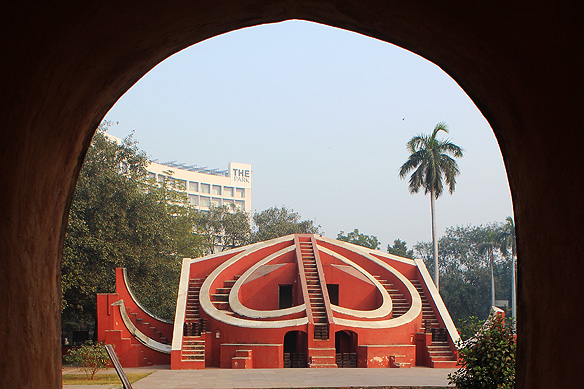
Deep in the heart of New Delhi’s central business district, Connaught Place, is a remnant of the Princely State of Jaipur. Surprised?

Known earlier as Jaisinghpura Village, this patch of land formed part of Jaipur’s territories from the 16th Century right up to the year 1911. When Maharaja Sawai Jai Singh II built a monumental observatory to measure time in Delhi, on the invitation of the Mughal Emperor in 1724, he was technically building it on his own land.

He named his futuristic structures to measure the movement of the heavens Jantar Mantar, meaning instruments and formulae. So chaffed was he by his invention, he repeated it in his own capital, Jaipur, and three other cities in the following years.

Fast forward to 1911: Sir Edwin Lutyens decides this area is to be the site for the new Imperial capital, New Delhi. But it is already occupied. So, the British government buys it off from Jaipur, relocates all the villagers [to nearby Karol Bagh], and razes their homes to the ground. Except for the monuments and places of worship that stand on it.

Hence, surrounded by high-rises is a fenced area of green with a medieval observatory, along with Hindu [Hanuman Mandir and Bhairav Mandir], a couple of Jain temples, and a Sikh temple [Bangla Sahib Gurudwara], all dating back to Jai Singh’s reign.

These have become so much a part of Delhi’s heritage, the fact that they are actually remnants of the Princely State of Jaipur are all but forgotten. 🙂

– – –

Note: Yash Gupta, a conservation architect at Intach, leads a fabulous 2-part walk through Jaisinghpura based on his research of the area.

lodhi art district’s 16 most dazzling street art paintings

What happens when a sedate neighbourhood for government employees comes face-to-face with passionate street artists from across the world—Lodhi Art District happens. 😊

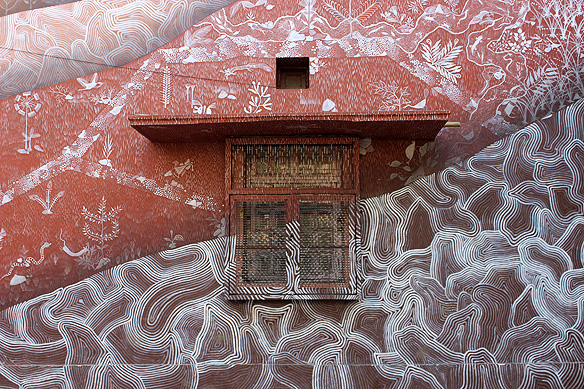
A leafy residential area dating back to Edwin Lutyens’ 1940s New Delhi, Lodhi Colony is characterised by wide streets and housing blocks encased in lofty colonial arches and vast facades. Unlike most of Delhi, it is relatively traffic-free—the perfect setting for an open-air art gallery, is what St+art India Foundation figured in 2015.

And so, over the years, street artists from across the world and India, were invited to transform its faded vanilla walls into riots of colour. At times the art was loaded with thought-provoking messaging, and at others about the simple truths of life. But always, magnificent in their aesthetic beauty.

There are some 60 street art works scattered over the neighbourhood, as of December 2022. You would need a whole day to see them all. Of these, 16 are drop-dead dazzling, and my absolute favourites!

I have included a link to a google map prepared by St+art at the end of this post to help you locate these paintings, along with a link to their official [free] audio guide available on HopOn India.

Here they are, the best of Lodhi Art District’s lot. Be prepared to be bowled over. ❤ Continue reading

delhi’s shahjahanabad unraveled: heritage, sacred places, markets, and food

No visit to Delhi would be deemed complete without a visit to Shahjahanabad, popularly referred to as ‘Old Delhi’ after the creation of Lutyens’ ‘New Delhi.’ But it is an overwhelming place. A sensory overload. After all, what do you expect from 400 years of continued habitation and history packed into 6.1 sq. kilometres.

This pocket of land has seen it all. The zenith of Mughal rule. India’s First War of Independence. The sure and steady takeover of Delhi by the British, culminating in India’s independence in 1947.

It has been razed to the ground and bathed in blood three times over the course of time. Yet, it has bounced back on its feet. Livelier. It has seen executions in the name of religion, and yet, coexistence continues to exist within its walls. Devoid of any ‘city planning,’ apart from the Fort area, Chandni Chowk, and Jama Masjid, it has grown organically over the centuries with bundles of overhead electric wires and unpaved paths put up, as and when needed, to meet infrastructure needs. Yet, there are heritage treasures in its midst which are some of the most stunning in the country.

This chaotic wonderland, which defies all rules, had its foundation stone laid on 19 April, 1639 by the Mughal Emperor Shah Jahan. For nine years, thereafter, construction took place under imperial orders, and in 1648 it was declared ready for use as the new Mughal capital. Continue reading

travel shorts: delhi’s 800-year-old spiritual retreat for eunuchs

This slideshow requires JavaScript.

Delhi is full of tombs and gravestones. There are tombs for sultans and emperors, and their consorts. For wealthy nobles and ordinary folks. But gravestones, sorry not for one, but 50 revered eunuchs or transgender women who lived eight hundred years ago? Aaah, that can only happen in Delhi. 😊

Hijron Ka Khanqah, which literally translates to ‘a Sufi spiritual retreat for eunuchs’ is a collection of whitewashed gravestones fronted by a wall mosque in Mehrauli Village, a neighbourhood in Delhi continuously inhabited for the past one thousand years. Amidst these gravestones stands a marble tomb marked with a kalamdan, a raised ridge, typical of graves belonging to males in medieval India. Continue reading

a travel guide to colonial delhi

If you have been to Delhi, India’s capital city, your memories of it would most likely comprise of evocative Sultanate and Mughal monuments. Monuments which are remnants of the multiple cities that flourished here over the past one thousand years.

But no one can deny the city’s most alluring charm, perhaps just a tad bit more than its monuments, is its dense green canopy. A veritable garden city, its broad leafy avenues transform into tunnels of foliage in the monsoons. Large roundabouts embellished with manicured lawns, regal palms, and flowering bushes punctuate the roads at short intervals; roads lined by whitewashed bungalows set amidst their own personal gardens. Expansive reserves called the ‘Ridge’ run wild with jungles. And then there are the countless parks laid out neatly around the city’s monuments and jogging tracts through dark forests.

What if I told you none of this greenery is indigenous to Delhi. That the green cover is the Britishers’ most visible legacy to the city which they made their capital from 12 December, 1911 to 15 August, 1947. Even the Ridge, which Delhiites take much pride in, is draped in the Vilayati Kikar, a Mexican species, planted by the British. Its deep roots kill off any competition, especially Delhi’s native trees. Continue reading

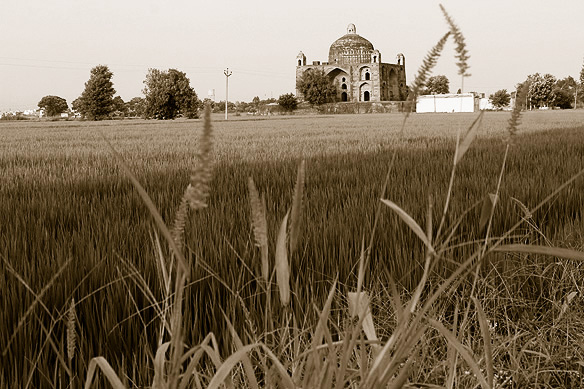
photo essay: sirhind, the lost atlantis of punjab

There was once a city called Atlantis, a Utopia which was both highly advanced and its people beautiful and wise. But then these very people became corrupted with their own might. Angered by this, the gods made the city disappear forever, never again to reappear.

Much like Plato’s fabled Atlantis, there was once a paradisaical Utopia nestled in the fertile Punjab plains in northern India. Strategically located halfway between Delhi and Lahore, it was wealthy and beautiful, decorated with some 360 mosques, gardens, tombs, caravansarais, and wells. It minted its own gold and copper coins, trade and industry flourished, and Sufi saints, artists and surgeons converged in its lanes, calling the city their home.

And like Atlantis, its wonders and fortunes disappeared overnight. Continue reading