top 15 memorable things to do in bukhara, silk road’s legendary trading post

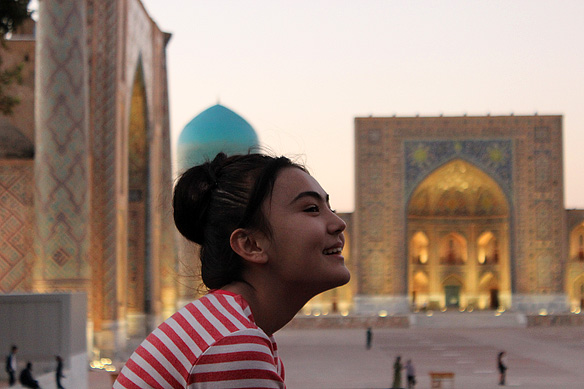
Bukhara is the third stop on my journey to Samarkand in Uzbekistan.

Whilst Khiva is a compact fairy-tale town enclosed in medieval walls, Bukhara is scattered, both geographically and thematically, as well as bigger: There is the marketplace, learning and spiritual hub, royal grounds, and necropolis. If one is not aware of its various facets, it is easy to give some of them a slip.

And hey, Bukhara does not come into our lives every day. So here are my top 15 things to do in Bukhara, a World Heritage Site, and why I chose to put them in this list. If you have any that you feel merit a place, please do share. 🙂

1. Get up close and personal with Nasreddin Hodja, the Islamic world and Bukhara’s most loved trickster

bukhara_nasreddinhodja Continue reading

khiva: pearl of the great silk road and khanate of khiva

khiva1

Khiva. The very word conjures up a vision of towering minarets and ancient mosques clustered together in a small, medieval, walled town in the midst of golden desert sands. Don’t you agree? The reality, even after centuries, is no different.

I arrived at this mystical city—tired, dusty, hungry—after a long day’s drive through the expanse of Khorezm, the Zoroastrian viloyet of Uzbekistan. As I opened my hotel bedroom window, distracted with memories of forts and dakhmas, a dusk-dappled Khodja Minaret, a mere stone’s throw away from my room, welcomed me to its home. It was one of those Aah-ah moments which I guess I will keep with me all my life. 🙂 The reason I had travelled miles to cover this journey washed over me. I smiled back at the minaret, and whispered “Rahmat [Thank you].” Continue reading

zoroastrian khorezm: the ancient viloyat of uzbekistan

mizdakhan1

A journey to Samarkand is about medieval mythical cities and ancient forts going as far back as 500 years before Christ. First Zoroastrian, followed by Islamic, the sites still stand in all their glory today—many restored, others in ruins. But in spite of this, the journey is not just about geographies, edifices or time. It is to the grandeur within us. But that, I hope, will become clearer as my blog post series on Uzbekistan unfolds. 🙂

I started in Nukus. You may well ask, why Nukus? It is not the usual starting point. Well, my answer is: It is the western most city, has the finest collection of historical and cultural artefacts at its State Art Museum Savitsky Collection thereby offering a splendid introduction to the country, and is the most low-key in Uzbekistan’s historical circuit. Everything only gets more fantastical from here onwards.

Nukus also lies on the outskirts of Khorezm [or Khwarezm or Chorasmia (Persian)]—an oasis, the site of an ancient civilization by the same name, and now a province. Continue reading

the golden journey to samarkand

uzbekistan_samarkand1

[I traveled to Uzbekistan for 11 days in September 2015. My below post first appeared as a travelogue in Hindustan Times, one of the largest newspapers in India, in both its print and online editions. The online edition can be read here. The post remains a personal favourite, and I wanted to share it with you. 🙂 ]

– – –

‘Ishani!’ I can feel scores of eyes bore into me. There is the blatant stare, the questioning glance, the shy surreptitious gaze. They are all invariably accompanied with the word ‘Ishani’ whispered in hushed tones. The wide-cheek-boned faces soon, thereafter, break into warm welcoming grins and I hear the magical word again, ‘Ishani’. Aah, I get it. It’s a greeting! Ishani to you too, my dear.

I have just arrived in Nukus, a remote, Russian-ised town in north-west Uzbekistan where I am to start my 11-day journey across a country I have dreamt about, bucket listed and hankered to visit since I read the poem The Golden Journey to Samarkand by James Elroy Flecker:

“We are the Pilgrims, master: we shall go
Always a little further …
White on a throne or guarded in a cave
There lives a prophet who can understand
Why men are born.”

Continue reading

photo essay: marrakech, stories told and untold

Marrakech is my last stop as I travel through Morocco.

What could be a better way as well, to end my Moroccan series, than a blog post on the city after which the whole country was once named.

From medieval times right until its independence, Morocco was known as the Kingdom of Marrakech. Till date, in both Persian and Urdu, the word for Morocco is Marrakech.

Whichever nickname you choose to refer to it by—Red City, the Ochre City, or the Daughter of the Desert—Marrakech brims with stories. But a little more than the usual. Some told and recounted again and again through guide books and travellers’ words. Some a little less obvious. Did you know, even the UNESCO-listed status for its vast medieval square, Djemaa el-Fna, is based on its oral traditions of story-telling. 😊

A tradition which goes back a thousand years. To 1070 AD to be exact. Continue reading

top 15 memorable things to do in fes, morocco’s cultural and spiritual capital

Fes.

It was everything I’d imagined it to be, and more.

When travellers claim no journey to Morocco is truly complete without a halt in the Kingdom’s oldest imperial city, it is no hogwash.

Fiercely spiritual and traditional. A centre for learning with the world’s oldest university. Yet fearless when it comes to voicing contradictory ideas.

Here the arts and crafts thrive, unhindered and unadulterated, as they have for 1,200 years. At the peak of the Almohad empire in the 12th Century AD, Fes had 372 mills, 9,082 shops, 47 soap factories, and 188 pottery workshops. But Fes is also politically voracious.

Its nine thousand alleyways are notorious as a place guaranteed to get lost in. Even locals claim they stick to the lanes they are familiar with.

Enigmatic and mysterious, it has secrets it does not divulge to the casual feet and eye. Continue reading

the 5 untold cultural treasures of rabat, morocco’s medieval and modern capital city

I fell in love with Rabat at first sight.

Sophisticated, Mediterranean, with a world-class museum and gallery, Morocco’s capital city is a breath of fresh air in a country otherwise steeped in romantic orientalism. Whitewashed Art Deco buildings vie with an ultramarine blue sky for attention here. Street-side cafes serve delectable tagines and kebabs accompanied with steaming cups of cafe nous nous.

Faced with the exotic wonders of Morocco further ahead, not many travellers break their journey in Rabat. What does a capital city have to offer in comparison to the enigmatic imperial cities of Fez and Marrakesh, and the wild call of the Atlas Mountains and sweeping dunes of the Sahara Desert?

The answer is: A different kind of Moroccan experience. Continue reading

meknes: the story of a bloodthirsty sex-addict sultan and his beloved imperial city

“Green is the sweetest colour; white is a good sign for those appealing to him; but when he is dressed in yellow, all the world trembles and flees his presence, because it is the colour that he chooses on the days of his bloodiest executions.”
~ Dominique Busnot, Histoire Du Regne de Moulay Ismail, Roi de Maroc (1704)

Once upon a time lived a Sultan in Morocco who loved his imperial city called Meknes with every fibre of his being. The 55 years he reigned, the longest by any Moroccan Sultan, were spent building gates, mosques, madrassas, palaces and gardens in it, each more magnificent than the other. When he died, aged 82 in 1727 AD, he had one of the most beautiful mausoleums ever built in the Kingdom made to house his corpse.

A slender man of medium height, a long face and dark skin [his mother was an African slave], he was the 2nd ruler of the Alaouite Kingdom. His name was Moulay Ismail ibn Sharif aka the Warrior King of Morocco.

Apart from Meknes, if there was anything else Moulay Ismail ibn Sharif loved—it was women, and sex. A lot more than the ordinary. Better known as the Sultan who had 10 wives, 500 concubines, and 1,171 children, his 700th son was born just after his death. His 10th wife was an Irishwoman by the name of Mrs. Shaw. He also proposed to his contemporary, Louis XIV’s, daughter. He was quite smitten by her charm and beauty. However, she declined.

The other two things he is still remembered for, nearly three hundred years after his death, are his cruelty and his army of Black Guards. Continue reading

8 hours in casablanca

Casablanca. The very name transports one back to 1942 and the black and white American romantic drama set in World War II. Starring Humphrey Bogart and Ingrid Bergman, the film was an unprecedented success like no other before. Who has not heard of Casablanca? And Rick’s Café?

But did you know that not a single scene in the movie was actually filmed on location. Casablanca was shot entirely at Warner Bros. Studio in California. There never was any Rick’s Café in Casablanca, back then, either. The one that stands now near Hassan II Mosque is a recreated version of the one in the film, built much later. It doesn’t really matter though, for through the movie Casablanca, Casablanca the city on which the film was based became a household name globally.

Most travellers zip past Casablanca onto the more exotic destinations Morocco has to offer. Compared to the cultural charms of the royal cities of Fes, Marrakesh, Meknes and Rabat, Casablanca comes in as a poor second. When it is rugged nature that tugs your heartstrings, what does a commercial port-city by the Atlantic Ocean have to offer?

Lots. Continue reading

discover ancient roman volubilis through a self-guided walk

There is a reason I travel solo. I tend to get lost when I travel. No, not physically. That would be impossible in today’s day and age with Google Maps and diligent service providers busy at work with their mobile phone tracking systems to keep you connected. What I mean is I get lost in the experience. I lose track of time. Which is great for me, but, have come to realize, is not so great for others. 😀

This post is about one such lost-in-the-experience day I spent at a place called Volubilis in northern Morocco, in the foothills of Mount Zerhoun. And how you too, if you wish [that is], could lose yourself in its magic!

Volubilis was a large Roman colonial town on the fringes of the Empire. Though dating back to the 3d Century BC and occupied till the 11th Century AD, its hey-day lasted from 44 – 285 AD when it was capital of the Roman province Mauretania Tingitana.

It was a wealthy town—fertile grain and olive oil-producing lands surrounded it—and its 20,000 Romanised Amazigh inhabitants lived in fancy villas lining broad avenues. Today, the archaeological site is a UNESCO World Heritage Site. Continue reading