the forgotten kasbahs and ksars of morocco’s high atlas mountains


[Valley of a Thousand Kasbahs]

A high-pitched Amazigh love song is playing on a loop in the car stereo. Abdul, my cab driver decides to give it company with deft dance moves from behind the steering wheel even as he swings the car around hairpin bends. He does not speak English. I don’t speak Arabic, Amazigh or French. We are high up in the High Atlas Mountains in Southern Morocco.

Should we crash down the rock face would anyone be able to trace us, I ask him with hand signs. He signals I should not worry, and grins. These mountains are his home. I tell myself I should be afraid. Instead, I have a huge smile plastered on my face as well.

Oh, how I love these blood-red, barren mountains spread all around us, till as far as the eye can see! Majestic, mysterious, and millions of years old. There is no other sign of life under the ultramarine blue sky, except for our car and glimpses of a green oasis which ribbons its way in the plunging valley below.

I am on my way to Telouet, a crumbling mud-brick Kasbah [palace] 5,900 feet high up in the mountains. I had chanced upon the name when reading up for my Morocco trip and though outside the tourist circuit, I just knew I had to visit it. Continue reading

travel diaries: hiking through the todra gorge

There are two choices for the hiker at Todra Gorge. You can either go up, scaling the burnt orange limestone crumbling cliffs of the High Atlas Mountains, higher with every step, or carry on along the canyon floor into its bowels, deeper ahead. Both have their own perks. A bit like life itself.

Since most people tend to climb up, and I like to do things a tad differently, I decided to walk on straight. It was a long walk. Some four-and-a-half-hours long.

I started at the most visited and dramatic section, a 10-meter-wide chasm shared by both river and road, and penned in with towering perpendicular cliffs 160 metres tall. Stretched over a length of 600 metres, the tourist crowds usually do their U-turn here and go back.

But should one venture on, the unfolding of the cliffs into craggy piles of rock up to 400 metres high that line a desolate sun-baked concrete road is surreal and unreal rolled into one. The only sound I could here as I trudged on alone under the ultramarine blue sky was the chirping of birds. They seemed almost glad for my company. Continue reading

photo essay: in search of the sahara desert

A sea of endless, sweeping, sand dunes which change colour in tandem with the sun. A night sky bristling with stars brighter than diamonds. The pin-drop silence that only nature can muster. Aah, the immensity of life and being part of it one-on-one!

Camping under a silver full moon in the Sahara Desert was the reason I travelled to Morocco last November. It was something I had fantasized about since as long as I could remember. It was the reason my heart thumped a little harder and my goose bumps rose a wee bit higher whilst I packed for my three-week trip. Yes, I knew there were going to be lots of other wonderful experiences, but this, this was special.

In my ignorance I expected to simply walk into the bone-dry fringes of the Sahara Desert which fell inside Morocco’s borders, once I left Fes. Wrong.

My journey of 470 kilometres took me through European-styled pristine and chilly hill-stations to 360-million-year-old fossil land choc-o-bloc with ammonites, trilobites, and orthoceras. I met proud, independent, solitary Amazigh nomads in their bare tents in the Middle Atlas and broke into giggles with schoolgirls at Rissani, once the ancient gold-trading centre of Sijilmasa. Continue reading

36 hours in essaouira, where europe meets africa

The year is 1765. The place: A windy bay in Western Morocco. Sidi Mohamed Ben Abdallah, Morocco’s Sultan, has come up with the idea of building a fortified port-city by the sea to strengthen trade ties with Europe and the New World.

But with a difference. He decides to commission a Frenchman, Theodore Cornut to build it, using French military architectural elements. The city is populated with Africans, Amazighs, Arabs, and Europeans. A colony of Moroccan Jews are especially brought in to carry out the trade. And, thus, Essaouira meaning “the beautifully designed” is born. Continue reading

8 reasons why hassan II mosque tops the casablanca travel bucket list

This is what the Hassan II Mosque on the shores of the ice-blue Atlantic Ocean in Morocco’s northern coast looked like when I landed up at its doorstep one wintry morning in November. ❤

Can you blame me if my camera and I went a little berserk with joy!

It had rained the previous day. With the sun now out, it was as if the world had been painted afresh and the sky and the sea truly met at “god’s throne.” Wonder what I am talking about? Do read on. Continue reading

the story behind chefchaouen, the blue pearl of the rif mountains

Me to Google in Marrakech: “How to get from Marrakech to Chefchaouen.”

Google’s response: “3-hour train journey to Casablanca and then a 6-and-a-half-hour bus ride to Chefchaouen.” No airport. No train. Just one daily CTM bus. I knew Chefchaouen was kind of remote. But this sounded over the top. If I missed the bus, shucks, I also missed a travel day.

But being in Morocco and not exploring Chefchaouen would be blasphemy. Originally called Chaouen meaning “peaks,” the town was renamed Chefchaouen in 1975 which means “look at the peaks.” And well, I wanted to look at the peaks.

If neither of the names strike a bell, do have a look at the post’s title picture. In all likelihood you would have come across this scene at least once online. It is the most Instagrammed backstreet in Chefchaouen. Along with it, pictures of igloo-blue homes and lanes would also have sprung out to you from travellers’ social media accounts.

Seems unreal to you? In fact, the real thing is bluer, prettier, and even more magical! Continue reading

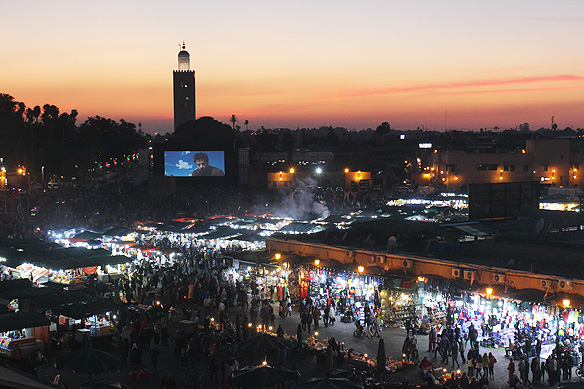
global travel shot: uninterrupted storytelling in djemaa el-fna

Image

Welcome to my blog post series on Morocco. 🙂

I was travelling through Morocco these past three weeks. Exploring its four Imperial cities, camping under the stars in the Sahara Desert, hiking through the Todra Gorge, soaking in the sun, sand and sea in Essaouira, and falling in love with pearl-blue Chefchaouen.

What better way could there be to kick-start my series than by writing a post on Morocco’s most popular city’s most famous site: Djemaa el-Fna. Continue reading

south africa: travel resources—where, what, why, how

emdoneni1

When putting together my travel plans for South Africa I was unable to find any package that truly covered what I was looking for. They either catered for the passive traveller or did the usual Cape Town/ Kruger combination and nothing else. A bit of a waste, I felt, since there was much more to South Africa. So I ended up travelling solo and independently through the country, doing all the things I really wanted to do, and pleasantly finding it one of the safest and friendliest countries for a woman to travel alone through.

I did some homework and luckily also found great guides whilst travelling. I’ve put together a list of the travel services I used. All of these are still valid as of now. I checked. Continue reading

south africa 10: kruger and the big 5

kruger1

Kruger National Park is nearly every South African’s favourite place in the world. It is also part of every tourist’s mandatory itinerary to the country. Covering an area of two million hectares, the game reserve is a realm in itself where wildlife reigns supreme and we humans are the outsiders, satiated with being mere audiences to a world that is complete.

No matter how many times one has been to Kruger, one can just never get enough of it. It is too big. It changes colours and moods with every passing day. Established in 1898 to protect the wildlife of the lowveld in the country, the park contains a mind-boggling number of animal and plant species together with centuries old cultural treasures such as rock paintings and archaeological sites.

I stayed for three days and two nights and, yes, saw all the Big 5. 🙂 Which boiled down to herds of buffaloes and elephants, a leopard smacking away its lips after an impala kill, rhinos marking their territories with trails of urine and dung, and seven lions and a herd of buffaloes battling away on the banks of a stream after the lions had attacked one of the buffaloes. Continue reading

south africa 9: the ‘panorama’ journey

panorama1

Guess you’ve heard the old adage—the journey is as important as the destination. My destination is Kruger National Park. The journey is appropriately the Panorama Route. 🙂

I had always wanted to do South Africa’s Panorama Route. One of those ‘have to do’ things in life. Why, you might well ask? It is scenic, on a majestic scale, cutting through the northern Drakensberg Mountains and Great Escarpment to abruptly give way to the plains of the lowveld.

Nature in South Africa is rather grand. Everything a little larger than life, a little more verdant, a little more unique and unduplicated by god. The Panorama Route’s first highlight is the Blyde River Canyon with the Three Rondavels standing sentry on the side; the latter evocative of the huts of the country’s indigenous people. Continue reading