#1 poignant taj mahal: 7 reasons why agra should be on every travel bucket list

“The world believes it was built by love but reading Shah Jahan’s own words on the Taj, one could say it was grief that built the Taj Mahal and it was sorrow that saw it through till completion.”
~ Aysha Taryam, The Opposite of Indifference: A Collection of Commentaries

This last week I travelled to Agra. I was keeping a promise to myself to revisit the city at a slower pace, in a more mindful way. It was my 4th visit. Needless to say, my previous ones were of the mass-produced variety.

The universe, weaving its magic in my favour, decided to back me on my plan and gave me one of my most memorable and beautiful travel experiences ever. I did not use any guide. I merely read up a lot, and wandered around the sites a lot more, often seating myself at a quiet spot or another to absorb the place at leisure. May I suggest you do the same? Live Agra’s treasures. Don’t just visit them.

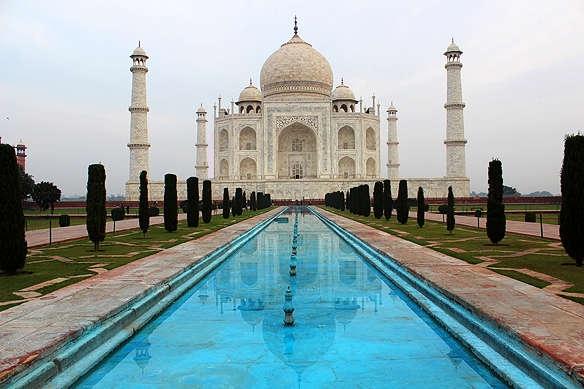
In this post I am uploading a series of pictures of the Taj Mahal, easily Agra’s biggest attraction, taken from 7 am to 12 noon [yes, I was there for five hours 🙂 ], and some basic context one needs to know. I hope it inspires you to let your soul and feet revel in the 350-year-old monument, like mine did. They will both thank you, profusely. Continue reading
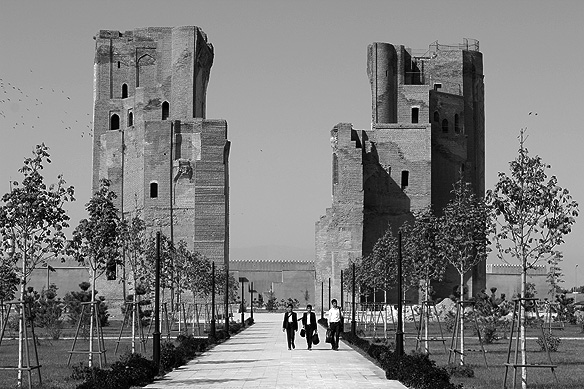
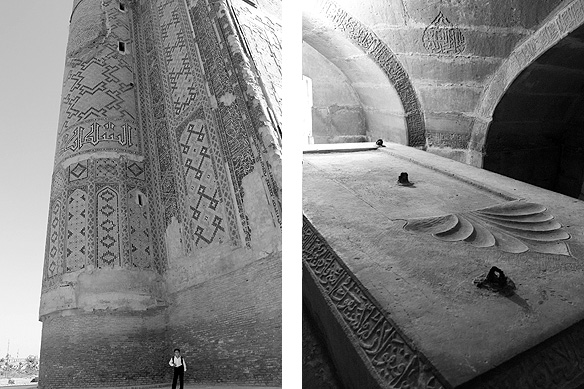
shakhrisabz, warlord tamerlane aka temur the lame’s hometown

shakhrisabz1
shakhrisabz2

The grandeur of the Ak-Saray Palace and the simplicity of his own intended tomb—both in Shakhrisabz—perhaps best describe Amir Temur the person, better known as Tamerlane [Temur, the lame]. Complex, multi-faceted, termed history’s most callous butcher, conqueror of southern, western and central Asia, he was the founder of the Timurid dynasty, and the great-great-great-grandfather of Babur, founder of the Mughal Empire in India. He lived from 1336 – 1405 AD.

Ahmad ibn Arabshah, Temur’s Arab biographer, had to say this of him when the latter was 70 years old:

“Steadfast in mind and robust in body, brave and fearless, firm as rock. He did not care for jesting or lying; wit and trifling pleased him not; truth, even were it painful, delighted him … He loved bold and valiant soldiers, by whose aid he opened the locks of terror, tore men to pieces like lions, and overturned mountains. He was faultless in strategy, constant in fortune, firm of purpose and truthful in business.”

Continue reading

the essential travel guide to aurangabad

Some travels are utopian. From brilliant guides to a lack of raucous crowds. From welcoming hotels to incident-free rides. From one-in-a-million experiences to unforgettable random moments. My 5-day solo exploration of Aurangabad and its environs in the month of March this year was one such. Unmarred at every level.

This post is about paying it forward. It is my way of passing on all the wonderful things that made my trip memorable. Perhaps some of these tips and insights could make your journey to Aurangabad just as special as they had made mine.

– – –

Aurangabad is no stranger to travellers. It is the springboard for excursions to the world-famous UNESCO World Heritage Sites of Ajanta and Ellora. It is from here that one usually sets off to explore the one-of-its-kind Lonar Crater Lake, a National Geo-Heritage Monument. Within the city itself are numerous edifices which bookmark key characters and events in India’s colourful history.

Yet, the sleepy town in the heart of the Indian state of Maharashtra seems unmoved by its role in the global tourism arena. Its traffic-free streets breathe at a leisurely pace. Its quiet neighbourhoods hum to a small-town rhythm reminiscent of the time when it was a village that went by the name Khadki. Continue reading

aurangabad: remnants of a despised emperor and his iranian queen

Aurangzeb. The very name evokes revulsion in Hindus and Sikhs alike throughout India. The butcher. Defacer of India’s rich Hindu cultural heritage. Murderer of Sikh Guru Tegh Bahadur. These are but a handful of epitaphs the country’s populace remembers Aurangzeb, India’s 6th Mughal emperor by.

His path to power was no less callous—he shed no tears when conniving the cold-blooded execution of his three brothers or when placing his old, frail father under house arrest.

It is 312 years since Shah Jahan’s fanatic son, Aurangzeb (1618 – 1707 AD) has died, but the hatred has not abated one iota. Stories of his cruelty fill school text-books. Nearly every major temple in India has either been mutilated or had a mosque built over it on his orders. The shudders are still there on the mention of his name. I have seen instances of all of these with my own eyes. Continue reading

24 hours in incredible allahabad

Amitabh Bachchan’s hometown. If one is Indian, it is the first thing that in most probability comes to mind when one hears of Allahabad. This is by virtue of the superstar’s constant vocal affirmation, flaunted with much pride, of its role in his life. It is where he was born and spent his childhood and youth, before becoming the country’s biggest and brightest star, still shining at 75.

To those spiritually inclined, Allahabad is evocative of all that is sacred in Hinduism. The meeting point of Ganga, Yamuna, and the mythical Saraswati, the city is built on the site of the ancient Aryan town of Prayag—the place for offerings. And perhaps, thus, by pure logic, it is also the site, since time immemorial, of the largest Hindu gathering held every 12 years on the banks of Sangam, or the confluence, in the form of the Maha Kumbh.

Rarely on most travellers’ circuit, Allahabad often gets side-lined in favour of its more popular neighbours on either side—Lucknow and Varanasi. But, like everything else in India, it too oozes of history, heritage, and stories galore, as I was quick to discover. Continue reading

global travel shot: alamgir aurangzeb’s mosque in varanasi

Image

Varanasi. The very name rings of sacred Hindu scriptures, stories of Lord Shiva and Ganga, and Hindu beliefs on life and afterlife. The oldest living city in the world, it is the accepted embodiment of Hinduism.

Yet, perched atop Panchganga Ghat by the holy River Ganges, where five streams are said to join, is a lovely functioning mosque—Alamgir Mosque. It is also the largest structure on the ghats. Standing over the ruins of a Krishna temple [the lower walls of the mosque belong to the original Hindu temple], the Hindu deities lie in a nearby edifice. Continue reading