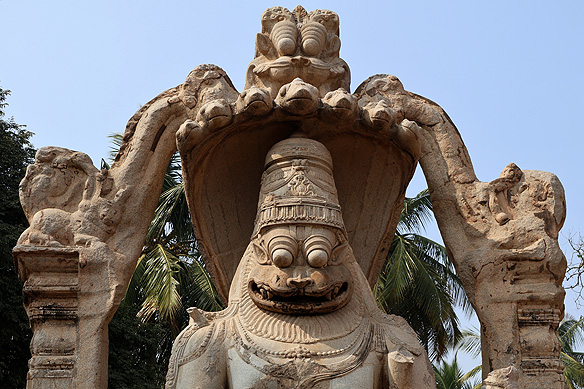
photo essay: hampi, stories told and untold

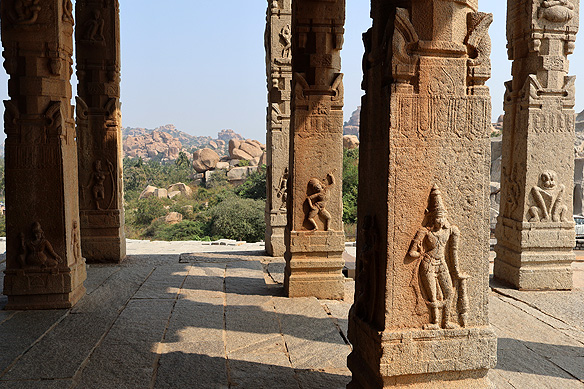
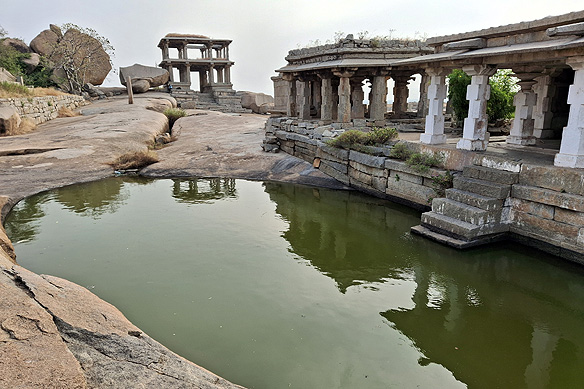
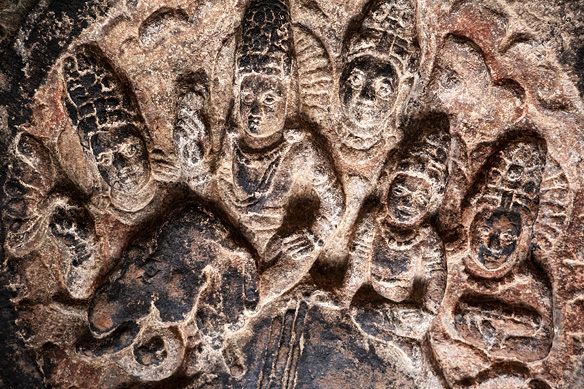
Don’t mistake the swarms of visitors at Hampi as tourists. Not all of them are. Most of them are pilgrims. For in Hampi, nestled in a surreal boulder-strewn landscape in north Karnataka, each stone is sacred.

Irrevocably tied to the Hindu epic Ramayana, Hampi traces itself back to a mystical past. Anegundi, the expanse across Hampi’s Tungabhadra river, was then known as the vanar [monkey] Kishkindha kingdom ruled by King Sugriva. In the epic, Sugriva’s commander Hanuman and army of monkeys helped Rama rescue his wife Sita from the demon Ravana.

Fast forward a few millennia from otherworldly mythology to historical facts substantiated by Kannada inscriptions and journals of Italian merchant Nicolo di Conti [1420], Persian diplomat Abdur Raazaq [1442], and Portuguese traveller Domingo Paes [1520].

Hampi, was now the capital of the wealthy, secular, and immensely powerful Hindu Vijayanagar empire. The richest city in the Indian subcontinent and the second biggest city in the world, it ruled a realm that encompassed modern-day Karnataka, Telangana, Andhra Pradesh, and Tamil Nadu.
Continue reading

aihole, cradle of indian temple architecture

Indian temple design did not arrive at in a day. Surprised? 🙂

More surprising is where its evolution took place.

The floor-plans and superstructures one takes so much for granted today took shape in a tiny village in north Karnataka over a period of two hundred years of vigorous, yet brazen experimentation.

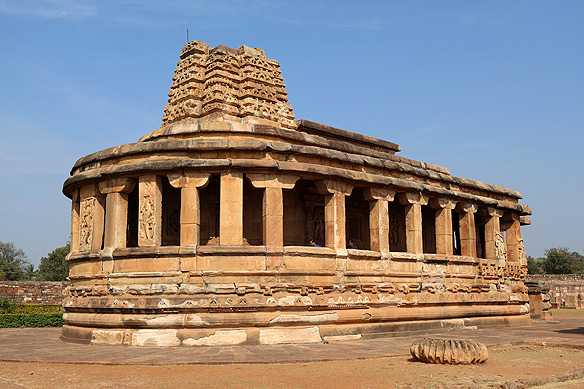
Known as the ‘cradle of Hindu temple architecture,’ Aihole, the first capital of the Early Chalukya Kingdom [6th to 8th Century] served as a laboratory for the construction of sacred sites.

From rock-cut cave temples to apsidal-shaped monumental structures to one akin to a cozy homely hut. From the ‘northern’ high curved Nagara-style and ‘southern’ pyramidal stepped Dravida-style superstructures to the hybrid ornate Vesara model typical of the Deccan. They all came into being here.

There are 15 prototypes of sandstone standalone and rock-cut cave temples in Aihole’s over 125. Each a masterpiece built by architects 1,500 years ago who designed fearlessly and were ready to break stereotypes.

It was a feat made possible by the prevailing rulers’ openness and willingness to experiment as they reigned over the Deccan, a region sandwiched between the north and south of the Indian subcontinent.

Currently on the UNESCO World Heritage Tentative List for its role in temple architecture evolution, many of Aihole’s edifices owe their names to a more recent and lax naming ceremony. Durga Temple is not dedicated to the goddess, but refers to a later Durg or watchtower built on its roof. Lad Khan temple, Aihole’s oldest temple, is so named because when discovered by the Archaeological Survey of India, it was known as where a Mr. Lad Khan once lived. A gentle reminder of Indian plurality. 🙂 And the Ravana Phadi rock-cut cave temple has less to do with Ravana and more to do with Shiva.

Next time you walk into a Hindu temple, surrounded by a familiar standardized floor-plan and superstructure, just remind yourself it is a design which won the lottery and got pushed into the future. There were many others in the original basket where these came from. And if you are curious about them, here are some of the candidates.

Continue reading

travel shorts: pattadakal, a marriage of sorts

Anyone who is acquainted with the idea of India, will also be familiar with the great north-south divide. It encompasses ethnicity, language, culture and in a deeply religious nation, temple architecture. Yet, in a narrow strip atop the Deccan plateau, one gets to witness a marriage of sorts in the latter that is completely unique to the subcontinent.

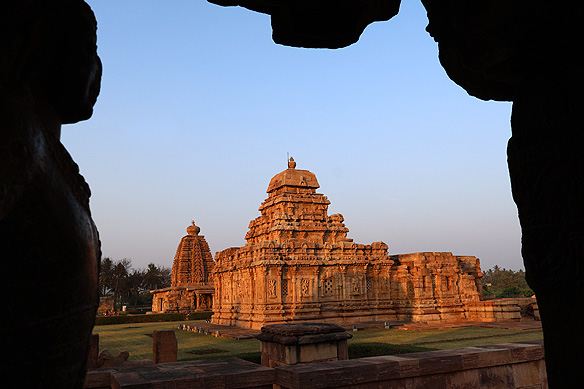
Pattadakal, a UNESCO-listed 7th-8th Century World Heritage Site displays this north-south eclectic mix at its finest. The enclosed part of the site is made up of eight temples—three of which are models, one a ‘project work,’ and four designed as full-fledged functional places of worship.

The Virupaksha Temple in the last group, with its sophisticated amalgamation of north and south elements, has been in continuous use since its consecration in 740 CE. It was commissioned by Lokamahadevi, a powerful Chalukya Queen, to commemorate her husband’s victory over the Pallava kings of the South.

If you have been wondering about my terminology, it is because Pattadakal, along with Aihole, were akin to a ‘laboratory’ where architects and artisans under royal decree experimented with temple architecture.

How about a corridor through which the local populace could circumambulate the holy sanctum which was otherwise out of bounds? A Nandi to mark the temple site? Perhaps a kalash finale atop the roof symbolising the meeting of heaven and earth? This investigational process, carried out over a couple of centuries culminated in Pattadakal’s most sophisticated edifices. Where the north and south architectural styles, till then side by side in platonic comradery, also merged in a hybrid blend for a while.

Scroll on to see some more images of this site. ❤ Continue reading

travel diaries: four caves, a lake, a seeker and badami

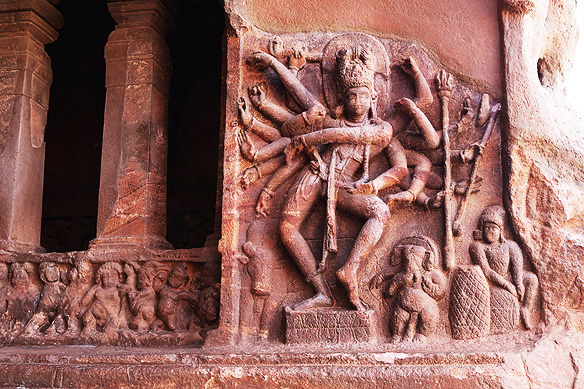
One of Badami Cave Temples' most impressive sculptures: Shiva as the 18-armed Nataraja doing the Tandava Nritya—the cosmic dance of creation, preservation, and destruction.

One of Badami Cave Temples’ most impressive sculptures: Shiva as the 18-armed Nataraja doing the Tandava Nritya—the cosmic dance of creation, preservation, and destruction.

One is never far from the gods in India. They are everywhere. Carved out of living rock. Carved into living rock. As far back as even 578 CE.

It is just after lunchtime, and I am at the foot of a gigantic red sandstone escarpment. Hundreds of school-children are racing down the steep uneven steps hewn into the cliff’s face. Their teachers shout behind them to slow down. Not that their wards pay any attention to the ominous warnings. Dressed in shiny tracksuits, they run in and out of the cavernous halls, doubled over in unstoppable giggles.

Slicing their way through this human avalanche are staid family groups. Their elderly matriarchs stomping ahead, undeterred by limps or wobbly canes.

Aaj bahut bheed hai [It is very crowded today],” I observe to the security guard at the gate. “Roz aisa hai. Season hai na aaj kal [It is like this every day. It is the season nowadays],” he smiles back happily.

In a few months these cliffs will be deserted again, first under the scorching summer sun and then because of the monsoons which would make the stone steps a veritable death trap.

Yet such ominous weathers rarely affected pilgrims in the distant past. 1,400 years ago.

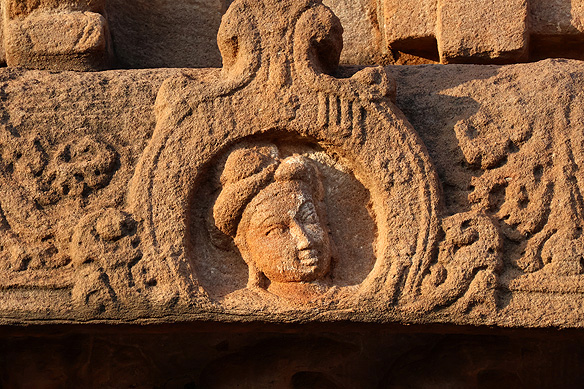
Portrait of a man in Ancient India. Ancient Hindu temples, by virtue of their depiction of both the sacred and secular, offer a fascinating insight into the then prevailing norms and societies.

Portrait of a man in Ancient India. Ancient Hindu temples, by virtue of their depiction of both the sacred and secular, offer a fascinating insight into the then prevailing norms and societies.

Continue reading

art focus – three dimensions of divinity – thanjavur art revealed

This slideshow requires JavaScript.

What can one person do? A lot. Never underestimate the efforts of a single individual.

The above thought kept going inside my head, in a loop, as I was reminded of other feats achieved by individual collectors. Such as Dr. Kelkar’s mind-boggling collection of 21,000 artifacts at the Kelkar Museum in Pune and the Jung family’s quirky walking sticks collection at the Salar Jung Museum in Hyderabad.

Meanwhile, right here in Mumbai, myths, legends, epics, temple layouts, local deities, stories of Hindu gods and goddesses, and 1,300-year-old poet-saints filled the museum walls wherever I looked.

I was standing amidst two centuries of an art style unique to India: The Thanjavur style of painting. Sheathed in jewelled colours and gold leaf, the masterpieces from the classical cities of Thanjavur and Mysuru, glinted and shone in the soft light. Calm in the face of my hard-to-hide awe.

It would be safe to surmise they were used to humans being bowled over by their resplendent beauty. After all, it had been part of their job. They had spent their lifetimes adorning sacred temples and shrines, in the company of gods. Continue reading

once upon a day in mysore: a one day itinerary of south india’s royal city

What if I told you there is a small town in South India which will forever remain your favourite, long after you visit it. What if I told you that in this town, frangipani trees sway gently and history, heritage, art and literature sit in easy camaraderie. That people here are simpler and the sky is bluer. Would the traveller in you jump for it?

I am talking about Mysore, renamed Mysuru, its original name, in 2014.

Less than a million-population live under its green shade of aged fig trees and their sprawling branches. Its wide dusty roads weave their way through a life where nothing much has changed over time.

From 1399 to 1950 Mysore was the seat of the Wodeyar dynasty, rulers of the Kingdom of Mysore except for a brief interlude when Hyder Ali and his son Tipu Sultan snatched the reigns. The Wodeyar family still lives in the Mysore Palace and the dynasty’s legacy permeates the entire town. From its seven palaces, of which two have been turned into museums, to its tutelary goddess perched high up on a hill, to its terraced gardens over the sacred Cauvery river. Continue reading

srirangapatna, historical capital of tipu sultan: the why, what, where, when, how guide

Some 18.5 kilometres to the north-east of Mysore city, on an island called Srirangapatna, lies a dusty town lost in time. Its current worn state belies its glorious past which still reveals itself shyly from behind its weathered structures.

Key historical events have taken place on its softly undulating plains. Larger than life rulers who till date evoke strong emotions made the island the centre of their universe.

Welcome to my guide on Srirangapatna, capital of the 18th Century ruler Tipu Sultan aka the Tiger of Mysore. The Why, What, Where, When and How guide of a town well off the usual tourist circuit, but deeply ingrained in every Indian history book, mass media, world museums and private collections.

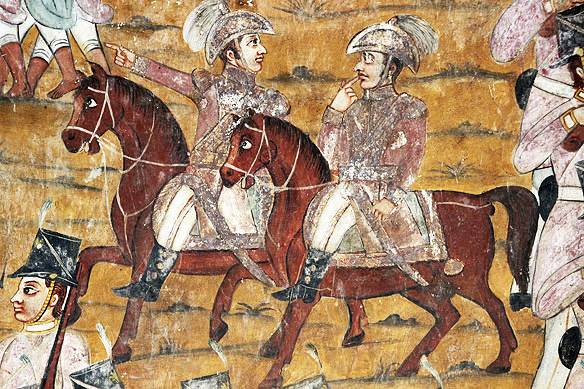
[Note: Top image: Detail, Fourth Anglo-Mysore War, 4 May 1799, British East India Company painting.] Continue reading

travel diaries: in search of shravanabelagola’s bahubali

The entire 615 steps carved into the rock’s gleaming surface rose straight above me. No left or right turns. Just straight up, with a rudimentary metal rod for support along its length. Some of the steps were shallow, others steep. All equally worn out under the bare feet of countless pilgrims and travellers over a thousand years. The steps themselves were just as bare under the scorching sun, minus any shade whatsoever.

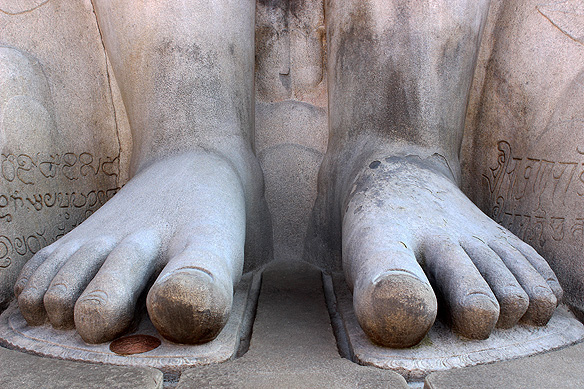
Only one spiritually legitimate way exists to reach the 58-feet-8-inch-high naked granite monolith of Bahubali Gommateshwara, the inimitable deity-hero in Jainism perched on top of the sacred Vindhyagiri Hill in Shravanabelagola. It is by climbing up these steps.

Though another flight of steps winds its way up on the western side of the 470-feet-high hill, this is the original path cut into the rock by Chavundaraya, a Ganga dynasty minister and commander way back in 981 AD. And by now you know me. It had to be the original path for me. 😀

It was 1 in the afternoon when I reached the minuscule town of Shravanabelagola after exploring the Hoysala temple at Somanathapur. My plan was to use one of the palanquins I had read about to reach the top. But do plans ever go as planned? Continue reading

poetry, myths and stone: the millennium-old sculpted hoysala temples of karnataka

[UPDATE: The ‘Sacred Ensembles of the Hoysalas’ made it to the UNESCO World Heritage Site list on 18 September, 2023. It is India’s 42nd UNESCO World Heritage Site.]

Cries of “Hoy, Sala” [Strike, Sala] rang out as Sala, a Jain youth, single-handed fought a tiger to save his guru. It was around 950 AD, in the Deccan plains of South India. He immortalised this cry in the name of the dynasty he founded—Hoysala—which ruled the region till 1355 AD. The incident became its emblem.

Sandwiched between the Chalukya dynasty in Badami and the ruling Cholas in Thanjavur, Sala and his descendants created a flourishing agrarian empire populated by a sophisticated society, and where the arts thrived. Their capital was Belur, then called Velapuri. Vishnuvardhana [1108 – 1152 AD], the 5th Hoysala king, later moved his capital to Halebidu, 17 kilometres away, where it stayed till the end.

Though Hoysala palaces and homes are long gone, their stone temples still stand. Even time and wars have not been able to diminish their exquisite beauty, a fascinating peek into a by-gone society’s values and aesthetics.

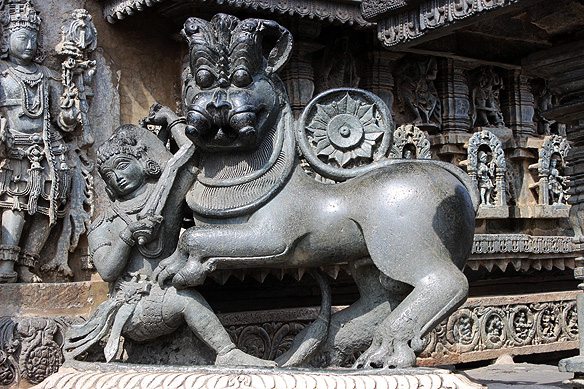
So, if you ever thought all temples in India look the same, think again. Every dynasty and empire in the Indian sub-continent created its own inimitable style through history. Hoysala temples are typified by being star-shaped, compact structures on a raised platform, ornate with a focus on dance and music, and carved out of soapstone. Continue reading

why tipu sultan’s dariya daulat bagh will take your breath away

Two-hundred-and-fifty years ago lived a man renowned for his opulence, and bravery. He was fearless. Nothing scared him. Or perturbed him. He also had a deep abhorrence for the British East India Company and its colonial inroads into India.

His name was Tipu Sultan, ruler of the Kingdom of Mysore. And his capital was Srirangapatna [spelt Seringapatam by the British], an island plonk in the middle of the mystical Cauvery River in present-day Karnataka.

It was to this tiny little, steeped in history, sleepy town that I found myself one day during my Mysore travels. Where.time.stood.still. And there were stories galore. Continue reading