discover ancient roman volubilis through a self-guided walk

There is a reason I travel solo. I tend to get lost when I travel. No, not physically. That would be impossible in today’s day and age with Google Maps and diligent service providers busy at work with their mobile phone tracking systems to keep you connected. What I mean is I get lost in the experience. I lose track of time. Which is great for me, but, have come to realize, is not so great for others. 😀

This post is about one such lost-in-the-experience day I spent at a place called Volubilis in northern Morocco, in the foothills of Mount Zerhoun. And how you too, if you wish [that is], could lose yourself in its magic!

Volubilis was a large Roman colonial town on the fringes of the Empire. Though dating back to the 3d Century BC and occupied till the 11th Century AD, its hey-day lasted from 44 – 285 AD when it was capital of the Roman province Mauretania Tingitana.

It was a wealthy town—fertile grain and olive oil-producing lands surrounded it—and its 20,000 Romanised Amazigh inhabitants lived in fancy villas lining broad avenues. Today, the archaeological site is a UNESCO World Heritage Site. Continue reading
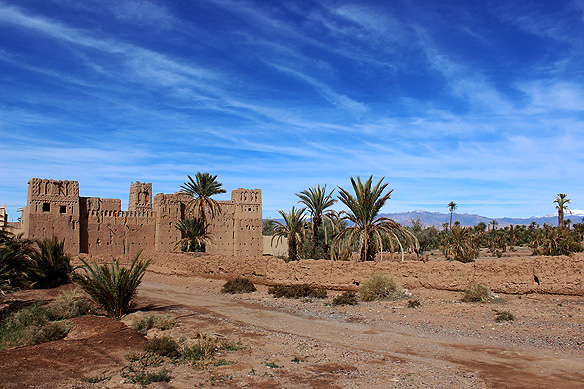
the forgotten kasbahs and ksars of morocco’s high atlas mountains


[Valley of a Thousand Kasbahs]

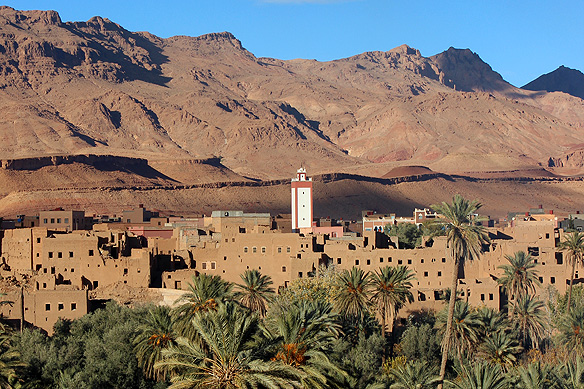
A high-pitched Amazigh love song is playing on a loop in the car stereo. Abdul, my cab driver decides to give it company with deft dance moves from behind the steering wheel even as he swings the car around hairpin bends. He does not speak English. I don’t speak Arabic, Amazigh or French. We are high up in the High Atlas Mountains in Southern Morocco.

Should we crash down the rock face would anyone be able to trace us, I ask him with hand signs. He signals I should not worry, and grins. These mountains are his home. I tell myself I should be afraid. Instead, I have a huge smile plastered on my face as well.

Oh, how I love these blood-red, barren mountains spread all around us, till as far as the eye can see! Majestic, mysterious, and millions of years old. There is no other sign of life under the ultramarine blue sky, except for our car and glimpses of a green oasis which ribbons its way in the plunging valley below.

I am on my way to Telouet, a crumbling mud-brick Kasbah [palace] 5,900 feet high up in the mountains. I had chanced upon the name when reading up for my Morocco trip and though outside the tourist circuit, I just knew I had to visit it. Continue reading

the essential travel guide to aurangabad

Some travels are utopian. From brilliant guides to a lack of raucous crowds. From welcoming hotels to incident-free rides. From one-in-a-million experiences to unforgettable random moments. My 5-day solo exploration of Aurangabad and its environs in the month of March this year was one such. Unmarred at every level.

This post is about paying it forward. It is my way of passing on all the wonderful things that made my trip memorable. Perhaps some of these tips and insights could make your journey to Aurangabad just as special as they had made mine.

– – –

Aurangabad is no stranger to travellers. It is the springboard for excursions to the world-famous UNESCO World Heritage Sites of Ajanta and Ellora. It is from here that one usually sets off to explore the one-of-its-kind Lonar Crater Lake, a National Geo-Heritage Monument. Within the city itself are numerous edifices which bookmark key characters and events in India’s colourful history.

Yet, the sleepy town in the heart of the Indian state of Maharashtra seems unmoved by its role in the global tourism arena. Its traffic-free streets breathe at a leisurely pace. Its quiet neighbourhoods hum to a small-town rhythm reminiscent of the time when it was a village that went by the name Khadki. Continue reading

travel diaries: hiking in the lonar crater

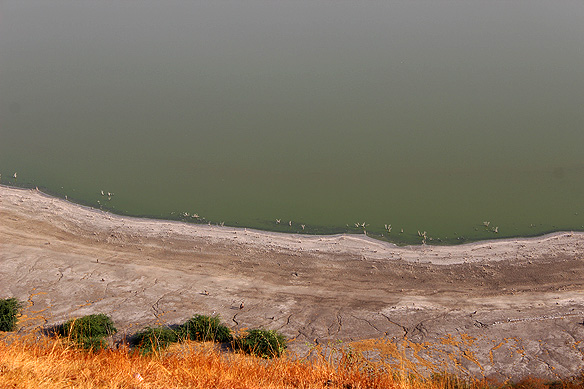
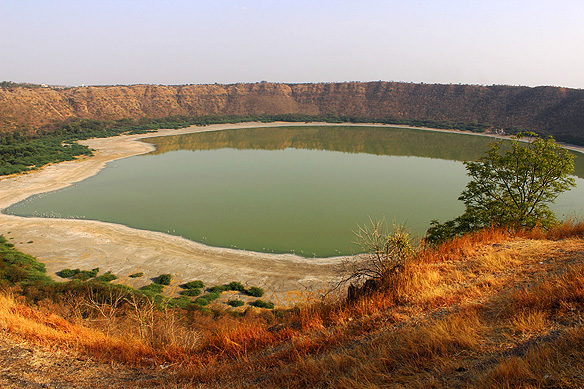
It was hot. Though still “spring,” the dry earth and parched twigs crackled in the heat under the relentless bleached sun. Nestled in a yawning hollow below me was a murky saline and alkaline lake. There was no path leading down. Just boulders and a smattering of clear patches.

I asked myself what the hell was I doing here.

High on every geologist’s bucket list, Lonar is the only hyper-velocity impact crater in basaltic rock on our earth. It was created some 52,000 years ago by a meteor weighing 2 million tonnes, hurtling at a speed of 90,000 kilometres per hour. Some believe the meteorite is still stuck inside the lake. But I am no geologist. For a devout Hindu, it holds in its folds scores of medieval crumbling stone temples. But I am no devout Hindu either. For the hiker, it is an opportunity to hike down and then up, an attractive enough deviation from the ordinary. Perhaps that was it. Continue reading

india’s classical masterpiece: the ellora caves

Be prepared to be bowled over.

No matter how many incredible photographs or videos you may have seen or paragraphs of eloquent text in guide books and articles you may have read, the real thing will.still.take.your.breath.away.

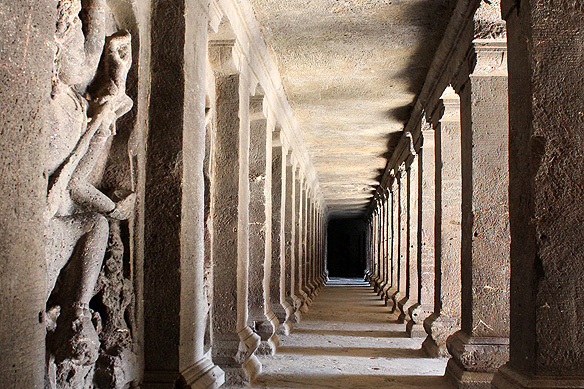
The Ellora caves are grander and more magnificent, yet full of intricate detailing, than you may ever have imagined.

Three ancient Indian religions are housed here. Three arts converge here. The site, spread over a two-kilometre long basalt massif, is one of the world’s largest rock-cut monastery-temple cave complexes with more than a hundred caves. And if that were not enough, these ‘caves’ were excavated out of living rock over a millennium ago, between 550 and 950 AD to be exact, with chisel and hammer, to create ethereal art and architecture in its wake.

Come, let me take you on a virtual tour of India’s Classical masterpiece and a UNESCO World Heritage Site since 1983. And in the process, inspire you to also make the journey to the Ellora caves in person. For what is life, but moments which take our breath away. 🙂 Continue reading

aurangabad: remnants of a despised emperor and his iranian queen

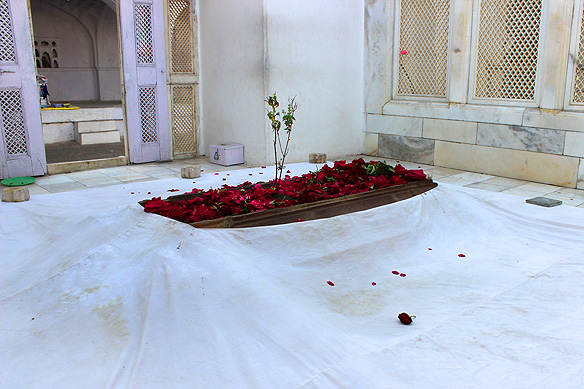
Aurangzeb. The very name evokes revulsion in Hindus and Sikhs alike throughout India. The butcher. Defacer of India’s rich Hindu cultural heritage. Murderer of Sikh Guru Tegh Bahadur. These are but a handful of epitaphs the country’s populace remembers Aurangzeb, India’s 6th Mughal emperor by.

His path to power was no less callous—he shed no tears when conniving the cold-blooded execution of his three brothers or when placing his old, frail father under house arrest.

It is 312 years since Shah Jahan’s fanatic son, Aurangzeb (1618 – 1707 AD) has died, but the hatred has not abated one iota. Stories of his cruelty fill school text-books. Nearly every major temple in India has either been mutilated or had a mosque built over it on his orders. The shudders are still there on the mention of his name. I have seen instances of all of these with my own eyes. Continue reading

the painted and sculpted caves of ajanta

This slideshow requires JavaScript.

If you were ever of the opinion that Buddhist art was all about asceticism and restraint, think again. The caves at Ajanta, in the Indian state of Maharashtra, are a lavish statement to the contrary as I discovered earlier this month on a five-day trip exploring the region in and around Aurangabad. But then, isn’t that what travel is meant to do? Break perceptions. 🙂

Imbued with sensuality borrowed from its sibling, Hinduism, ancient Buddhist art in its parent country is filled with nudes performing graceful mudras, figures wrapped in erotic embraces, and faces marked with raw emotion. Interspersed in this human carnival are serene, silent, meditating Buddhas, perfectly at peace in their company.

The mix of spiritual with secular, ordinary with sublime are common traits in Indian aesthetics. Why then should Buddhist art have been any different! Continue reading

global travel shot: lonar crater, a meteorite’s shot at earth

Image

“That’s where the meteorite came hurtling from,” my guide Mahesh points towards the Gomukh Temple perched on a slight dent in the rim.

“When was this?” I ask, breathless, as I slip over rubble and step gingerly down boulders, trying hard to look where he is pointing to and not go tumbling down in the process.

“Some say 52,000 years ago, some say 570,000 years ago.” Continue reading

travel diaries: hiking through the todra gorge

There are two choices for the hiker at Todra Gorge. You can either go up, scaling the burnt orange limestone crumbling cliffs of the High Atlas Mountains, higher with every step, or carry on along the canyon floor into its bowels, deeper ahead. Both have their own perks. A bit like life itself.

Since most people tend to climb up, and I like to do things a tad differently, I decided to walk on straight. It was a long walk. Some four-and-a-half-hours long.

I started at the most visited and dramatic section, a 10-meter-wide chasm shared by both river and road, and penned in with towering perpendicular cliffs 160 metres tall. Stretched over a length of 600 metres, the tourist crowds usually do their U-turn here and go back.

But should one venture on, the unfolding of the cliffs into craggy piles of rock up to 400 metres high that line a desolate sun-baked concrete road is surreal and unreal rolled into one. The only sound I could here as I trudged on alone under the ultramarine blue sky was the chirping of birds. They seemed almost glad for my company. Continue reading

photo essay: in search of the sahara desert

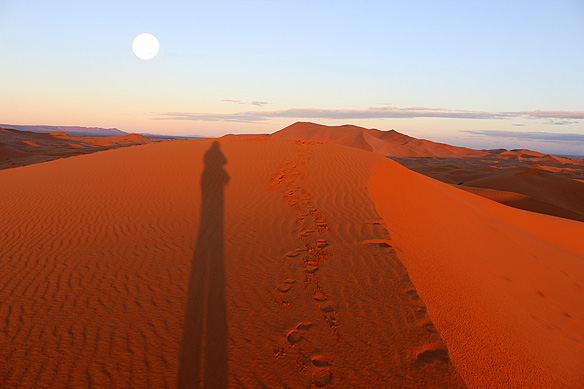
A sea of endless, sweeping, sand dunes which change colour in tandem with the sun. A night sky bristling with stars brighter than diamonds. The pin-drop silence that only nature can muster. Aah, the immensity of life and being part of it one-on-one!

Camping under a silver full moon in the Sahara Desert was the reason I travelled to Morocco last November. It was something I had fantasized about since as long as I could remember. It was the reason my heart thumped a little harder and my goose bumps rose a wee bit higher whilst I packed for my three-week trip. Yes, I knew there were going to be lots of other wonderful experiences, but this, this was special.

In my ignorance I expected to simply walk into the bone-dry fringes of the Sahara Desert which fell inside Morocco’s borders, once I left Fes. Wrong.

My journey of 470 kilometres took me through European-styled pristine and chilly hill-stations to 360-million-year-old fossil land choc-o-bloc with ammonites, trilobites, and orthoceras. I met proud, independent, solitary Amazigh nomads in their bare tents in the Middle Atlas and broke into giggles with schoolgirls at Rissani, once the ancient gold-trading centre of Sijilmasa. Continue reading