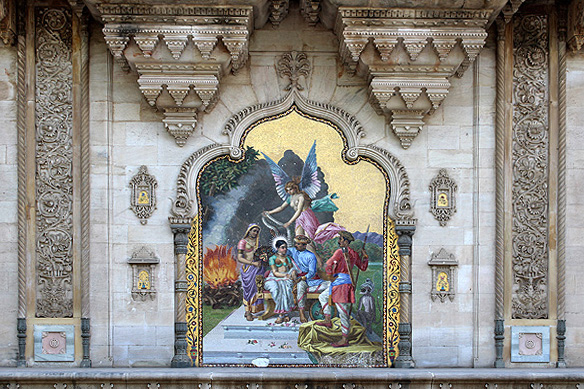
the heritage precinct of gamdevi in mumbai: modern india’s birthplace

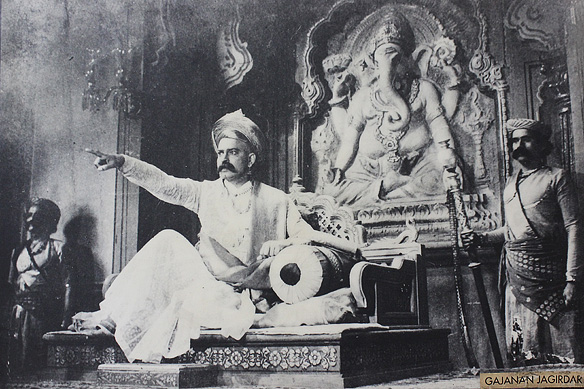
gamdevi1_sepia

Whoever said Mumbai is all steel and glass, often-times grotesque, or miles of slums topped with blue tarpaulin needs to revisit it. Seriously, and, no, this is not some biased Mumbaikar’s rambling.

The city spills over with heritage. It is perhaps not in a blatant form as in other Indian cities which are decorated with grand tombs and forts. Mumbai’s heritage is sepia-toned, like a beautiful memory living on in the modern everyday life we live out on a daily basis, and are unaware of where it stems from. It is a heritage not of brick and mortar but of ideologies and modernism, the latter both political and cultural. It is the sapling that grew up to become “Modern India.”

A few months ago, this became evident to me when I joined a heritage walk through a precinct in South Bombay called Gamdevi or Gaondevi, meaning Village Goddess. The neighbourhood is named after its 200-year-old temple dedicated to Durga, also referred to by its devotees as Lilavati “a graceful woman.”

Spanning less than 500 metres across in width and length each, Gamdevi is where Bollywood talkies originated and Indian feminism shaped itself. Its lanes have triggered the imaginations of painters and authors alike, and its edifices given concrete form to convictions. It is also where Mahatma Gandhi lived and launched the Quit India Movement in 1942. Gamdevi is a pot pourri of the makers of Modern India, and their stories, and by default, our stories, I like to believe. Continue reading

thimphu, the unusual capital city—a photo essay

thimphu_bridge1bw

[My below post was published in the November–December 2016 edition of Druk Air’s in-flight magazine Tashi Delek. All proceeds from my fees went to support the Ability Bhutan Society, a charity supported by Her Majesty the Gyaltsuen in aid of persons living with moderate to severe diverse abilities.]

– – –

Imagine. Imagine a city, a functioning capital city, with all its chores of running a nation perched high up in the Himalayas, bereft of any street lights, and one which made its debut in international tourism and on the “world stage” as recently as 1974. Before that, you and I would not even have been able to cross its borders.

Imagine a city with multinationals and media houses, where architecture, culture and everyday life wear the mantle of Tantric Buddhism. By law, buildings are mandated to be modelled on traditional lines, replete with symbolic paintings. Bhutanese have to dress in local attire.

Imagine a city where there are national tournaments in archery at the national stadium coz, yes, archery is the national sport. Monks are not allowed to take part in archery. They play another sport in its place—daygo which involves throwing flat circular discs.

Till the 1960s schooling was limited to religious studies in monasteries. Bhutan lifted its ban on the Internet in 1999. It was the last country in the world to do so. Mobile telephones were introduced in 2003. The only way to reach Thimphu is by road [it does not have an airport].

For all the above reasons, and many more, Thimphu is worth that extra set of miles. It was, definitely, worth mine. Continue reading

the secret, sacred wonders of paro valley

Paro Valley, Bhutan

[My below post was published in the March–April 2017 edition of Druk Air’s in-flight magazine Tashi Delek. All proceeds from my fees went to support the Ability Bhutan Society, a charity supported by Her Majesty the Gyaltsuen in aid of persons living with moderate to severe diverse abilities.]

– – –

Deep in a valley in Western Bhutan, on the banks of the Paro Chhu river, lies a town suspended in time. The emerald green fields glimmer in the sun, punctuated with scraggy scarecrows. A lone woman in a purple kira tills the soil under an azure blue sky.

Lao Tzu’s words, from way back in the 6th Century BC, echo in my mind:

“Be still,
Stillness reveals the secrets of eternity.”

My reverie is broken by hollers and laughter in the distance. The farmers have started setting up their produce in the local market comprising a string of wooden tables piled high with fresh and sun-dried vegetables. The latter help carry the Bhutanese over the cold dry sterile winters. A line of red-robed monks file past me, a gentle smile on their lips.

It’s the crack of dawn, and I am in Paro. The main street I am walking down is lined with traditional buildings and was paved only recently, in 1985. Continue reading

when a blog comes of age

ramaarya_kanyakumari

Those of you following my blog from before the 24th of July, 2016 may have noticed its new URL. It was changed from returnoftheprodigal.wordpress.com to ramaarya.wordpress.com on the 25th. Why? Because the blog had grown beyond being about just one chapter of my life. 🙂 Continue reading

36 hours in kolkata

kolkata_36hours11

Let me first clarify that this is not a mandatory schedule, or a list of top not-to-miss attractions. It is instead how I spent my 36 hours in the city of joy—as a traveller, art enthusiast, and a volunteer, and ended up falling in love with it, despite the lousy weather, crowds, and advertised poverty.

It is an attempt to see the city with very personal eyes.

Kolkata aka Calcutta is not a world city. I would not even call it an Indian city. It is Bengali where the faces are round and everyone and all road signs converse in the native tongue, under a colonial mantle.

The mix, I would like to believe, is unique to it. On one side Kolkata is deeply indigenous when it comes to deities and festivals, and the arts and music. On the other, it nonchalantly wears its monumental British legacy with ease and a stiff upper lip. Somewhere in between, the city has become synonymous with charity.

36 hours is not really enough to absorb all that it holds in its folds. But it sufficed as an engaging enough introduction for me, and maybe does for you as well. 🙂 Continue reading

sacred mountain passes of western bhutan

mountain_passes13

[My below post was published in the September–October 2016 edition of Druk Air’s in-flight magazine Tashi Delek. All proceeds from my fees went to support the Bhutan Nuns Foundation, a charity run by the queen mother in aid of women’s empowerment and education.]

– – –

Sacred
‘seɪkrɪd (Adjective)
Regarded with reverence, awe, or respect

Mountain pass
‘maʊntɪn pɑːs (Noun)
A route through a mountain range

Reading up about Bhutan during my travels, I came across a quote by Jeffrey Rasley, spiritual seeker and adventure traveller that perhaps best sums up the mountain experience: “Chasing angels or fleeing demons, go to the mountains.”

Whether it is angels or demons in your case [in mine it is usually both], mountains have often enough been associated with the sacred, and none more so than the Himalayas, and like all other mountain realms in the region—Bhutan. Perhaps because mountains are closer to the heavens and impregnable to traverse, the routes through them lets us ordinary folks get up close and personal to the sacrosanct in them. And everything feels OK. 🙂 Continue reading

the taktsang trek for the non-trekker

taktsang1
That little white speck in the middle—that’s the destination, Taktsang Palphug Monastery, Bhutan. The climb up the ravine—that’s the journey 🙂

I am not a trekker. Don’t get me wrong. I am not lazy. 😛 I can walk miles and miles. But walking on level ground and up boulders, shrubbery, and running streams are two very different things. My excuse is that I spend most of my time in large metropolises. I am aware it is a weak argument. I know many, way more urbane than me, who sip their wines amidst swirls and dress as if they’d just stepped out of a fashion glossy, able to clamber up a mountain with equal ease. How do they do it??? I’d love to be able to. Truly.

But that has not stopped me from attempting climbs and treks which are universally accepted as being spectacular. And doable. Taktsang Trek was one such. Continue reading

indian sculpture’s 1,500 year journey at the indian museum, kolkata

indian_museum

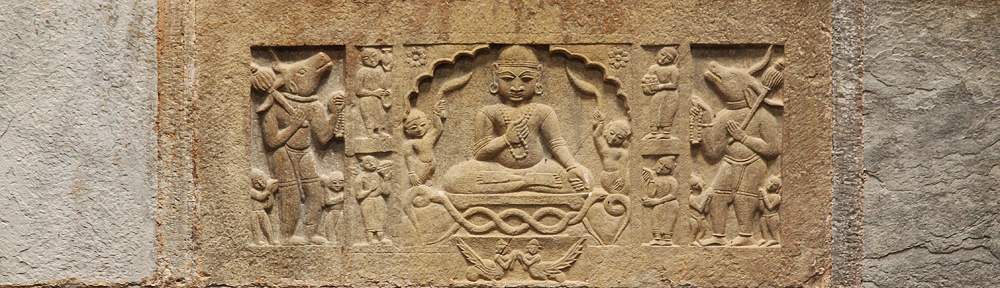
A nondescript placard on the wall reads: “Buddhist Stupa, 2nd Century BC, Bharhut, Madhya Pradesh.”

I turn around and almost knock into a magnificent red sandstone 9-feet high railing and 23-feet high gateway, teetering in awe at its grandeur and proximity. It is covered profusely with intricate imagery of secular life and Buddhist teachings in 2nd Century BC India. Short inscribed labels in Brahmi script record the names of donors.

The monumental piece is nothing short of breathtaking. Much like everything else in the archaeology gallery of India’s oldest and largest museum, the Indian Museum located just around the corner of Park Street, Kolkata, and built in 1878 by the then British Raj.

Arranged in chronological rather than thematic order, the gallery showcases 1,500 years of India’s sculpture art, from which emanate its various schools and inter-linkages, in a seamless story.

Piqued? Come join me on a virtual tour of this collection under whirring fans, encased in a hot humid corridor in a Doric columned colonial edifice. 🙂 Continue reading

punakha dzong: bhutan’s most beautiful dzong

Magical things happen when nature, history and humankind, with a dash of the spiritual come together. More so when it is Bhutan, and even more so in a 1637 Palace of Great Happiness built on the confluence of two rivers, charmingly named Pho Chhu [father] and Mo Chhu [mother].

If there is only one dzong you get to see in the Thunder Dragon Kingdom, let it be the Punakha Dzong, or the Pungtang Dechen Photrang Dzong built by Ngawang Namgyal (1594–1651), 1st Zhabdrung Rinpoche [Great Lama] and founder of the Bhutanese State. Continue reading

global travel shot: the unknown 5th century shiva saptamurti in parel

Image

parel_5thCentury_sculpture_1

You may well say, Aah, I have seen this sculpture before. That is, if you are a museum buff. Wrong.

Allow me to make a confession. I often find myself torn between awe at the cultural treasures with which India bursts at its seams with, and angry at the apathy, neglect and state of degradation in which many lie. I know I am not alone in this conflict.

Exactly a year ago I visited the sculpture gallery at Chhatrapati Shivaji Maharaj Vastu Sangrahalaya, Mumbai, formerly known as the Prince of Wales Museum of Western India. Like very many others, I fell in love with one piece. Continue reading