photo essay: mountains, desert, and coast of northern oman

If you look closely at Oman’s map you will notice a peculiar detail. There is the mainland, and separated from it is its governate Musandam on a peninsula jutting into the Strait of Hormuz. Look more closely. You will see an exclave [called Madha] between the two that is surrounded by the UAE. Look at it even more closely. Within Madha is Nahwa, an enclave that belongs to the UAE.

Now you may well ask, how did this happen?

Somewhere around the late-1930s, the four rival sheikhs controlling the surrounding area asked Madha’s village elders who did they want to pledge their allegiance to? Madha chose the Sultanate of Oman, but the bit inside it called Nahwa chose the Arab Emirates. Based on their choice, the rather unusual border between the UAE and Oman was drawn out in 1969.

That is Oman for you.

The eclectic set of borders further transposes into an eclectic set of mountains, desert, and coastline, juxtaposed right next to each other. It is as if the gods asked them too, whose realm did they choose, and they all in unison said “Oman.”

Described as a geologist’s paradise, the oldest continuously independent nation in the Arab World [since 1650] has held on to its authenticity well. Despite being a high-income country, there is no rivalry for high rises in the Sultanate of Oman, nor glitzy shows of oil wealth.

Come travel with me through my photo essay across northern Oman as I take you from Muscat to Fins Beach via the Bimmah Sinkhole and Wadi Tiwi, on to Ras Al-Hadd to see turtles and Sur to see dhows, camp under the stars in the Sharqiya Sands, stop by at a Bedouin market in Sinaw, have meals at traditional mud settlements, drive offroad to the top of Jebel Shams and then down Wadi Bani Awf, to be back in Muscat. And on the way, learn about this fascinating country and its warm, laid-back, friendly people. ❤
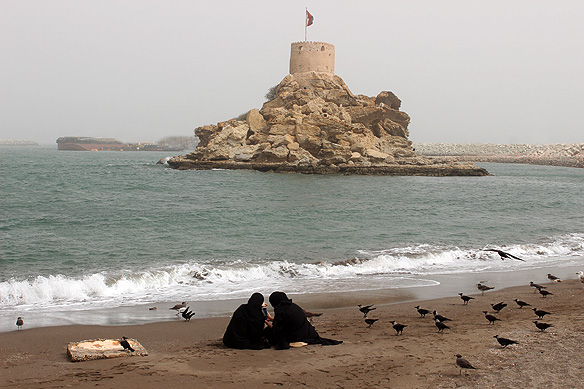

The journey begins. Continue reading
self-portrait: happy in spiti

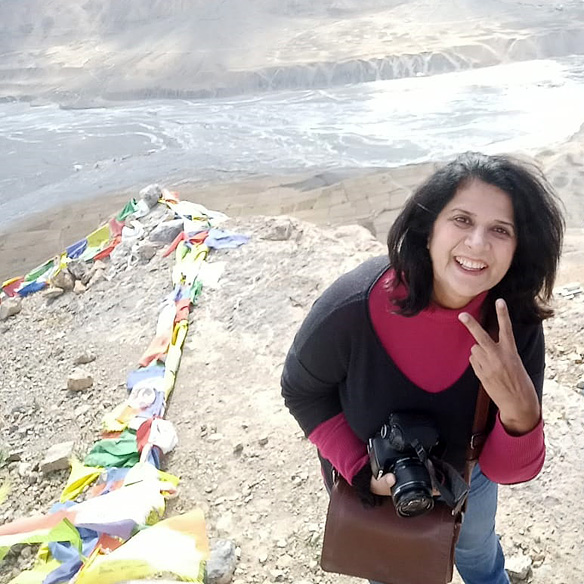
Those of you who have been following my blog would be well aware that I rarely, if ever, post pictures of myself in my blog posts. The closest I get to is the inclusion of a photograph of my hand holding something I’d picked up at the site or that of my feet. There is neither a deep philosophical reason, nor an effort to create a sense of enigma, behind this. It is simply because I usually travel alone, and I am lousy at taking selfies.

So, when my driver offered to take a picture of me during a recent 15-day solo road trip though Kinnaur, Spiti and Lahaul, deep in the remote northern reaches of Himachal Pradesh, amongst the towering Himalayas, I jumped at it. It was a precious opportunity to make my joy whilst travelling to this part of the world achieve posterity. 🙂 Continue reading

exploring jaisalmer: one of the world’s few surviving living forts

It was nearing midnight. We’d been on the road for close to nine hours, having left Mandawa at three in the afternoon.

The deserted highway, smooth and wide, was sheathed in golden desert sand under a pitch-black sky. Our drive constantly interrupted with herds of prancing wild camel, stoic buffaloes, and abandoned cattle which merged with the darkness of the night. We were on our way to Jaisalmer in the north-west frontiers of Rajasthan.

I will never forget the calm words of my 22-year-old driver, Budharam Bishnoi, the first time an animal sneaked in front of our speeding vehicle: “Jitna aapki suraksha karna mera dharam hai, utna hi inn jeevo ka suraksha karna bhi mera dharam hai. Aap chinta mat karein.” [Just as it is my duty to protect you, it is also my duty to protect these animals. Don’t worry.” Continue reading

global travel shot: silk road opulence in bikaner

Image

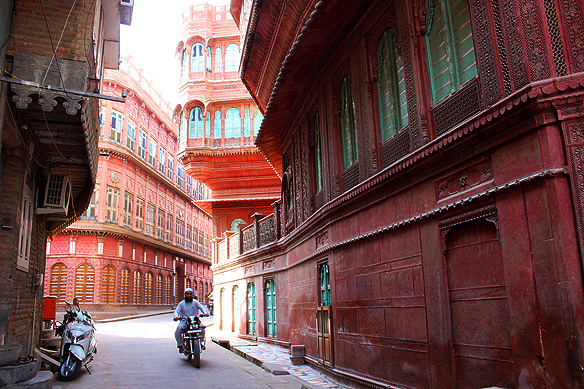
Ever wondered what the homes of the Great Silk Road merchants looked like? Please look at the image above this paragraph. All the monumental edifices lining the pronged road belonged to one such family—the three Rampuria brothers—the wealthiest merchants in Bikaner.

A small princely state deep in the deserts of northern Rajasthan, Bikaner’s strategic location on the Great Silk Road promised, and delivered, immense wealth to its people through the taxes imposed on the wares that passed through it and access to markets for Indian commodities. Silk, spices, precious stones, metals, and opium made the people of Bikaner into billionaires of their era. Continue reading

photo essay: amer, the unesco-listed fort and beyond

“This heaven like place was completed in the Hijri year 1008 [1599 AD], being built in a period of 25 years, having been most meticulously designed and expertly decorated. Just as the heavens should always be laden with rain, so also this stately building, the foundation of the Maharaj’s longevity and wealth, be preserved from any kind of damage.”
~ Excerpt from the English translation of a Persian plaque inside the Zenana, Amer Fort.

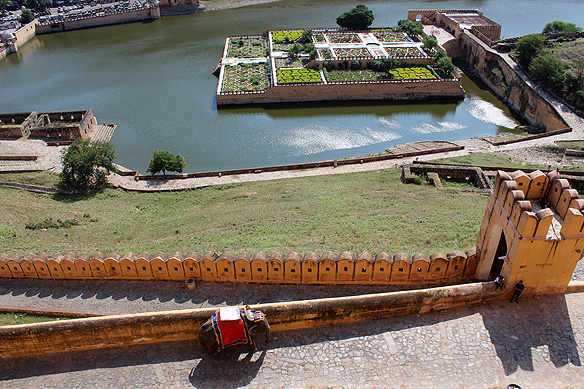
Part of the six ‘Hill Forts of Rajasthan’ UNESCO World Heritage Site, Amer Fort rises high above the placid waters of Maota Lake. Its magnificent Rajput-Mughal edifices reminiscent of the power of the Kachhwaha Rajputs and their strategic ties with the Mughal empire. For 128 years, Mirza Raja Man Singh I’s labour of love served as the administrative base and royal residence of the Amber kingdom. That is, until 1727 when Maharaja Sawai Jai Singh II decided to move the capital to Jaipur some 15 kilometres away.

Most travellers simply visit the fort, gush in wonder, and leave. But there is more to Amer than just this glorious marvel. Much more, beyond the fort. Continue reading

the epic solo rajasthan road trip: because travel heals pain

This slideshow requires JavaScript.

[Updated on 30 November 2021]

My mother passed away on 19 July this year from old age. She was 84. It is now almost four months since she’s been gone, yet the pain is still raw. She went too fast. I knew she was going to go to the other side one day. One day. Just that one day was some distant occurrence which I naively believed was not going to happen in my lifetime. We all believe our parents will live forever.

If you are a follower of my blog, you would have noticed the change in the title. I have added ‘Toshi’ in it. Toshi was my mother’s maiden pet name. By adding it to my blog it keeps her alive for me.

We were chalk and cheese. Fought and hugged. She was the most loving human being I had ever come across. And through all of life’s trials and tribulations, she was my constant best friend.

More than anyone else, she also knew my need to travel. To wander. To explore. She understood travel was my one source of inspiration, as well as escape. A source of pragmatic knowledge and elusive wisdom.

It is no surprise then that as I struggled, and still struggle, to cope with my loss, my sister, as if in serendipity, suggested I turn to travel. Continue reading

the spectacular treasures of samarkand

Registan, Samarkand

We travel not for trafficking alone;
By hotter winds our fiery hearts are fanned:
For lust of knowing what should not be known,
We take the Golden Road to Samarkand.

~ James Elroy Flecker

One cannot claim to be a traveller, and not have made the journey to Samarkand. Or at least have thought of it, fantasised about it. It would be blasphemy.

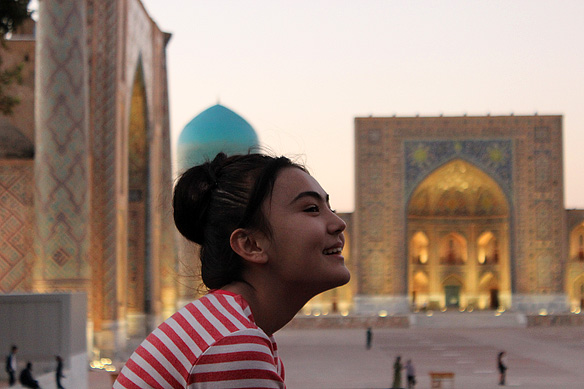
Samarkand is everything the traveller searches for, within and outside of oneself. It reveals secrets about life held gently amidst its spectacular edifices in blue and gold. The romantic exotic tile-clad mosques, madrasahs, tombs, bazaars and squares transpose one back 500 years in time to a grand fairy-tale city, deep in arid windswept Central Asia. On a philosophical note, Samarkand is the semi-mythological place of “justice, fairness, and righteousness” in Islamic Classical literature.

Much like Flecker’s reference to it, a lust for knowing more about ourselves and these ideals, makes the passage to Samarkand one of those non-negotiable, mandatory journeys one just has to take. 🙂 Continue reading

why tashkent needs to be in your travel bucket list

tashkent1

I bet you never thought of Tashkent as a candidate for your travel bucket list. Khiva, Bukhara, Samarkand in Uzbekistan—of course. But Tashkent? It’s the administrative centre. Aren’t capital cities of historically rich countries drab and dry in comparison? Well, at least that is the assumption we most often live with. A fair enough one, for they often are so, serving as entry and exit points for air travel, or are confined to business and politics.

But some are a bit more. Tashkent is one of them. Now I am not saying it is steeped in history or burgeoning with attractions like the rest of the country. You may well be disappointed if you expect too much. You may even get cross with me for my recommendation. 🙂

Known as Tashkent or Toshkent, meaning ‘Stone City’ since the 11th Century, it is a showcase of ‘modern Uzbekistan’, a sparsely populated country proud of both its rich heritage and recent independence in 1991. Continue reading

shakhrisabz, warlord tamerlane aka temur the lame’s hometown

shakhrisabz1
shakhrisabz2

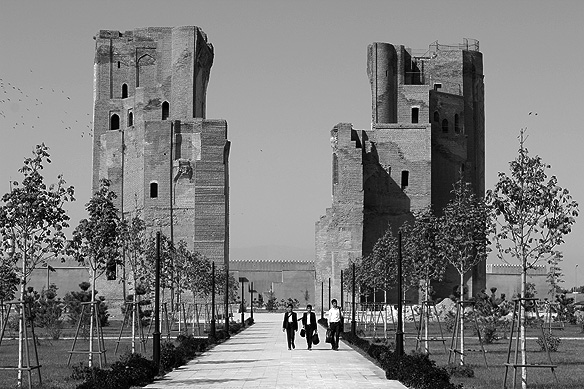
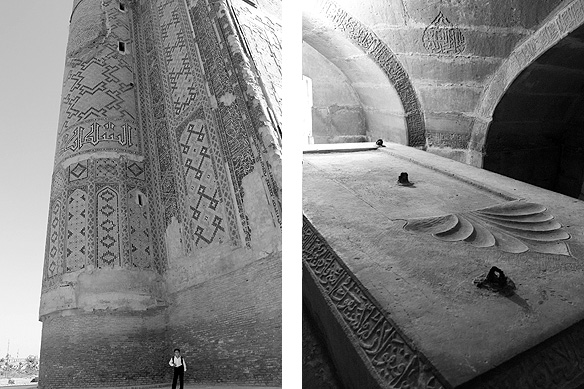
The grandeur of the Ak-Saray Palace and the simplicity of his own intended tomb—both in Shakhrisabz—perhaps best describe Amir Temur the person, better known as Tamerlane [Temur, the lame]. Complex, multi-faceted, termed history’s most callous butcher, conqueror of southern, western and central Asia, he was the founder of the Timurid dynasty, and the great-great-great-grandfather of Babur, founder of the Mughal Empire in India. He lived from 1336 – 1405 AD.

Ahmad ibn Arabshah, Temur’s Arab biographer, had to say this of him when the latter was 70 years old:

“Steadfast in mind and robust in body, brave and fearless, firm as rock. He did not care for jesting or lying; wit and trifling pleased him not; truth, even were it painful, delighted him … He loved bold and valiant soldiers, by whose aid he opened the locks of terror, tore men to pieces like lions, and overturned mountains. He was faultless in strategy, constant in fortune, firm of purpose and truthful in business.”

Continue reading

top 15 memorable things to do in bukhara, silk road’s legendary trading post

Bukhara is the third stop on my journey to Samarkand in Uzbekistan.

Whilst Khiva is a compact fairy-tale town enclosed in medieval walls, Bukhara is scattered, both geographically and thematically, as well as bigger: There is the marketplace, learning and spiritual hub, royal grounds, and necropolis. If one is not aware of its various facets, it is easy to give some of them a slip.

And hey, Bukhara does not come into our lives every day. So here are my top 15 things to do in Bukhara, a World Heritage Site, and why I chose to put them in this list. If you have any that you feel merit a place, please do share. 🙂

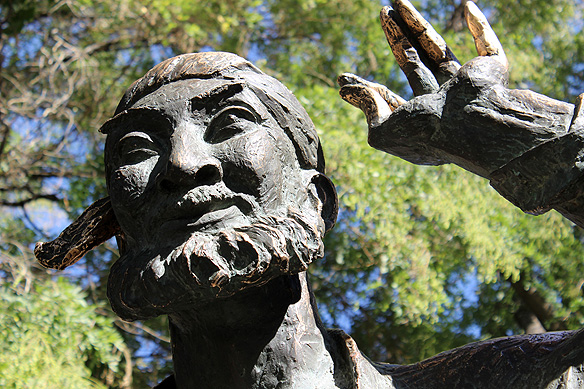
1. Get up close and personal with Nasreddin Hodja, the Islamic world and Bukhara’s most loved trickster

bukhara_nasreddinhodja Continue reading