buddha’s bodh gaya: the sacred hidden treasures of mahabodhi temple complex

“Is there some festival or special event taking place here today?” I whisper to the Buddhist monk seated next to me.

I am confused, and overwhelmed.

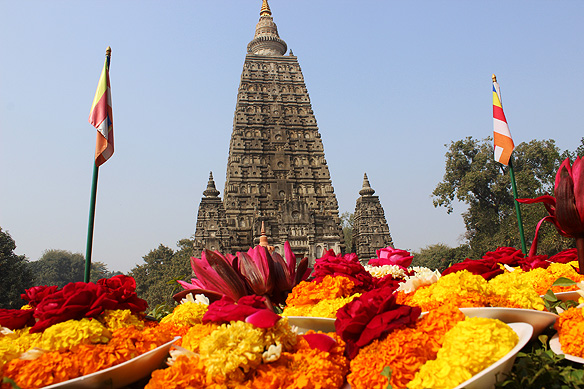
The entire Mahabodhi Temple Complex in Bodh Gaya, in the Indian State of Bihar, is draped with marigolds, lotuses, and roses. Hundreds of ochre and red-robed shaven-headed Buddhist monks and nuns prostrate in prayer in the grounds, and around the main temple. A handful of tourists quietly join the circumambulations around the main temple. I see pilgrims from Bhutan, Burma, Cambodia, China, Japan, Korea, Thailand, Tibet, and Sri Lanka in deep prayer. Most are dressed in their traditional attires. I see a few pilgrims from the West as well, no less in the purity of their faith. Groups chant with micro precision around me, not one voice out of sync, their mantras punctuated with the crescendo beats of rattle drums.

“No. Nothing special. It is like this every day all winter.” And he goes back to his meditation.

Nothing special. Just the extraordinary experience of being part of, and witnessing Buddhists from all corners of the world come and pay homage to the place where Buddha received enlightenment. 🙂 Continue reading

global travel shot: nalanda, the world’s first residential international university

Image

When writing the title of this post, I found myself in a bit of a quandary. Should I call it a global travel shot or an Indian travel shot? The former won.

The above image is of the red brick ruins of the world’s first residential international university—Nalanda Mahavihara—built in the Indian state of Bihar in the 5th Century AD. To be more specific, it is an image of the stupa marking the nirvana of Sariputra, Buddha’s famed disciple, within the university. A Sanskrit name, Nalanda means giver of lotus stalks; mahavihara translates to great monastery.

For 800 years, Nalanda, now a UNESCO World Heritage Site, attracted the brightest brains from all over the ancient world, from as far afield as Central Asia, China, and Korea. Hungry for knowledge, these scholars flocked to Nalanda’s doors to be met by a rigorous oral examination by its gatekeepers. Only those who passed were allowed to study inside the coveted walls. Many were turned away. Continue reading

delhi’s national museum bronze gallery: where bronzes sing tales of god and art

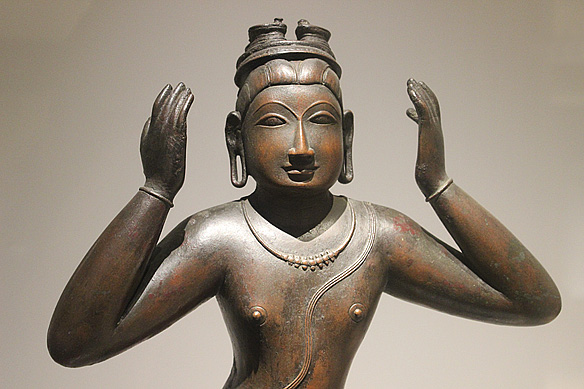
A babel of meditative Hindu, Jain, and Buddhist chants fills the gallery. Breaking the rhythmic loop is the tinkle of bells on a dainty anklet wrapped around a goddess’ voluptuous leg. Almost in competition, I hear the stomping of feet as Shiva, the destroyer, dances in passionate abandon, flames emanating in a fiery ring around him. Bharata, Rama’s brother from the Ramayana, a mere couple of feet away, holds up his brother’s sandals on his head to place them on the throne to rule as regent of the Ayodhya kingdom, accompanied by verses from the epic.

“Excuse me.”

The clipped British accent snaps me out of my reverie. And that of the deities too, who freeze mid-dance, mid-song, mid-chant, in sparkling glass cubicles scattered across the air-conditioned hall—lurching the room to pin-drop silence. And I wonder if I had imagined it all. Continue reading

beyond the unesco sites: what not to miss in ahmedabad

You have finished exploring the UNESCO-designated historic city of Ahmedabad. And combed through the sites to its north [Modhera, Patan and Sidhpur] and south [Lothal and Utelia] spanning a few millennia each in time. What now? Is there more?

There is in fact lots more, but if one had to pare it down to the absolute unmissable, what would that be? The one museum not to give a miss. The one restaurant where not eating at would be sacrilege. This post is about that—about the unmissables. Luckily, I was guided by friends who have lived in and loved Ahmedabad, with all its quirks and treasures. This is what they insisted I experience. Paying it forward, these are the top five experiences I insist you too have whilst in the city. 😊 Continue reading

36 hours in india’s first unesco world heritage city: ahmedabad

When Ahmed Shah I laid the foundations of his capital way back on 26 February, 1411, little did he know his legacy would earn the status of a World Heritage City six hundred years on. Nineteen years old at the time, Ahmed Shah I was the third Sultan of the Gujarat Sultanate (1407 – 1573). In July 2017, his city Ahmedabad beat Delhi, Mumbai, and Varanasi in the bid to become India’s first UNESCO designated city. Continue reading

11 incomparable experiences only to be had when in bhopal

Let’s face it, Bhopal does NOT appear high up on travel bucket lists or itineraries. Why, even when considering to visit it, you may well be asked “What for???” I was, and that too repeatedly.

At the most, the capital city of Madhya Pradesh is seen as a stepping stone for Buddhist Sanchi. On its own, it is a bit of an enigma, its secrets veiled from casual inquiry. Which is a good thing, for it means you will have the “City of Lakes” to yourself, with very few tourists, and be in the company of locals instead. Continue reading

bhimbetka—the prehistoric rock art wonders of india

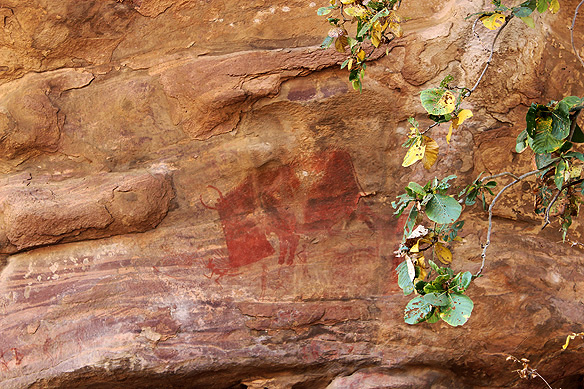
Every time I think I am “different” as a generation or a nationality, I am reminded of how alike I am to my ancestors and to those in other geographies. There is nothing unique about me. Nothing at all. But it is not really such a bad thing at all—this commonness or ordinariness of human existence—for it creates a bridge which spans time and space.

Okay, let me explain. I too record my life around me because I am consumed by a need to do so. And so did my prehistoric ancestors. I too express my joys and fears, and so did they. And so do you, dear reader, sitting in another city, another country. And so did your prehistoric ancestors in South Africa or France or the USA.

When looking at it from today’s digital lens, it comes as no surprise. But when one sees it from a stage set 10,000 years ago, it is a wonder how prehistoric people in disparate communities around the globe were expressing themselves in a similar way, using the same forms and tools, no matter where they lived and whom they were with. And we, in 2018 are to a large extent, the same as them. Continue reading

photo essay: buddhist sanchi, stories told and untold

Sanchi. The little town in the heart of Madhya Pradesh had been calling out to me since as far back in time as I could remember. From before I moved back to India. Before I even knew the immensity of its import in the bigger scheme of things.

I would fantasize wandering around the 2,300-year-old Buddhist stupa built by Ashoka the Great, in the company of birdsong and golden rays of sunshine. It epitomized all my soul was constantly hungering for: a space which was closer to nirvana. Don’t get me wrong. I am a hard-core city person. I love the rat race, of ambition and success. But within a mantle of purpose and intention. Of meaning and depth. Sanchi, I believed could help me put the pieces, which I knew as my “life,” into some semblance of balance. For is that not what Gautama Buddha preached about. The Middle Way.

After many a planned trip crumbled to dust as a result of life’s unpredictability, I finally found myself this past month on a rickety bus, driving through ripened wheat fields. I was on my way to ancient Sanchi. Continue reading

india travel shot: pithora painting, the art of ritual in tribal madhya pradesh

Image

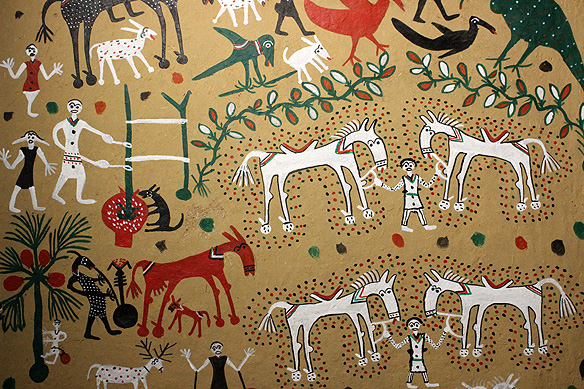
I came across this fantastical painting in the Tribal Museum at Bhopal. It would be easy to mistake it for art. But it is not. It is instead a ritual practiced by the Rathva Adivasis in Madhya Pradesh. Continue reading

preserving a disappearing heritage: the bagh cave paintings at bhopal state museum

Nestled deep in the heart of India, on the banks of the seasonal Baghani river in Madhya Pradesh, are a series of nine rock-cut Buddhist temples covered with jewel-like murals. Known as the Bagh Caves, they date back to the 4th to 6th Centuries AD. According to legend they were built by a Buddhist monk called Dataka.

Contemporaries of the better-known Ajanta Caves in Maharashtra, only five survive of its original nine. Very few even know of these five. I for one, did not. Did you? Continue reading