georgia: a story of war and faith

Two stories define Sakartvelo. War and faith.

We know this ancient country as Georgia. But that’s not what Georgians call it. For them, it is Sakartvelo, land of the Kartvelians. Kartvelian means ‘a person of Kartli’—the historical name of the region since the 4th Century BCE.

Caught between powers hungry for regional domination, Georgia has spent millennia keeping itself and its identity intact in the face of attacks.

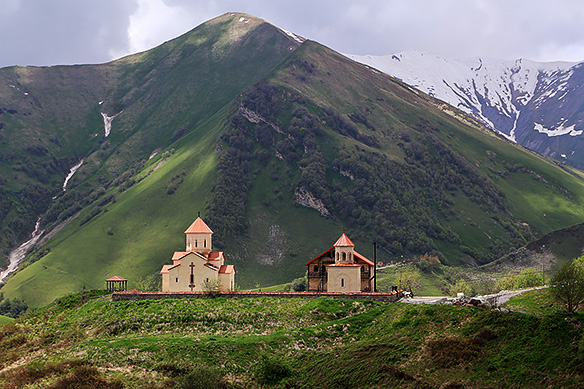
As the third country in the world to adopt Christianity in 327 CE, religion runs deep in the Georgian veins. It was faith that strengthened their resolve. It was equally imperative to protect that same faith.

Together these two stories are the story of Georgia. And the Georgian. Continue reading →

a cultural buff’s guide to tbilisi

So, you like museums, art, theatre, and live music. Then you are in the right place if you are in Tbilisi. 🙂

I spent 10 days in Georgia’s capital this June before travelling deeper west into the country. Though I would venture out on some days to discover the country’s north, south, and east, coming back to Tbilisi always felt like I was returning home.

The city’s hills hugged both the Kura river and hot sulphur springs; its slopes dotted with medieval stone churches. Strains of music would waft through the air, an accompaniment to the fragrance of freshly baked cheesy pies. A patchy sky overhead seemed perpetually torn between sunshine and rain.

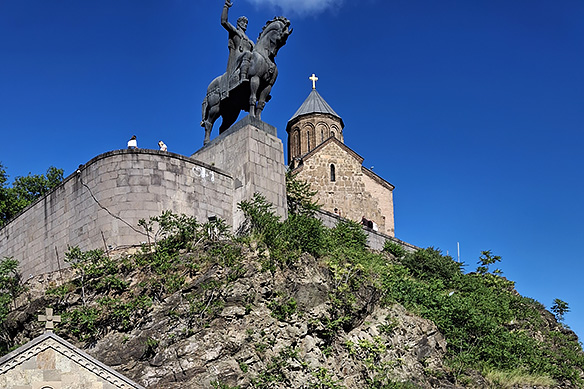
Popular legend credits King Vakhtang I Gorgasali as the city’s founder in 458 CE. An achievement reaffirmed by an equestrian statue of him perched on the riverbank. The story goes somewhat as follows: One day the king and his falcon went hunting. The falcon caught a pheasant, but both birds fell into a nearby hot sulphur spring. Chaffed at his discovery of these scalding hot waters miraculously emerging from the earth, the king decided to build a city at this spot. And so, Tbilisi—meaning the ‘warm place’—was born. Archaeological findings tend to dismiss this tale and place the city’s habitation further back in time to the Palaeolithic age. Continue reading →

towering peaks and gold jewellery: georgia, land of the golden fleece

This is the story of Colchis. A contemporary of the Sumerians and Ancient Egyptians, with references in Classical Greek mythology, this pre-Christian kingdom today lies somewhat in obscurity.

But three-and-a-half thousand years ago, Colchis was not some figment of literary imagination. It was Jason and the Argonauts actual gold-encased quest. Its peaks that touched the heavens, where narrative saga decided Zeus would chain Prometheus.

Deep inside the isthmus joining Europe and Asia, in valleys tightly sandwiched between the soaring peaks of the Greater and Lesser Caucasus Mountains were a people of immense wealth. Gold dust speckled its 25,000 rivers which when caught using sheepskin with shaggy hair, turned them into ‘golden fleece.’ The people there then transformed this gold into exquisite jewellery, typified by fine granulation, inlaid gems, and animal motifs.

Headdress with four deer, two lions and a pair of birds, made with cutting out portions of metal, Vani, Burial 24, end-4th Century BCE.

Headdress with four deer, two lions and a pair of birds, made with cutting out portions of metal, Vani, Burial 24, end-4th Century BCE.

Continue reading →

batumi: stories told and untold

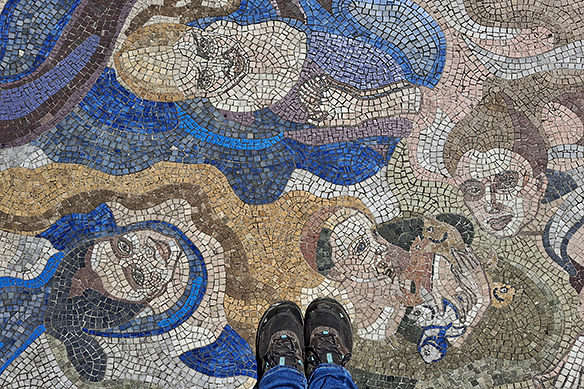
Mosaic in Batumi Piazza by Georgian-Swiss designer Natalia De Pita-Amirejibi comprises 88,244,735 cut and treated tiles of 1 sq. cm each. The marble for the tiles was sourced from 15 different countries.

Mosaic in Batumi Piazza by Georgian-Swiss designer Natalia De Pita-Amirejibi comprises 88,244,735 cut and treated tiles of 1 sq. cm each. The marble for the tiles was sourced from 15 different countries.

Batumi sits on the far western frontier of Georgia, on a pebble-strewn Black Sea coast a mere 20 kilometres away from neighbouring Türkiye. Not many travellers to Georgia make it this far. Which is a pity. The chalk to the rest of Georgia’s cheese, Batumi is an over-the-top Las Vegas-styled sea-side resort in a country known otherwise for its soaring mountains, Soviet remains, Georgian Orthodox history, and earthy wine.

Brazen, brash, and straight out of Disneyland, Batumi is generous to the curious traveller. It tosses in a Byzantine fortress and a world-famous botanical garden into a quirky mix of fantastical skyscrapers, restored Russian Imperial-era edifices, fabulous outdoor art, mega events, and global cuisine.

Much like it did with me. Continue reading →

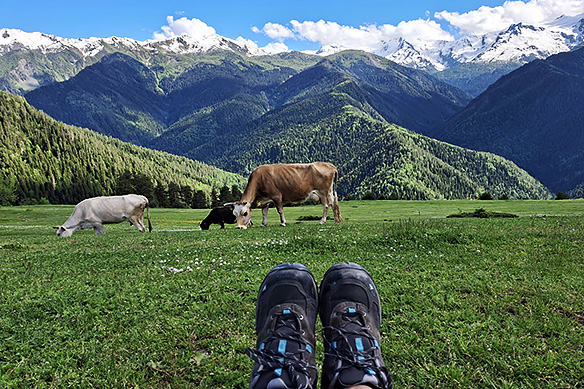
travel diaries: in search of king tamar’s svaneti

Mepeta Mepe, King of Kings Tamar was only 18 when she was crowned co-ruler of the Kingdom of Georgia in 1178. Six years later, when her father King Giorgi III died, she became its sole ruler. Here, I’d like to add some context regarding the word ‘Mepe’ before I write further. Georgian is a gender-neutral language, and Mepe means king or sovereign ruler, immaterial of whether the person is male or female.

Coming back to Tamar, her title was not the only unusual part of her story. Georgia, under her rule, reached its political and cultural zenith. Its borders spread from the Black Sea in the west to the Caspian Sea in the east, and the Greater Caucasus Mountains in the north all the way to eastern Türkiye and northern Iran in the south. She founded multiple cultural academies, and the arts and literature flourished with masterpieces such as the epic poem Knight in the Panther’s Skin by Shota Rustaveli written as an ode to her extraordinariness. Continue reading →

travel shorts: georgia, birthplace of wine and the toastmaster

When the word for ‘cheers’ [Gaumarjos] translates to ‘to victory,’ it tells you a lot about the role of wine drinking in a country that has been racked by attacks for millennia.

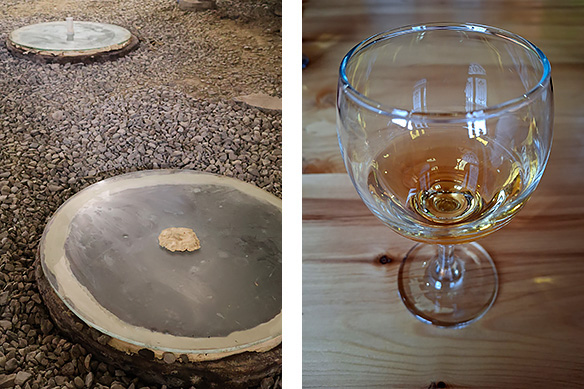
Wine in the Caucasian country of Georgia is not just a drink. It is an integral part of elaborate feasts called ‘supra‘ led by a ‘tamada‘ or toastmaster, who makes fiery toasts using scooped-out animal horns without ever getting drunk. It is a celebration—of a people holding onto their own identity. Hoping for wins at war. Winning those wars. Rejoicing in those wins. Whether the borders expanded or shrunk. Continue reading →

photo essay: remnants of soviet georgia

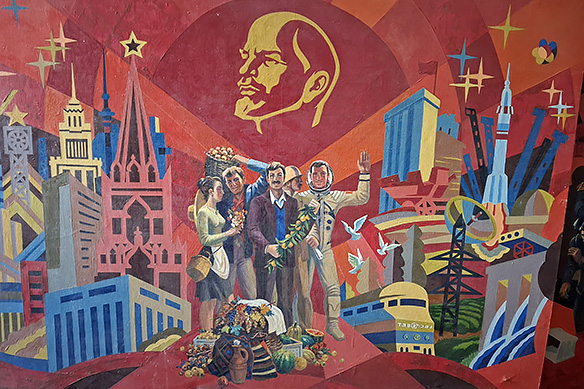
The relationship between Georgia and Russia is, well—complicated. Irrevocably woven, yet defiantly independent, Georgia’s past avatar as the Georgian Soviet Socialist Republic still peeps through across the country. You only need to look. A brutalist masterpiece. A colossal deserted mine with cable cars still frozen mid-air in space and time. Poker-faced apartment blocks sliced with horizontal walkways and plunging lifts. Magnificent abandoned sanatoriums built over healing springs that have given way to tall overgrown trees, moss, and wildflowers.

An urbex paradise. A lesson that nothing lasts forever. Continue reading →

travel shorts: home at the kutaisi family house museum

I am
what inspires me.
You are
what you love.
If you set your heart
upon a purpose,
you shall arrive there—
and believe me—
there,
you will find me.
~ Mari Berdzenadze, Excerpt from LAK’ECH

Deep in the heart of Kutaisi’s oldest neighbourhood is Mari’s home. Number 39 on Dato Berdzenadze Street—the street is named after her brother who died aged 21. He was the bodyguard of Eduard Shevardnadze, foreign minister during the Soviet-era, and independent Georgia’s second president. Dato was killed during elections. The house goes by the name Kutaisi Family House Museum. Continue reading →

the top 11 cultural highlights of tsarist, imperialist, communist moscow

No list of world cities is considered complete without the mention of Moscow. Immaterial of whether it was in the Middle Ages or now in the 21st Century. Irrespective of whether it is in times of peace. Or conflict.

Spread over seven hills, just like Rome, Moscow was determined from the outset to outdo Kyiv. Kyiv had been the historical capital of Kievan-Rus as Russia was called till the 13th Century Mongol raid. A higher cathedral, longer city-walls, taller city-gates—Moscow had to be better, and grander than its precursor. Period.

What started off as a wooden Kremlin [fortress] built by Prince Yuri Dolgorukiy in 1156, went on to become the citadel of the Tsars, headquarters of the USSR, and now the office and residence of the world’s largest country’s Head of State.

Moscow has remnants from everyone who ruled Russia from its crenelated walls. The Tsars gave it its grand cathedrals, Red [in Russian is another word for ‘beautiful’] Square, and a fortified stone Kremlin. They then burnt their own city to the ground in 1812 to drive Napoleon’s army out, and rebuilt it in an Empire [Baroque and Neoclassical] style. The Soviets after them gave the city its enormous streets, palatial metro system, and Stalin’s ‘Seven Sisters.’ Modern Moscow threw in the Moscow International Business Centre’s futuristic steel and glass skyscrapers into the mix.

It is a massive city in which an eclectic past and present jostle side-by-side, never far from a Christian Orthodox church or the performing and fine arts.

Here are Moscow’s top 11 cultural highlights from its very many eras. Wishing you travels which widen and deepen our intellect, hearts, and souls. Always. 🙂

Continue reading →

photo essay: st. petersburg, where the pragmatic met the poetic

If there is one man who single-handedly changed Russia’s course for keeps, it would be Peter I, better known as Peter the Great. His rule spanning 43 years opened Russia to Europe. By the time he died aged 52, he had made Russia Europe.

Peter the Great came to power early. He was just 10 when he became co-Tsar of all Russia, sharing the throne with his half-brother Ivan V in 1682. Once Ivan V died in 1696, there was no stopping Peter.

A giant, both physically, and metamorphically, he set about putting his vision of a European outward-looking Russian empire, built on marine trade and naval battles, into action. His capital St. Petersburg, which he built from scratch in 1703 on the marshlands of the Neva Delta in the Baltic Sea, was to be his launchpad for these dreams.

Multi-talented, he was just as adept at building ships as he was at stitching a pair of shoes. He was also equally comfortable executing in cold blood those guilty of wilful treason, including his own son Alexei Petrovich, as of intense loyalty to his friend Alexander Menshikov, a commoner, and deep love for his second wife Catherine I, a laundress from Poland-Lithuania.

After his death, for almost a century Russia was ruled by a string of women from St. Petersburg. First his widow Catherine I, then his niece Anna Ioannovna, followed by his daughter Elizabeth I, and finally Elizabeth I’s nephew’s wife Catherine II aka Catherine the Great. This period came to be known as the Petticoat Period, with each Empress embellishing the city with splendid palaces, monuments, and bridges in the Baroque and Neoclassical styles by French and Italian architects, which one sees today.

The arts thrived here. And so did literature. In its 300-year-old history, St. Petersburg has been home to some of Russia’s greatest writers. Alexander Pushkin, the founder of modern Russian literature, Fyodor Dostoyevsky who churned out one masterpiece after the other, Nikolai Gogol who doggedly destroyed romantic illusions, Anna Akhmatova, a rare poetess in a male-dominated field, and Vladimir Nabokov, author of ‘Lolita.’

These 300 years also saw St. Petersburg have its fair share of name changes reflecting changing geo-politics. From 1914 to 1924 it went by the name Petrograd, and from 1924 to 1991 it was known as Leningrad in honour of Lenin, during which for 2 years, 4 months and 19 days [from 1941 to 1944] it was subjugated to one of the deadliest sieges in history, but never captured. After the collapse of the Soviet Union in 1991, the city reverted to its original name St. Petersburg [meaning St. Peter’s City] given by Peter the Great. St. Peter’s City, because the keys the saint held to the heavens, herein represented the keys to the West.

Here is a photo essay of St. Petersburg which started off on a pragmatic note and ended up being sheer poetry, punctuated with quotes from its writers whose favourite muse was their city. ❤ Continue reading →