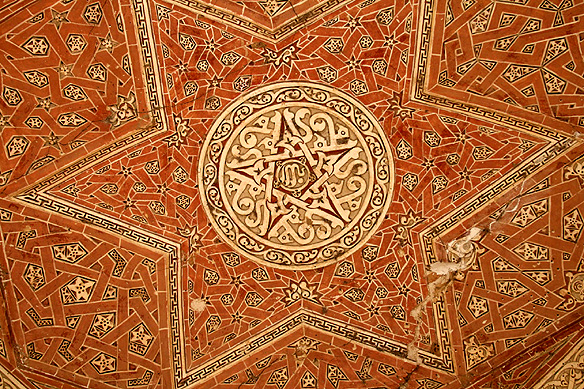
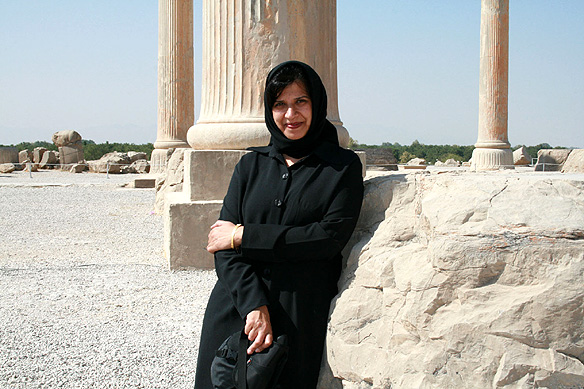
iran 4: the story of persepolis

“Passer-by, I am Cyrus the Great, I have given the Persians an empire and I have ruled over Asia. So do not envy me for this tomb.”
~ Inscription on the tomb of Cyrus the Great, Pasargade, 6th Century BC

I love rambling through archaeological sites, running my fingers over millennia old ruins, walking down worn out paths where before me countless souls had also passed along. Where history was made and destinies defined. Sites like these are humbling, making us realize how small we are in the bigger picture. And yet such sites also fill us with a deep sense of pride in humanity’s political achievements and artistic endeavors which are a legacy belonging to all mankind.
persepolis_rama Continue reading

iran 3: takht-e soleyman, epicentre of zoroastrianism

kurdishvillage1

The unspoilt expanse of Western Iran is desolate. Its people simple. Barren red mountains stretch as far as the eye can see, in sharp contrast with the clear blue skies above. Decade-old cars of forgotten makes and models plough highways punctuated with police checkpoints at rapid regularity. I’m on my way to Takht-e Soleyman, the spiritual center of Zoroastrianism, and on to Takab for the night, a minuscule town less than a hundred miles from the Iraqi border. Continue reading

iran 2: soltaniyeh’s mongolian sultans and exotic bazaars in zanjan

soltaniyeh1

The adventure begins. I’m off to north-west Iran. There is something terribly exciting about visiting places away from the beaten path, meeting people who are not part of the global cloned collectivity. There is somehow always a heartwarming uniqueness in isolated individuality.

Western Iran is largely underdeveloped with a mixed history. Whilst it has enjoyed the spin-offs of being part of the famed Silk Road, it has also suffered the most in the Iran-Iraq war.

Soltaniyeh, a Mongol town built in the 14th Century, is my first stop. The mausoleum of the Mongol Sultan Khodabandeh, now a UNESCO World Heritage Site, has the world’s second highest dome at 48 meters high and 25 meters in diameter. Continue reading

iran 1: tehran … museums, palaces, bazaars, and mosques

Note: I travelled to Iran in October 2007 for two weeks. Iran has been one of my most memorable travels to date. I am republishing the series comprising 10 posts till this mid-June. Refreshing my personal memories. This is the first post in the seriesβ€”on Iran’s capital city Tehran and its museums, palaces, bazaars, and mosques. Hope you enjoy the reads. πŸ™‚

– – –

meiran1“Why are you going to Iran???” “Coz I want to.” “But why? You’ve really gone cuckoo. Just look at the current global political scenario!!!” “I’m going because I want to go that extra mile. Cross that extra river. Go beyond preconceptions and expectations. Learn for myself what really is out there.” “You’ve gone cuckoo, period!”

Salaam. I’m off to Iran. It was not an easy task explaining my choice of holiday for the year. πŸ™‚ But, hey, who cares. I’m going where my heart wants me to go. I want to walk through the ruins of Xerxes’ Persepolis, wonder at the beauty of Esfahan, and smile and play with Kurdish children before it is all too late. Before it all becomes another Baghdad, Kabul or Libya. Come along with me? Continue reading

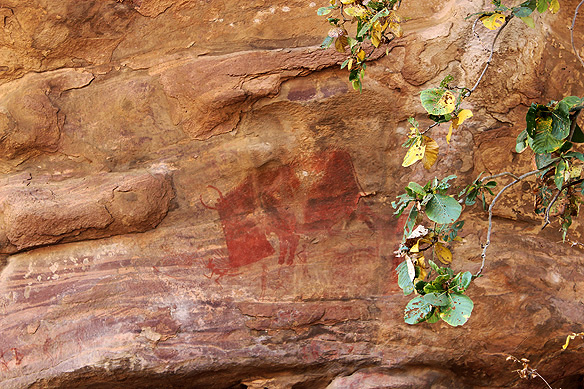
bhimbetkaβ€”the prehistoric rock art wonders of india

Every time I think I am “different” as a generation or a nationality, I am reminded of how alike I am to my ancestors and to those in other geographies. There is nothing unique about me. Nothing at all. But it is not really such a bad thing at allβ€”this commonness or ordinariness of human existenceβ€”for it creates a bridge which spans time and space.

Okay, let me explain. I too record my life around me because I am consumed by a need to do so. And so did my prehistoric ancestors. I too express my joys and fears, and so did they. And so do you, dear reader, sitting in another city, another country. And so did your prehistoric ancestors in South Africa or France or the USA.

When looking at it from today’s digital lens, it comes as no surprise. But when one sees it from a stage set 10,000 years ago, it is a wonder how prehistoric people in disparate communities around the globe were expressing themselves in a similar way, using the same forms and tools, no matter where they lived and whom they were with. And we, in 2018 are to a large extent, the same as them. Continue reading

photo essay: buddhist sanchi, stories told and untold

Sanchi. The little town in the heart of Madhya Pradesh had been calling out to me since as far back in time as I could remember. From before I moved back to India. Before I even knew the immensity of its import in the bigger scheme of things.

I would fantasize wandering around the 2,300-year-old Buddhist stupa built by Ashoka the Great, in the company of birdsong and golden rays of sunshine. It epitomized all my soul was constantly hungering for: a space which was closer to nirvana. Don’t get me wrong. I am a hard-core city person. I love the rat race, of ambition and success. But within a mantle of purpose and intention. Of meaning and depth. Sanchi, I believed could help me put the pieces, which I knew as my “life,” into some semblance of balance. For is that not what Gautama Buddha preached about. The Middle Way.

After many a planned trip crumbled to dust as a result of life’s unpredictability, I finally found myself this past month on a rickety bus, driving through ripened wheat fields. I was on my way to ancient Sanchi. Continue reading

a 1,000-year-old royal couple’s expression of love and piety: modhera and patan

Do you like stories? I do. A lot. πŸ™‚

Especially stories of those who live larger-than-life lives in spirit and feat.

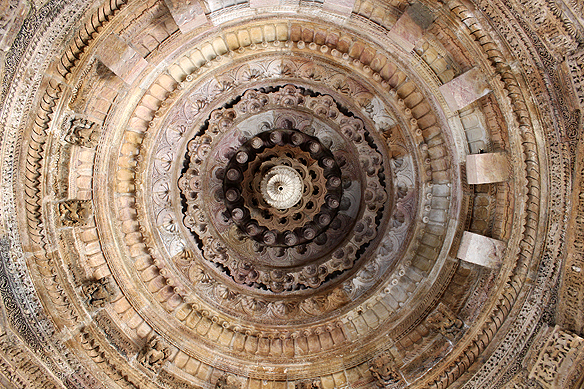
This post is the tale of one such storyβ€”of a king called Bhimadeva I and his lovely, loving queen Udayamati, who lived a thousand years ago. And no, it is no myth. There are colossal monuments they left behind as testimony of their love and piety, as I discovered one sunny wintry day I travelled 75 kilometres north-west of Ahmedabad in Western India, in the state of Gujarat.

Come, let me tell you more.

Son of Agni, the fire-god’s, Sun Temple of Modhera

Continue reading

the 6 untold treasures of vadodara

Friend: β€œYou’re going to Vadodara. Wonderful idea! There is a lot to see in the city. After all, it is the cultural capital of Gujarat.”
Me: β€œNice. So what do you suggest I visit and explore?”
Friend: β€œThe Lukshmi Villas Palace is an absolute must!”
Me: β€œOk, will do. What else?” [As I jotted it frantically in my notebook in anticipation of being hit by a barrage of to-do-things]
Friend: β€œThe museum attached to the palace is another must do.”
Me: β€œOk, got that down too. And?”
Friend: β€œHmmm. Oh well. I don’t know. But there is a lot. Hey, it is the cultural capital. But I don’t know…”

Yes, that is it with Vadodara, earlier known as Baroda. Though it is publicly acknowledged as the cultural capital of Gujarat, its attractions are neither documented nor publicised. At least not enough and one cannot be blamed for wondering if they even exist. Continue reading

champanerβ€”the muslim part of the champaner-pavagadh unesco world heritage site

Fairy tales often start like this, don’t they: Once upon a time there was a fearless, virtuous king who had dreams of conquering an invincible fortress perched on a hill. His father and grandfather had time and again attempted to defeat it too, but to no avail.

The tale I am writing about continues like this: The brave king was Sultan Abu’l Fath Nasir-ud-Din Mahmud Shah I, ruler of the Gujarat Sultanate and great-grandson of Ahmed Shah I, founder of Ahmedabad, Gujarat in 1411. The invincible fortress belonged to the Kichchi Chauhan Rajputs on Pavagadh.

Calling himself “Sultan al-Barr, Sultan al-Bahr” meaning β€œSultan of the Land, Sultan of the Sea,” history knows him as Mahmud Begada. The name β€œBegada” was derived from his winning two gadhs in his lifetime, namely Pavagadh and Junagadh. Continue reading

pavagadhβ€”the hindu part of the champaner-pavagadh unesco world heritage site

I have a book titled Speaking Stones World Cultural Heritage Sites in India which I must confess is my most prized possession. Coming to terms these past few months with some harsh realities on death and the transience of life, I reached out to the hard bound volume on my bookshelf to see what I could add to a wish-list to make come true.

The pages opened, almost as if urged by some mysterious calling, on Champaner-Pavagadh. Truth be told, I had never heard of the place before. But it was nearby and seemed doable over a few days. A friend pointed out the weather was all wrong for the rendezvous: β€œNo one travels for pleasure to Gujarat in May when temperatures are soaring at 43 degrees.” The little voice in me said, β€œWho cares about the heat. Remember life truths!” πŸ™‚

And, thus, one fine early morning, I found myself boarding a train to Vadodara, my base for my explorations. What I learnt and saw and experienced in the ensuing days far outweighed my expectations. But I run ahead of myself. Let’s start at the beginning. Continue reading