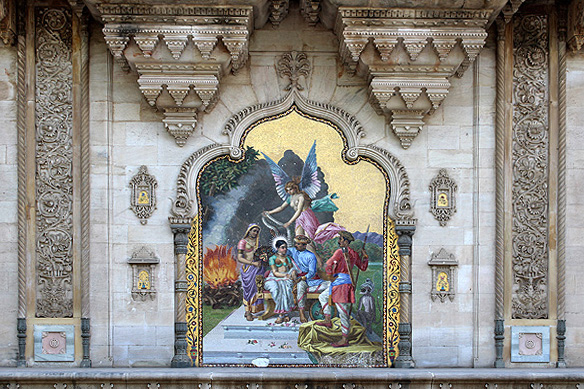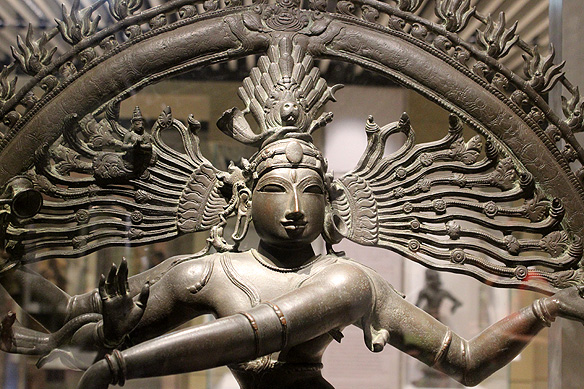
global travel shot: alamgir aurangzeb’s mosque in varanasi

Image

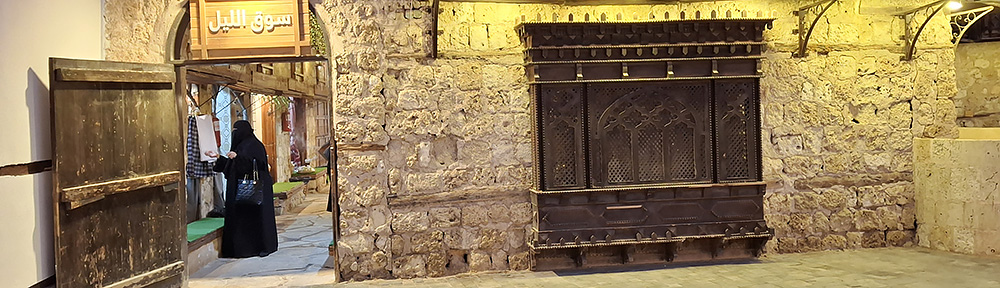
Varanasi. The very name rings of sacred Hindu scriptures, stories of Lord Shiva and Ganga, and Hindu beliefs on life and afterlife. The oldest living city in the world, it is the accepted embodiment of Hinduism.

Yet, perched atop Panchganga Ghat by the holy River Ganges, where five streams are said to join, is a lovely functioning mosque—Alamgir Mosque. It is also the largest structure on the ghats. Standing over the ruins of a Krishna temple [the lower walls of the mosque belong to the original Hindu temple], the Hindu deities lie in a nearby edifice. Continue reading

in search of buddha’s sarnath: the traveller’s guide

Oftentimes what we are consciously searching for is not what we are subconsciously looking for. Sounds confusing? 🙂

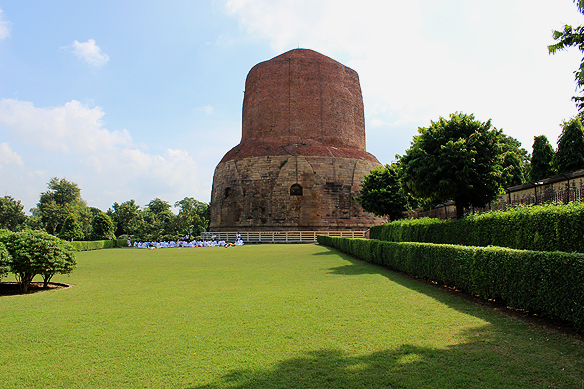
A few weeks ago, I took a train and bus trip from Delhi in search of Varanasi [Benaras], the Kashi of yore. I found Sarnath in Kashi’s place instead. Perhaps this occurred because there is more of the Buddhist in me than the Hindu. Whatever be the case, Sarnath touched a place deep within my core.

May I state from the outset you do not need a guided tour for Sarnath, and that is not what this post aims at being. Sarnath needs to be experienced and understood at a personal level, in one’s own space and rhythm. What I want to share here are my personal travel learnings to help you make the most of your Sarnath experience, and perhaps allow Sarnath to speak to the Buddhist in you too. ❤ Continue reading

5 best kept secrets of bundi, india’s best kept secret

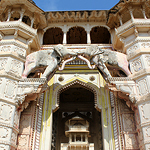
Bundi. The very name is evocative. Translated literally it means sweetened, fried chickpea flour—a snack indigenous to Rajasthan. When applied to a small, sleepy, powder-blue painted town nestled in a deep gorge surrounded on three sides by the Aravalli hills with a spectacular fort and palace looming over it, it becomes synonymous with one of India’s best kept secrets. A secret with myriad secrets within its folds.

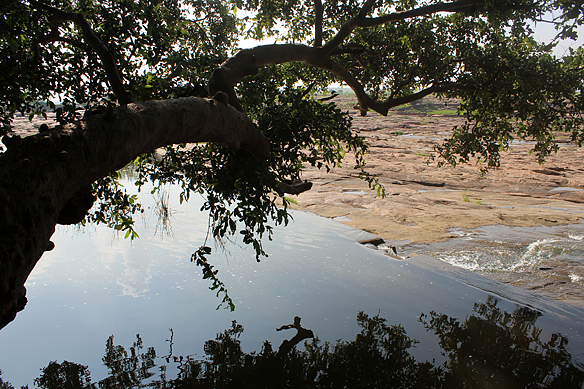
Founded by a gentleman of the Meena tribe who went by the name Bunda, it was annexed by Rao Deva Hada in 1342, founder of Bundi [the princely state] and Hadoti [land of the great Hada Rajputs]. Friends with the Mughals and thereafter, the British Raj, it retained its princely status till 1947. Not many venture into Bundi; neither today nor in the past.

Here are five secrets I discovered in Bundi which make it the treasure trove that it is. If you know of more, please do share in the comments section. 😊 Continue reading

the bundi-kotah school of miniature painting in kotah’s garh palace

Me: Kotah Palace jaanaa hai. [I want to go to Kotah Palace.]

Auto rickshaw driver: Palace hotel?

Me: Nahin. Sirf palace. Jahaan rajah maharajah rehtey they. [No. Just palace. Where the kings used to live.]

Auto rickshaw driver (confused): Par vahaan toh koi Indian nahin jaataa! Sirf gorey log jaatey hai! [But Indians don’t go there! Only white people do.]

Me: Haan, vahin jaana hai, jahaan gorey log jaatey hai. [My deep gratitude to Caucasians at this point for appreciating the treasures hidden in India’s midst.]

Auto rickshaw driver (laughing): Chalo, aaj yeh bhi dekh letey hai. [Sure, let me see this place too, today.]

It’s chaotic and crowded. I had just got off a rickety bus from Bundi. My train to Delhi, deep into the night, was a good few hours away. The plan was to spend the time in-between devouring the miniature painting frescoes of the Kotah Garh Palace. Continue reading

the painted palaces of bundi

This slideshow requires JavaScript.

A woman looks brazenly across the room. Her perfect profile decorated with jewels is tilted in anticipation. On the wall opposite, a royal damsel is being dressed by her lady-in-waiting whilst a Rajput prince slyly peeps from behind the curtains in blatant lust. Two women on a side wall make erotic love to each other.

The gods and goddesses are no less immune to the dynamics of the room. A series of frescoes have Krishna dancing in gay abandon with Radha and her sakhis in the raas leela. In another, he is perched atop a tree with the stolen garments of the gopikas.

Painted using a palette of turquoise green, black, and white, the colonnaded open-sided hall with private rooms leading out of it, was once the maharaja’s pleasure room. It is befittingly called Chitrashala—chitra meaning picture, shala meaning house or abode. The abode of pictures.

What makes these paintings, and those in Bundi’s other royal palaces unparalleled, is they comprise some of the finest examples of the Bundi School of Miniature Painting. A style normally associated with paint on paper, the Bundi school found its way in its parent city to the walls of the ruling family’s private rooms to create visual extravaganzas of colour and storytelling tipped with gold. Continue reading

why bundi’s stepwells will take your breath away

If like me, you were brought up on a travel diet of London and Paris, with Persepolis thrown in for effect, you would wonder what all the hullabaloo about India’s stepwells was for. That is, until you saw them in person.

Since moving back to India, I have time and again read that the stepwells or baoris [as they are known in the local dialect] of Gujarat and Rajasthan were stunning. I was told there was even one in Connaught Place, the heart of New Delhi, which was a complete beauty. I, thus, conjured them in my mind as architectural marvels to be found in the historically grand cities of India. Read—grand.

And as always, India took me by surprise. Continue reading

photo essay: in search of bundi’s prehistoric rock paintings

Destination, or the journey? In travel, it is often hard put to distinguish between the two.

When I went to Bundi in Rajasthan a fortnight ago, I had no clue that merely 30 kilometres south of the town were 101 sites of prehistoric rock art painted 15,000 years ago. They were discovered by a one Mr. Kukkiji in 1997, who was to take me to the sites himself. What I knew less of was the charms of the paintings’ backdrop—the caves lined tranquil wide rivers, on whose lush shores the Bhil, an Indian Adivasi tribal had made their homes. Continue reading

global travel shot: the prehistoric rock paintings of bundi

Image

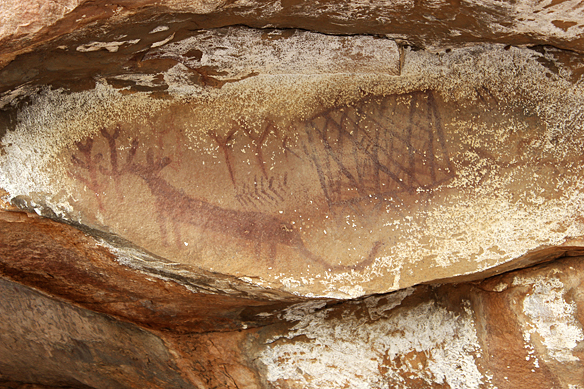
The image above is that of an antelope in a forest, next to a trap waiting to catapult it to its death. Nope. This is not somewhere in the interiors of France or Spain, more commonly associated with prehistoric art, or even in Bhimbetka where India’s prized rock art collection lies.

It is instead on the insides of a cave lining a tributary of the river Chambal in Gararda, Rajasthan, 35 kilometres from Bundi, my base a fortnight ago.

Painted 15,000 years ago in mineral colours, very few people know of it. Just a handful come from the far corners of the world to marvel at its beauty, and timelessness.

And if it were not for a local sweetmeat-shop-owner-turned-archaeologist, we would not know of it either. He discovered the site in 1997 and has passionately been creating awareness of it ever since, unearthing 101 caves festooned with prehistoric art to-date. His name is Kukkiji. Continue reading

national museum, new delhi – 90 minutes at the museum

The National Museum, New Delhi makes the herculean task of experiencing India’s monumental heritage spanning 5,000 years—doable. You could always spend 3 minutes looking at each object in its 210,000 piece collection. But that would take 14.5 months with no sleep or meals inbetween. Or you could do an audio tour and spend a day exploring its glorious galleries through 64 masterpieces. And if you have just one and a half hours, then why not feast your eyes on its very best.

Earlier housed in the Rashtrapati Bhawan [President’s residence], the collection has its roots in 1947 when the Royal Academy, together with the governments of India and Britain, decided to hold an “Exhibition of Indian Art” in London. Selected artefacts from museums across India were collected for the showing.

Before returning the exhibits to their respective museums, it was decided to display the exhibition in Delhi as well. What a huge success it turned out to be! The overwhelming response led to the idea of a permanent National Museum being set up in the capital with its very own building by India Gate which it moved into in 1960.

The National Museum has it all. From the iconic Harappan Dancing Girl to elegant Gandharan Buddhas, from exquisite miniature Mughal paintings to luscious Tanjore compositions, from Chola bronzes to 20th Century decorative arts, from medieval sculptures of voluptuous Hindu deities to diamond and emerald regalia of its once-upon-a-time royalty. The Museum has all these, and much much more.

Here are my 15 favourite pieces collated after rambling through its collections and meditating over its audio tour. Doable in 90 minutes. 🙂 Continue reading

the 6 untold treasures of vadodara

Friend: “You’re going to Vadodara. Wonderful idea! There is a lot to see in the city. After all, it is the cultural capital of Gujarat.”
Me: “Nice. So what do you suggest I visit and explore?”
Friend: “The Lukshmi Villas Palace is an absolute must!”
Me: “Ok, will do. What else?” [As I jotted it frantically in my notebook in anticipation of being hit by a barrage of to-do-things]
Friend: “The museum attached to the palace is another must do.”
Me: “Ok, got that down too. And?”
Friend: “Hmmm. Oh well. I don’t know. But there is a lot. Hey, it is the cultural capital. But I don’t know…”

Yes, that is it with Vadodara, earlier known as Baroda. Though it is publicly acknowledged as the cultural capital of Gujarat, its attractions are neither documented nor publicised. At least not enough and one cannot be blamed for wondering if they even exist. Continue reading